

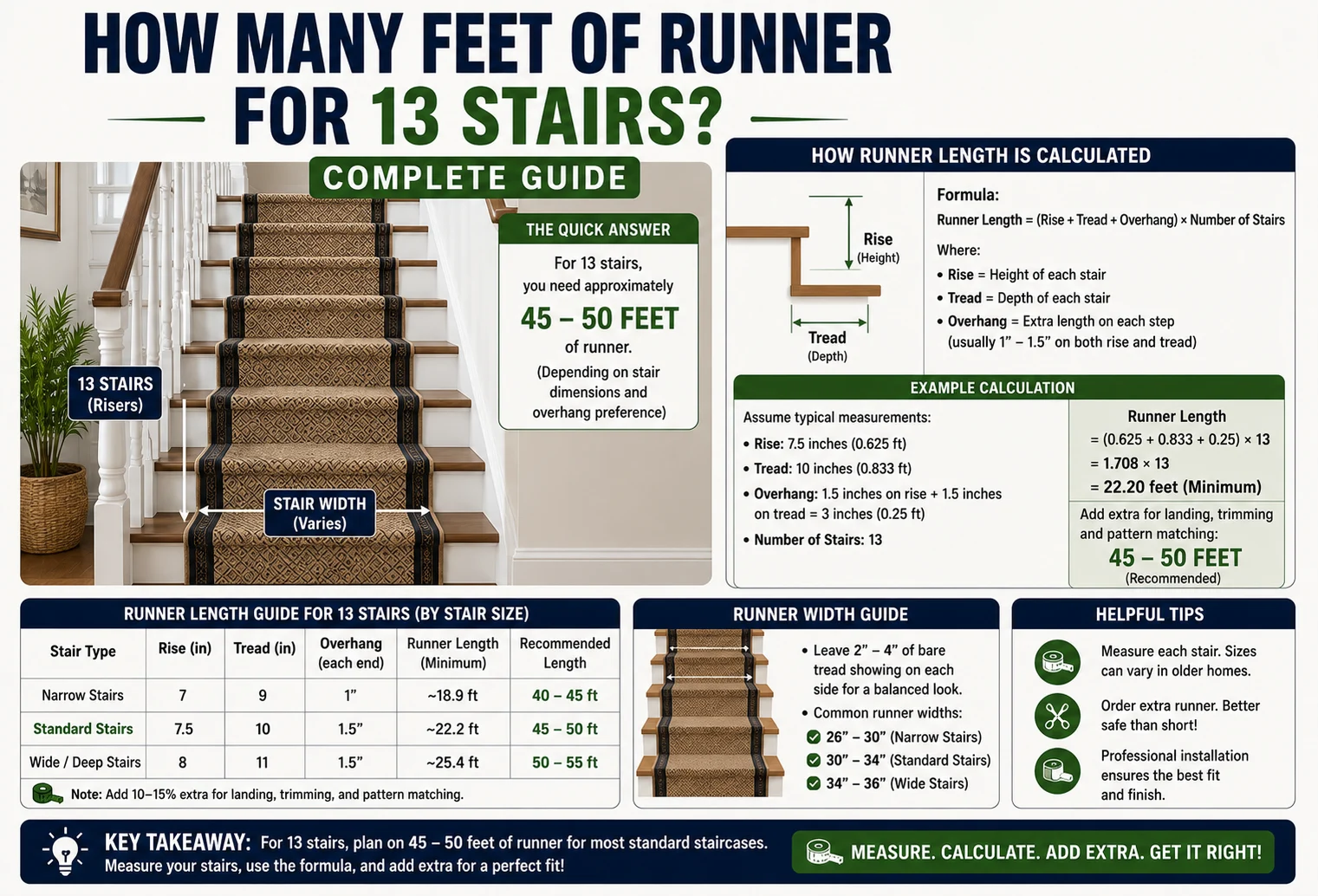
If you’re wondering how many feet of runner for 13 stairs, the amount depends on the tread depth, riser height, and whether you want the runner to cover the top landing.
For a common staircase with approximately 10-inch treads and 7.5-inch risers, 13 stairs need roughly:
13 × (10 + 7.5) = 227.5 inches
Convert to feet:
227.5 ÷ 12 = 18.96 feet
So, you would need approximately 19 linear feet of stair runner for 13 stairs, before adding extra material for installation, finishing, or landings.
A safer purchasing amount would often be around 21–22 feet, depending on the runner installation method.
| Stair Setup | Approx. Runner Needed for 13 Stairs |
|---|---|
| 10″ tread + 7″ riser | ~18.4 ft |
| 10″ tread + 7.5″ riser | ~19.0 ft |
| 10″ tread + 8″ riser | ~19.5 ft |
| 11″ tread + 7.5″ riser | ~20.1 ft |
| 11″ tread + 8″ riser | ~20.6 ft |
These are estimates. Measure your actual stairs before ordering a runner.
How Much Runner Do 13 Stairs Need?
The easiest way to estimate stair runner length is to measure the part of each stair where the runner will sit.
Each step has two important measurements:
- Tread: The horizontal surface you step on
- Riser: The vertical section between two treads
If the runner covers both the tread and riser, add these measurements together for each step.
Basic Formula
Runner Length = Number of Stairs × (Tread Depth + Riser Height)
For example:
- 13 stairs
- 10-inch tread
- 7.5-inch riser
Calculation:
13 × (10 + 7.5) = 227.5 inches
Then convert inches to feet:
227.5 ÷ 12 = 18.96 feet
That means the staircase needs approximately 19 feet of runner.
How to Measure for a Stair Runner
Before buying carpet runner, measure your staircase carefully.
Step 1: Measure the Tread
Measure from the front edge of the tread to the back where it meets the riser.
For example:
10 inches
Step 2: Measure the Riser
Measure vertically from the top of one tread to the next.
For example:
7.5 inches
Step 3: Add Them Together
10 + 7.5 = 17.5 inches
Each stair uses approximately 17.5 inches of runner.
Step 4: Multiply by 13
17.5 × 13 = 227.5 inches
Step 5: Convert to Feet
227.5 ÷ 12 = 18.96 feet
Round up for planning:
About 19 feet
How Much Extra Runner Should You Buy?
It’s usually better not to order exactly the calculated length.
You may need additional material for:
- Installation
- Trimming
- Pattern matching
- Wrapping stair edges
- Starting and finishing
- Landing areas
- Measurement errors
- Waste
For a calculated requirement of approximately 19 feet, buying 21–22 feet may provide a useful allowance.
However, the appropriate amount depends on the installation method and the type of runner.
| Calculated Length | 5% Extra | 10% Extra | 15% Extra |
|---|---|---|---|
| 18 ft | 18.9 ft | 19.8 ft | 20.7 ft |
| 19 ft | 20.0 ft | 20.9 ft | 21.9 ft |
| 20 ft | 21.0 ft | 22.0 ft | 23.0 ft |
| 21 ft | 22.1 ft | 23.1 ft | 24.2 ft |
For a staircase calculated at 19 feet, a 10% allowance gives about 20.9 feet, so approximately 21 feet would be a reasonable planning figure.
How Many Feet of Runner for 13 Stairs With a Landing?
If your staircase includes a landing, you need to account for the landing separately.
For example, suppose your 13 stairs require approximately:
19 feet
and the runner must continue across a 4-foot landing.
Then:
19 + 4 = 23 feet
You would need approximately 23 linear feet, before allowing for installation waste.
If the runner turns at the landing, the measurement can be more complicated because the runner may need to change direction or use a separate section.
Example
| Section | Estimated Length |
|---|---|
| 13 stairs | 19 ft |
| Landing | 4 ft |
| Total | 23 ft |
| 10% allowance | ~25.3 ft |
In this example, approximately 25–26 feet could be a practical amount to plan for.
Does the Number of Stairs Determine Runner Length?
The number of stairs is important, but it isn’t enough by itself.
Two staircases can both have 13 steps but require different amounts of runner.
For example:
Staircase A
13 × 17 inches = 221 inches
221 ÷ 12 = 18.4 feet
Staircase B
13 × 19 inches = 247 inches
247 ÷ 12 = 20.6 feet
That’s more than 2 feet of difference even though both staircases have 13 stairs.
This is why measuring your actual stairs is more accurate than using a fixed “feet per stair” rule.
Common Stair Dimensions and Runner Requirements
The following examples show how tread and riser dimensions affect the total.
| Tread | Riser | Per Stair | 13 Stairs |
|---|---|---|---|
| 9 in | 7 in | 16 in | 17.33 ft |
| 10 in | 7 in | 17 in | 18.42 ft |
| 10 in | 7.5 in | 17.5 in | 18.96 ft |
| 10 in | 8 in | 18 in | 19.50 ft |
| 11 in | 7.5 in | 18.5 in | 20.04 ft |
| 11 in | 8 in | 19 in | 20.58 ft |
| 12 in | 8 in | 20 in | 21.67 ft |
These calculations assume the runner covers the full tread and riser for each step.
How Many Yards of Runner for 13 Stairs?
Carpet runners may be sold by the linear foot or linear yard.
Since:
1 yard = 3 feet
If you need approximately 19 feet:
19 ÷ 3 = 6.33 yards
So you would need approximately 6.33 linear yards.
If you want 10% extra:
20.9 ÷ 3 ≈ 6.97 yards
That is essentially 7 linear yards.
| Runner Length | Linear Yards |
|---|---|
| 18 ft | 6 yd |
| 19 ft | 6.33 yd |
| 20 ft | 6.67 yd |
| 21 ft | 7 yd |
| 22 ft | 7.33 yd |
| 24 ft | 8 yd |
If a supplier sells only full yards, round up rather than down.
How Much Does a Stair Runner Cost?
Runner pricing varies significantly based on material, width, pattern, quality, and installation.
The total project cost can include:
- Runner material
- Padding
- Installation
- Tack strips or rods
- Staples
- Binding
- Adhesive
- Delivery
- Landing installation
For example, if a runner costs $15 per linear foot and you need 21 feet:
21 × $15 = $315
If another runner costs $25 per linear foot:
21 × $25 = $525
This illustrates why comparing the price per foot is useful.
| Runner Price | 21 Feet | 22 Feet |
|---|---|---|
| $10/ft | $210 | $220 |
| $15/ft | $315 | $330 |
| $20/ft | $420 | $440 |
| $25/ft | $525 | $550 |
| $30/ft | $630 | $660 |
These are example calculations, not current product prices. Installation and other materials would be additional.
Does Runner Width Affect How Many Feet You Need?
Usually, no.
The length of runner is primarily determined by the staircase’s tread and riser dimensions.
The width determines how much of the stair is covered from side to side.
For example, a staircase might use a:
- 24-inch runner
- 27-inch runner
- 30-inch runner
- 32-inch runner
The correct width depends on your staircase width and the amount of exposed stair you want on each side.
A wider runner does not necessarily require more linear feet.
How Wide Should a Runner Be for Stairs?
There isn’t one universal width.
Suppose your stairs are 36 inches wide.
A 27-inch runner would leave:
36 − 27 = 9 inches
Divide that between both sides:
9 ÷ 2 = 4.5 inches
So you’d have approximately 4.5 inches of exposed stair on each side.
| Stair Width | Runner Width | Approx. Space Each Side |
|---|---|---|
| 36 in | 24 in | 6 in |
| 36 in | 27 in | 4.5 in |
| 36 in | 30 in | 3 in |
| 40 in | 30 in | 5 in |
| 40 in | 32 in | 4 in |
These are simple width calculations and don’t account for unusual stair shapes or installation requirements.
How Much Runner for 13 Stairs With a Bullnose Edge?
Bullnose or rounded stair edges can affect how the runner is installed.
If the runner wraps around the front edge of the tread, you may need additional material compared with a simple tread-plus-riser calculation.
The exact allowance depends on:
- Bullnose depth
- Installation method
- Runner thickness
- Padding
- How tightly the runner is fitted
Therefore, don’t automatically assume that:
13 × (tread + riser)
is the final cutting length for every staircase.
Straight Stairs vs. Turned Stairs
A straight staircase is the easiest to calculate.
A staircase with:
- Landings
- Turns
- Winder steps
- Split flights
- Irregular steps
requires more detailed measurements.
For a straight 13-step staircase, the basic calculation is usually straightforward.
For a staircase with turns, measure each section separately and add the lengths together.
Common Mistakes When Buying Stair Runner
1. Ordering Exactly the Calculated Length
Always consider a reasonable installation allowance.
2. Measuring Only the Treads
If the runner covers the risers too, you must include them.
3. Forgetting Landings
A landing can add several feet to the required material.
4. Confusing Linear Feet With Square Feet
A runner’s length is normally measured in linear feet.
For example, 21 linear feet of a 27-inch-wide runner is not 21 square feet.
5. Ignoring Pattern Matching
Patterned runners may require extra material to align the design correctly.
6. Not Measuring the Actual Staircase
Standard dimensions are useful for estimates, but your staircase may differ.
FAQs
1. How many feet of runner do I need for 13 stairs?
For typical stairs measuring about 10 inches deep with 7.5-inch risers, 13 stairs require approximately 19 linear feet of runner. Adding installation allowance may bring the purchase amount to around 21–22 feet.
2. How do I calculate stair runner length?
Add the tread depth and riser height, then multiply by the number of stairs:
Runner length = stairs × (tread + riser)
Then convert inches to feet.
3. How many yards of runner do I need for 13 stairs?
If your staircase requires approximately 19 feet, divide by 3:
19 ÷ 3 = 6.33 linear yards
With extra material, approximately 7 yards may be appropriate.
4. Do I need extra runner for 13 stairs?
Usually, it’s wise to allow some extra material for trimming, installation, pattern matching, and measurement differences. The amount depends on the installation method.
5. Does a landing require additional stair runner?
Yes. If the runner continues onto a landing, measure the landing separately and add its length to the stair-runner calculation.
Conclusion
So, how many feet of runner for 13 stairs? For a typical staircase with 10-inch treads and 7.5-inch risers, the calculation is:
13 × (10 + 7.5) = 227.5 inches
227.5 ÷ 12 = 18.96 feet
So you’ll need approximately 19 linear feet of runner for the stairs themselves. With a reasonable allowance for installation and cutting, planning for roughly 21–22 feet can be more practical.
If your stairs have different dimensions, a landing, bullnose edges, turns, or a patterned runner, measure each section carefully before ordering.
Discover More Articles
How Many Tarsals Are in Both Feet? Anatomy Guide