
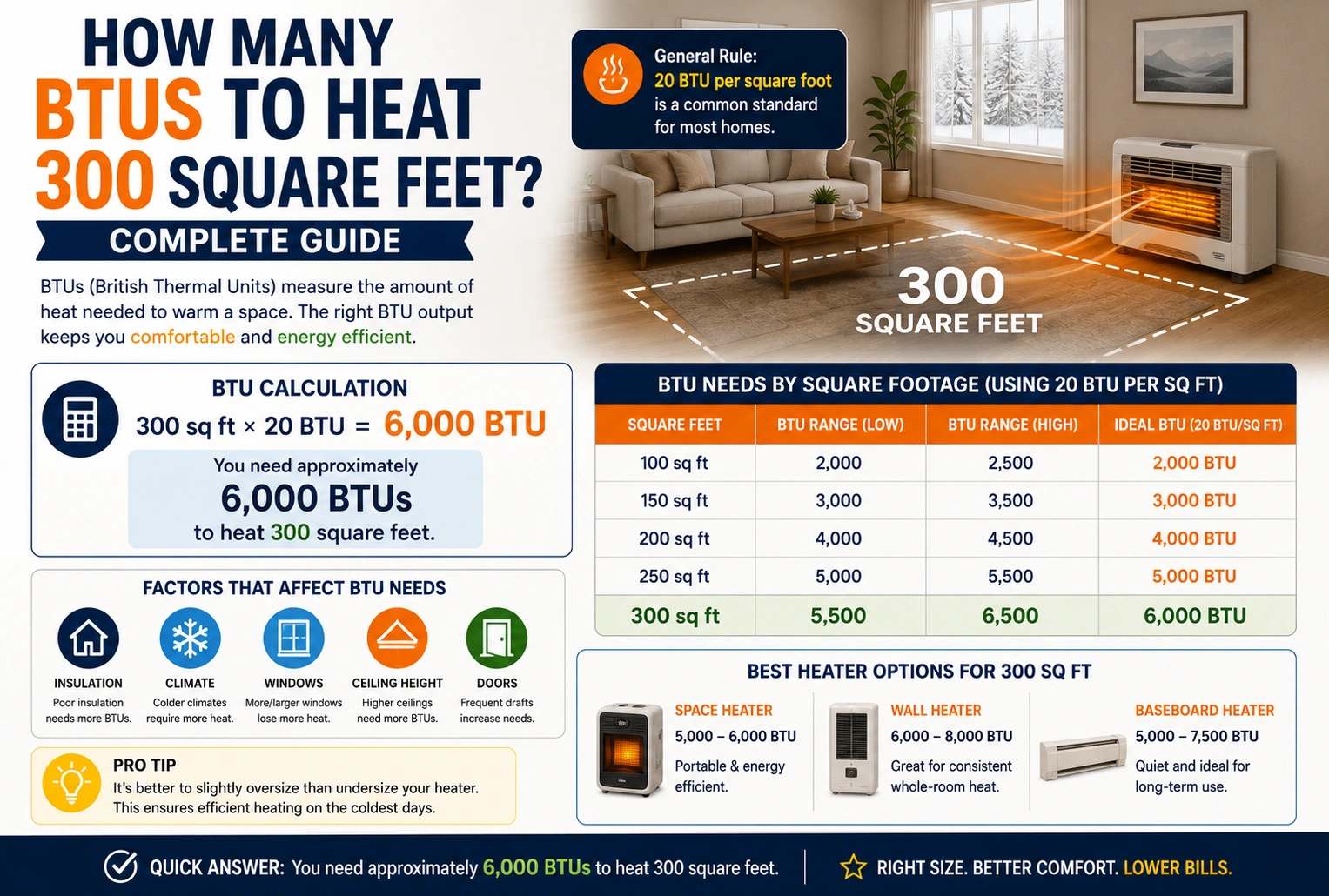
A 300-square-foot room generally needs about 6,000 to 9,000 BTUs per hour for heating, depending on climate, insulation, ceiling height, windows, and the building’s construction.
A commonly used rough estimate is around 20 to 30 BTUs per square foot for residential heating.
For 300 square feet:
300 × 20 = 6,000 BTU/hr
and:
300 × 30 = 9,000 BTU/hr
Therefore, a reasonable preliminary range is approximately 6,000 to 9,000 BTU/hr.
However, this is only a general estimate. The actual heating requirement can be lower or higher depending on the room and local climate.
Quick Answer
| Heating Requirement | Approximate BTUs |
|---|---|
| 15 BTU/sq ft | 4,500 BTU/hr |
| 20 BTU/sq ft | 6,000 BTU/hr |
| 25 BTU/sq ft | 7,500 BTU/hr |
| 30 BTU/sq ft | 9,000 BTU/hr |
| 35 BTU/sq ft | 10,500 BTU/hr |
| 40 BTU/sq ft | 12,000 BTU/hr |
For many typical situations, 6,000 to 9,000 BTU/hr is a useful starting range for heating 300 square feet.
A professional heating-load calculation is more accurate than relying on square footage alone.
What Is a BTU?
BTU stands for British thermal unit.
It is a unit used to describe the amount of heat energy required to raise the temperature of one pound of water by approximately one degree Fahrenheit.
When discussing heaters and furnaces, BTU ratings generally describe heating capacity per hour.
For example, a heater rated at 8,000 BTU/hr has a nominal heating capacity of 8,000 BTUs per hour.
The BTU rating helps compare the heating capacity of different heating appliances.
How Do You Estimate BTUs for 300 Square Feet?
A simple preliminary method is to multiply the room’s square footage by an estimated BTU-per-square-foot requirement.
The formula is:
Required BTUs ≈ Square Feet × BTUs per Square Foot
For 300 square feet using 25 BTUs per square foot:
300 × 25 = 7,500 BTU/hr
That gives a preliminary estimate of 7,500 BTU/hr.
The appropriate BTU-per-square-foot figure varies with climate and building characteristics.
BTU Requirements for Different Conditions
The same 300-square-foot room can have different heating requirements depending on its construction and location.
| Room or Building Condition | Approximate BTU Range |
|---|---|
| Mild climate / well insulated | 4,500–6,000 BTU/hr |
| Average insulation | 6,000–7,500 BTU/hr |
| Colder climate | 7,500–9,000 BTU/hr |
| Poor insulation / significant heat loss | 9,000–12,000+ BTU/hr |
These figures are general planning estimates rather than exact heating-load calculations.
Is 5,000 BTUs Enough to Heat 300 Square Feet?
A 5,000 BTU/hr heater may be enough for some 300-square-foot spaces, particularly when the room is well insulated and located in a relatively mild climate.
However, it may not provide enough heat in a poorly insulated room or a colder climate.
If the room loses heat quickly, a higher-capacity heater may be necessary.
Is 6,000 BTUs Enough for 300 Square Feet?
A 6,000 BTU/hr heater may be suitable for a well-insulated 300-square-foot room under favorable conditions.
At 20 BTUs per square foot:
300 × 20 = 6,000 BTU/hr
This makes 6,000 BTU/hr a reasonable lower-end estimate for some rooms.
Is 8,000 BTUs Enough for 300 Square Feet?
An 8,000 BTU/hr heater can be suitable for many 300-square-foot spaces, depending on the heating load.
It provides:
8,000 ÷ 300 ≈ 26.7 BTU per square foot
That falls within a commonly used preliminary range for residential heating estimates.
The actual suitability depends on the building.
Is 10,000 BTUs Too Much for 300 Square Feet?
Not necessarily.
A 10,000 BTU/hr heater may be appropriate for a 300-square-foot room with high heat loss, poor insulation, large windows, high ceilings, or a cold climate.
However, using a heater that is substantially larger than the actual heating load can lead to inefficient cycling and uneven comfort.
The goal is to match the heating equipment to the space’s actual heat loss rather than simply choosing the largest heater.
What Factors Affect BTU Requirements?
Square footage is important, but several other factors affect how much heat a room needs.
Climate
Colder climates generally require more heating capacity because the temperature difference between indoors and outdoors is greater during the heating season.
Insulation
Well-insulated walls, floors, ceilings, and attics reduce heat loss.
Poor insulation can significantly increase heating requirements.
Windows
Large or inefficient windows can allow heat to escape more quickly.
Older single-pane windows may have greater heat loss than modern energy-efficient windows.
Ceiling Height
A 300-square-foot room with an 8-foot ceiling contains less air volume than one with a 12-foot ceiling.
Higher ceilings can increase the amount of space that needs to be heated.
Exterior Walls
A room with several exterior walls may lose more heat than an interior room surrounded by heated spaces.
Doors
Exterior doors can contribute to heat loss, especially when they are poorly sealed or frequently opened.
Air Leakage
Gaps around windows, doors, vents, and other openings allow conditioned air to escape and outside air to enter.
Sun Exposure
Rooms receiving significant sunlight may gain heat during the day, reducing the amount of heating needed at certain times.
Does a 300-Square-Foot Room Need a 10,000-BTU Heater?
It depends.
A 10,000 BTU/hr heater provides approximately:
10,000 ÷ 300 = 33.3 BTU per square foot
That may be reasonable in a colder climate or a room with substantial heat loss.
For a well-insulated room in a mild climate, however, a smaller heater may be sufficient.
The best size is determined by the room’s actual heating load.
Heater Size Comparison for 300 Square Feet
| Heater Capacity | BTUs per Square Foot | General Assessment |
|---|---|---|
| 4,000 BTU/hr | 13.3 | May be too small |
| 5,000 BTU/hr | 16.7 | Lower-end use |
| 6,000 BTU/hr | 20.0 | Suitable in some conditions |
| 7,500 BTU/hr | 25.0 | Common preliminary estimate |
| 8,000 BTU/hr | 26.7 | Potentially suitable |
| 9,000 BTU/hr | 30.0 | Useful for greater heat loss |
| 10,000 BTU/hr | 33.3 | May suit colder/high-loss spaces |
| 12,000 BTU/hr | 40.0 | May be oversized for many rooms |
These are not equipment-selection recommendations for every home. Actual heating loads vary.
How Do You Know if a Heater Is Too Small?
A heater may be undersized if it cannot maintain the desired indoor temperature during cold weather.
Signs can include:
- The heater runs continuously
- The room remains cold
- Temperature drops quickly when the heater turns off
- Certain areas remain noticeably colder
- The system struggles during the coldest periods
If these problems occur, the issue may be heater capacity, insulation, air leakage, ductwork, or another building factor.
Can a Heater Be Too Large?
Yes.
An oversized heater may heat the room quickly and shut off frequently.
Depending on the heating system, frequent cycling can reduce comfort and increase equipment wear.
A properly sized heater should provide enough capacity to handle the design heating load without being unnecessarily oversized.
How Many BTUs Are Needed for 300 Square Feet With High Ceilings?
Ceiling height can affect heating requirements because it changes the volume of air inside the room.
For example, a 300-square-foot room with an 8-foot ceiling has:
300 × 8 = 2,400 cubic feet
A 300-square-foot room with a 12-foot ceiling has:
300 × 12 = 3,600 cubic feet
The second room has 50% more air volume.
However, heating systems are not sized using room volume alone. Insulation, outdoor temperature, windows, air leakage, and other factors also matter.
Is BTU the Same as Watts?
No.
BTUs and watts are different units.
BTUs measure thermal energy, while watts measure power.
For electric heaters, manufacturers may provide both wattage and BTU/hr.
As a rough conversion:
1 watt ≈ 3.41 BTU/hr
Therefore, a 1,500-watt electric heater produces approximately:
1,500 × 3.41 ≈ 5,115 BTU/hr
This can be useful when comparing electric heater ratings with BTU-rated heating equipment.
How Much Area Can Common Heaters Heat?
Heating capacity varies by building conditions, so there is no single square-footage figure for every heater.
A general comparison using 20–30 BTUs per square foot looks like this:
| Heater Capacity | Approximate Area at 20 BTU/sq ft | Approximate Area at 30 BTU/sq ft |
|---|---|---|
| 5,000 BTU | 250 sq ft | 167 sq ft |
| 6,000 BTU | 300 sq ft | 200 sq ft |
| 8,000 BTU | 400 sq ft | 267 sq ft |
| 10,000 BTU | 500 sq ft | 333 sq ft |
| 12,000 BTU | 600 sq ft | 400 sq ft |
These calculations illustrate how the required heater capacity changes when the assumed heat-loss rate changes.
Common Mistakes When Choosing a Heater
Using Square Footage Alone
Square footage provides a starting point, but it does not account for climate, insulation, windows, ceiling height, or heat loss.
Automatically Choosing the Largest Heater
A bigger heater is not always better. Oversizing can cause frequent cycling and uneven heating.
Ignoring Insulation
Poor insulation can dramatically increase the amount of heat a room loses.
Forgetting Ceiling Height
Two rooms with the same floor area can have different heating requirements if their ceiling heights differ significantly.
Confusing Heating and Cooling BTUs
BTU capacity is used for both heating and cooling, but the sizing calculations and building loads are not identical.
Frequently Asked Questions
How many BTUs do I need to heat 300 square feet?
A rough estimate is approximately 6,000 to 9,000 BTU/hr, using a general range of 20 to 30 BTUs per square foot.
Is 6,000 BTUs enough for 300 square feet?
It can be enough for some well-insulated 300-square-foot rooms, particularly in mild climates. Colder or poorly insulated spaces may need more capacity.
Is 8,000 BTUs enough for 300 square feet?
An 8,000 BTU/hr heater may be suitable for many 300-square-foot spaces, but the correct capacity depends on the room’s actual heat loss.
Is 10,000 BTUs enough for 300 square feet?
Yes, 10,000 BTU/hr can provide substantial heating for 300 square feet. Whether it is appropriate depends on climate, insulation, windows, ceiling height, and other factors.
Is 12,000 BTUs too much for 300 square feet?
It may be more capacity than many 300-square-foot rooms require, but it could be appropriate for a space with high heat loss or a particularly cold climate.
How many watts are needed to heat 300 square feet?
There is no single wattage that works for every 300-square-foot room. As a rough example, 1,500 watts provides about 5,115 BTU/hr, but actual heating requirements depend on the building.
Does insulation affect how many BTUs I need?
Yes. Better insulation reduces heat loss and can lower the required heating capacity.
Does climate affect heater size?
Yes. A room in a cold climate generally requires more heating capacity than a similar room in a mild climate.
Does ceiling height affect heating requirements?
Yes. Higher ceilings increase room volume and can increase the amount of heat needed, although heating load depends on more than volume alone.
What is the best way to determine the exact BTU requirement?
A professional heating-load calculation is the most reliable approach. It considers climate, building construction, insulation, windows, doors, air leakage, and other heat-loss factors.
Conclusion
So, how many BTUs do you need to heat 300 square feet?
A useful preliminary estimate is approximately 6,000 to 9,000 BTU/hr, based on a general assumption of 20 to 30 BTUs per square foot.
| Heating Estimate | BTUs for 300 Sq Ft |
|---|---|
| 20 BTU/sq ft | 6,000 BTU/hr |
| 25 BTU/sq ft | 7,500 BTU/hr |
| 30 BTU/sq ft | 9,000 BTU/hr |
| 35 BTU/sq ft | 10,500 BTU/hr |
| 40 BTU/sq ft | 12,000 BTU/hr |
For many situations, a heater in the 6,000–9,000 BTU/hr range may be a reasonable starting point. However, the ideal heater size depends on the room’s climate, insulation, windows, ceiling height, exterior walls, doors, and air leakage.
For an accurate equipment choice, use a professional heating-load calculation rather than relying on square footage alone. This helps ensure the heater has enough capacity to keep the 300-square-foot space comfortable without unnecessary oversizing.
Discover More Articles
How Many Square Feet Will 5,000 BTU Cool? Complete Guide