

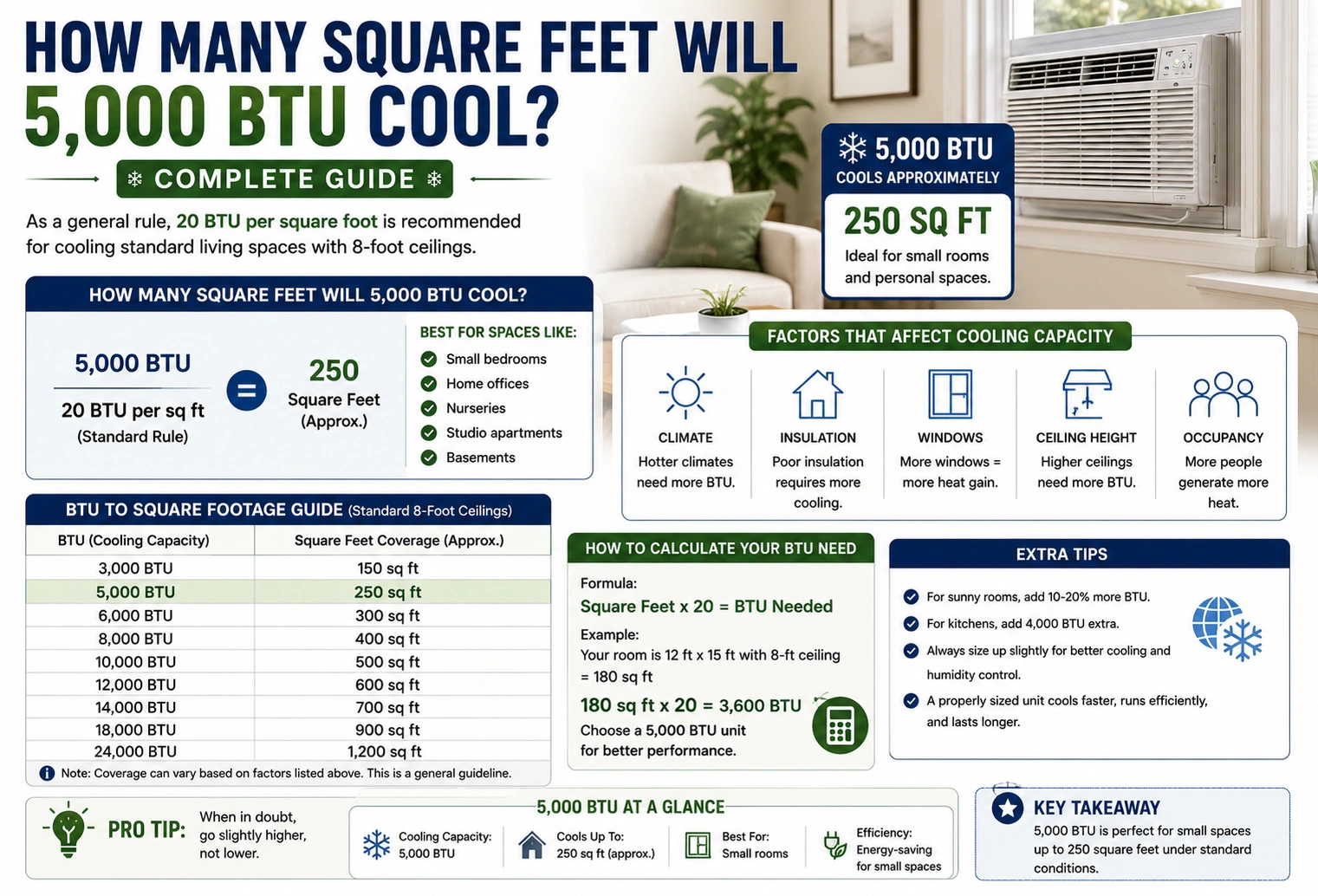
How many square feet will 5,000 BTU cool? A 5,000-BTU air conditioner can generally cool about 150–250 square feet under typical conditions.
For a moderately insulated room with average ceiling height and limited heat exposure, 150–200 square feet is a safer target. A well-insulated space in a mild climate may approach 250 square feet, while a hot, sunny, or poorly insulated room may require more BTUs.
| Room Conditions | Approx. Area a 5,000-BTU AC Can Cool |
|---|---|
| Very hot/sunny or poor insulation | 100–150 sq ft |
| Average conditions | 150–200 sq ft |
| Good insulation, moderate climate | 200–250 sq ft |
| Excellent conditions | Up to ~250 sq ft |
Important: These are general estimates. Actual AC sizing depends on climate, insulation, windows, ceiling height, sunlight, occupancy, and heat-producing appliances.
What Does 5,000 BTU Mean?
BTU stands for British thermal unit, a measurement of heat energy.
For an air conditioner, the BTU rating describes its cooling capacity. A 5,000-BTU AC removes heat from a room at a relatively modest rate, making it best suited to smaller spaces.
That’s why 5,000-BTU window air conditioners are commonly used for:
- Small bedrooms
- Home offices
- Small studios
- Guest rooms
- Small living spaces
- Dorm rooms
- Individual rooms
A 5,000-BTU unit is generally not intended to cool an entire large home.
How Many Square Feet Will 5,000 BTU Cool?
Under common conditions, 5,000 BTUs can cool approximately 150–250 square feet.
A simple rule of thumb often places basic cooling requirements around 20 BTUs per square foot.
Using that estimate:
5,000 ÷ 20 = 250 square feet
That produces a theoretical estimate of 250 square feet.
However, the simple calculation doesn’t account for the conditions inside the room. That’s why 150–200 square feet may be a more practical target when conditions are hot or the room has a higher heat load.
5,000 BTU Room Size Chart
Here’s a quick comparison based on different room conditions.
| Room Size | 5,000 BTU Suitability |
|---|---|
| 100 sq ft | Excellent |
| 125 sq ft | Excellent |
| 150 sq ft | Very good |
| 175 sq ft | Good |
| 200 sq ft | Good under average conditions |
| 225 sq ft | May work in favorable conditions |
| 250 sq ft | Upper end of basic estimate |
| 300 sq ft | Usually undersized |
This chart is a general guide rather than a substitute for a professional cooling-load calculation.
How to Calculate the Cooling Area for 5,000 BTUs
You can make a basic estimate using this formula:
Cooling area = BTUs ÷ BTUs per square foot
Using 20 BTUs per square foot:
5,000 ÷ 20 = 250 square feet
So the basic calculation gives:
5,000 BTU ≈ 250 square feet
But you should adjust this estimate when the room has additional heat sources.
For example, if the room receives strong afternoon sunlight, the actual cooling requirement could be higher.
How Climate Affects 5,000-BTU Cooling Capacity
Climate is one of the most important factors.
A 5,000-BTU air conditioner may cool a larger room in a mild climate than it can in an extremely hot climate.
Mild Climate
A well-insulated 200–250-square-foot room may be reasonable.
Moderate Climate
Approximately 150–200 square feet is a practical target.
Hot Climate
You may want to limit the unit to approximately 100–150 square feet, depending on insulation and sunlight.
| Climate/Condition | Approx. 5,000-BTU Coverage |
|---|---|
| Mild climate | 200–250 sq ft |
| Moderate climate | 150–200 sq ft |
| Hot climate | 125–175 sq ft |
| Very hot + sunny | 100–150 sq ft |
If you live in a consistently hot region, sizing based only on the maximum advertised square footage can leave the room uncomfortable.
Does Sunlight Affect How Much 5,000 BTU Can Cool?
Yes.
Direct sunlight adds heat to a room, especially through windows.
A small 150-square-foot bedroom with heavy afternoon sun may need more cooling than a shaded 200-square-foot room.
Factors that increase solar heat include:
- Large windows
- South- or west-facing windows
- Little exterior shade
- Dark roofing
- Poor window insulation
- Thin curtains
If your room receives strong direct sunlight, choose the cooling capacity based on the higher end of the load rather than assuming 5,000 BTUs will handle the maximum area.
How Insulation Affects 5,000-BTU AC Performance
Good insulation helps keep cooled air inside and outdoor heat outside.
A well-insulated room can therefore be easier to cool.
Poor insulation allows heat to enter more quickly.
For example:
| Insulation | Possible 5,000-BTU Application |
|---|---|
| Excellent | 200–250 sq ft |
| Good | 175–225 sq ft |
| Average | 150–200 sq ft |
| Poor | 100–150 sq ft |
These figures are estimates. The actual result depends on the entire building envelope.
Can a 5,000-BTU AC Cool a 300-Square-Foot Room?
A 5,000-BTU AC may struggle to cool 300 square feet, especially in a hot or sunny environment.
Using the basic 20-BTU-per-square-foot estimate:
300 × 20 = 6,000 BTUs
That suggests approximately 6,000 BTUs of cooling capacity before making adjustments for other factors.
If the room is poorly insulated or exposed to substantial sunlight, the requirement could be higher.
Therefore, a 5,000-BTU unit isn’t usually the ideal choice for a 300-square-foot room.
Can a 5,000-BTU AC Cool a 200-Square-Foot Room?
Yes, 200 square feet is generally within the practical range of a 5,000-BTU AC under average conditions.
It is more likely to work well if the room has:
- Standard ceiling height
- Good or average insulation
- Limited direct sunlight
- Normal occupancy
- Few heat-producing appliances
If all of these conditions are favorable, 5,000 BTUs can be a suitable choice for a 200-square-foot room.
Can a 5,000-BTU AC Cool a 100-Square-Foot Room?
Yes.
A 100-square-foot room is relatively small for a 5,000-BTU air conditioner.
In many situations, a 5,000-BTU unit can cool such a room effectively.
However, even a small room can have a high cooling load if it has:
- Strong direct sunlight
- Poor insulation
- Multiple occupants
- Computers or other heat-producing equipment
- High ceilings
The unit’s ability to cool the room depends on the conditions, not just the floor area.
What Size Room Is Best for 5,000 BTU?
For most average situations, 150–200 square feet is a useful target for a 5,000-BTU air conditioner.
If conditions are excellent, it may handle closer to 250 square feet.
If conditions are difficult, you may need to stay closer to 100–150 square feet.
The best choice is based on the actual cooling load rather than simply maximizing the manufacturer’s stated coverage.
5,000 BTU vs. Other AC Sizes
Comparing different BTU ratings can help you choose the right unit.
| AC Capacity | Approx. Basic Coverage* |
|---|---|
| 5,000 BTU | 150–250 sq ft |
| 6,000 BTU | 200–300 sq ft |
| 8,000 BTU | 300–400 sq ft |
| 10,000 BTU | 400–500 sq ft |
| 12,000 BTU | 500–600 sq ft |
| 15,000 BTU | 600–750 sq ft |
| 18,000 BTU | 750–900 sq ft |
*General estimates only. Actual requirements can vary significantly by climate and building conditions.
How Many BTUs Do You Need for Different Room Sizes?
If you’re not sure whether 5,000 BTUs is enough, compare your room with these approximate starting points.
| Room Area | Basic BTU Starting Point |
|---|---|
| 100 sq ft | 2,000–3,000 BTU |
| 150 sq ft | 3,000–4,000 BTU |
| 200 sq ft | 4,000–5,000 BTU |
| 250 sq ft | 5,000–6,000 BTU |
| 300 sq ft | 6,000–7,000 BTU |
| 400 sq ft | 8,000 BTU |
| 500 sq ft | 10,000 BTU |
These numbers are only for preliminary sizing.
A properly calculated cooling load can produce a different recommendation.
Does Ceiling Height Matter?
Yes.
Most basic room-size charts assume a standard ceiling height.
A room with an 8-foot ceiling has less air volume than a room with a 12-foot ceiling.
For example:
200 sq ft × 8 ft = 1,600 cubic feet
While:
200 sq ft × 12 ft = 2,400 cubic feet
The second room has substantially more air volume.
High ceilings can therefore increase the amount of cooling needed, although BTU sizing isn’t determined by cubic feet alone.
Do People Affect 5,000-BTU Cooling Capacity?
Yes.
People generate body heat.
A 5,000-BTU AC cooling a bedroom occupied by one or two people has a different load from the same unit cooling a small office with several people.
Rooms with frequent occupancy may require additional cooling capacity.
This is especially important for:
- Offices
- Meeting rooms
- Small classrooms
- Entertainment rooms
- Commercial spaces
Appliances Can Add Heat
Heat-producing appliances can increase the cooling load.
Common examples include:
- Computers
- Televisions
- Lamps
- Ovens
- Stoves
- Gaming systems
- Refrigerators
A small room containing several electronics may therefore need more cooling than an otherwise identical room.
5,000 BTU Window AC vs. Portable AC
A 5,000-BTU window air conditioner and a portable air conditioner can have different real-world performance.
Window units generally exhaust heat directly outside through the window.
Portable units may have different efficiency characteristics depending on their design and exhaust configuration.
When comparing them, don’t look only at the BTU number. Also consider:
- Room size
- Energy efficiency
- Noise
- Installation
- Exhaust requirements
- Actual rated capacity
The manufacturer’s specifications are the best source for comparing specific models.
Is a Bigger AC Always Better?
No.
It’s tempting to buy the largest possible unit, but oversized air conditioners aren’t necessarily better.
An oversized unit can:
- Cool the room very quickly
- Cycle on and off frequently
- Provide less consistent humidity control
- Create uneven temperatures
- Potentially waste energy
Likewise, an undersized unit may run continuously and still fail to maintain the desired temperature.
Proper sizing is the goal.
Common Mistakes When Choosing a 5,000-BTU AC
1. Using Only Square Footage
Square footage is only one factor.
2. Ignoring Climate
A 200-square-foot room in a mild climate isn’t equivalent to one in extreme heat.
3. Forgetting Sun Exposure
Direct sunlight can substantially increase heat gain.
4. Ignoring Insulation
Poor insulation can make a small room surprisingly difficult to cool.
5. Choosing the Largest Possible Unit
More BTUs don’t automatically mean better performance.
6. Forgetting Occupancy
More people mean more internal heat.
7. Ignoring Ceiling Height
Tall ceilings can increase the cooling load.
Tips for Getting the Most From a 5,000-BTU AC
If a 5,000-BTU unit is properly sized, you can improve its performance by:
- Keeping doors and windows closed
- Using curtains or blinds during strong sunlight
- Cleaning the air filter regularly
- Improving insulation
- Sealing obvious air leaks
- Reducing unnecessary indoor heat
- Using fans to distribute cooled air
- Keeping the condenser or outdoor-facing components unobstructed
These steps can help the AC operate more effectively.
How Much Electricity Does a 5,000-BTU AC Use?
Energy use depends on the specific model, efficiency, operating time, thermostat setting, and electricity rate.
For example, two 5,000-BTU units can have different energy consumption.
| Factor | Lower Energy Use | Higher Energy Use |
|---|---|---|
| Insulation | Good | Poor |
| Room exposure | Shaded | Sunny |
| Runtime | Shorter | Longer |
| AC efficiency | Higher | Lower |
| Thermostat | Moderate | Very low |
| Maintenance | Clean | Dirty filter |
To estimate your actual operating cost, check the unit’s wattage or energy rating and multiply its electricity consumption by your local electricity rate.
FAQs
1. How many square feet will 5,000 BTU cool?
A 5,000-BTU air conditioner can generally cool around 150–250 square feet. For average conditions, 150–200 square feet is a practical target.
2. Is 5,000 BTU enough for 200 square feet?
Yes. A 5,000-BTU AC is generally suitable for a 200-square-foot room under average conditions, assuming reasonable insulation and no unusually high heat load.
3. Can 5,000 BTU cool 300 square feet?
It may struggle. A 300-square-foot room may need around 6,000 BTUs or more under basic sizing assumptions, with higher requirements possible in hot or sunny conditions.
4. What size room can a 5,000-BTU window AC cool?
A 5,000-BTU window AC is commonly suited to approximately 150–250 square feet, depending on climate, insulation, sunlight, ceiling height, and occupancy.
5. Is a 5,000-BTU AC good for a bedroom?
Yes. It can be a good choice for a small bedroom, particularly around 100–200 square feet. The exact size should account for windows, sunlight, insulation, and other heat sources.
Conclusion
So, how many square feet will 5,000 BTU cool? A reasonable general estimate is 150–250 square feet, with 150–200 square feet being a practical range for many average rooms.
A simple calculation gives:
5,000 BTU ÷ 20 BTU per square foot = 250 square feet
But this represents a basic estimate rather than a guaranteed coverage area. Hot climates, poor insulation, large windows, direct sunlight, high ceilings, and multiple occupants can increase the required cooling capacity.
For the best results, choose an AC based on the actual cooling load of the room, not square footage alone.
Discover More Articles
How Many Feet of Runner for 13 Stairs? Complete Guide