

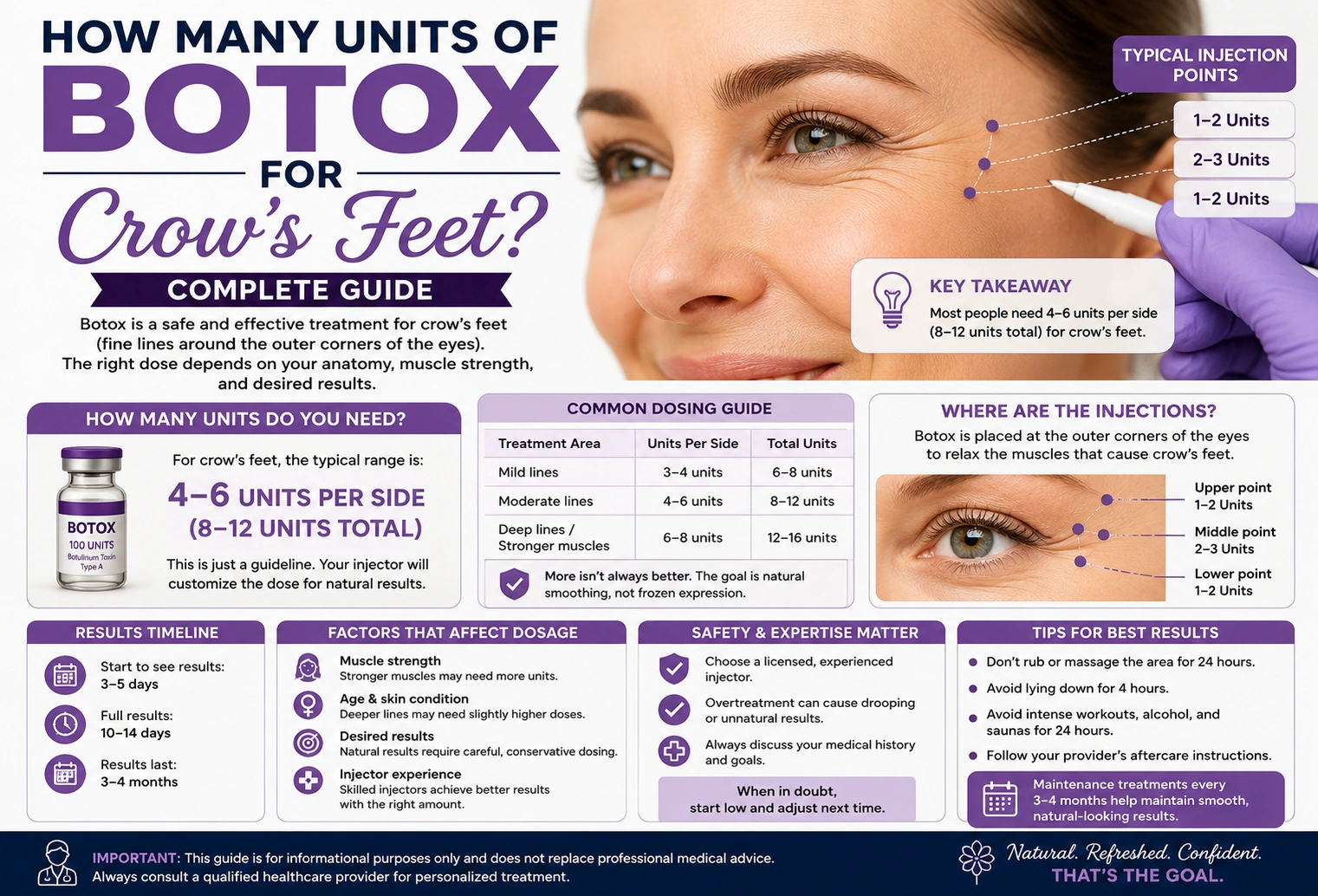
How many units of Botox for crow’s feet? There is no single dose that works for everyone. For adults, clinicians commonly use small amounts around the outer corners of the eyes, with the exact number based on muscle strength, wrinkle severity, treatment goals, and the product used.
For cosmetic treatment, dosing should be determined by a qualified, licensed medical professional. Botox injections near the eyes require particular care because the area is close to muscles involved in eyelid movement and facial expression.
Important: Botox is a prescription treatment. Do not use a general unit estimate as a personal dosing recommendation.
What Are Crow’s Feet?
Crow’s feet are fine lines and wrinkles that develop at the outer corners of the eyes.
They are often called lateral canthal lines. They become more visible when you smile, squint, or make other facial expressions.
Several factors contribute to them, including:
- Repeated facial movement
- Natural aging
- Reduced skin elasticity
- Sun exposure
- Smoking
- Genetics
- Changes in collagen and skin structure
Because these wrinkles are strongly linked to muscle movement, Botox can be used to temporarily reduce their appearance.
How Many Units of Botox for Crow’s Feet?
The amount used for crow’s feet varies considerably between patients.
There is no universal number of units that should be injected into every person’s crow’s feet.
A clinician may consider:
- The strength of the muscles around the eyes
- The depth of the wrinkles
- How visible the lines are at rest
- How much movement the patient wants to retain
- Facial anatomy
- Previous Botox treatments
- The specific botulinum toxin product being used
A consultation is therefore more useful than choosing a dose from a generic chart.
Why Does the Dose Vary?
Two people can have very different muscle activity around the eyes.
One person may have mild expression lines and relatively weak muscle activity, while another may have deeper lines and stronger contractions.
Using the same amount for both people may produce different results.
Botox Units Are Not the Same as Milligrams
One important point is that Botox units are product-specific potency measurements.
They should not be treated like milligrams or as a universal measurement that can be directly compared between different botulinum toxin products.
Different brands and formulations can have different unit systems.
For this reason, you should not assume that a certain number of units of one product is automatically equivalent to the same number of units of another.
Your injector should use the dosing information appropriate to the specific product.
Botox for Crow’s Feet vs. Other Facial Areas
The amount of botulinum toxin used can differ depending on the facial area being treated.
Crow’s feet are around the eyes, while other cosmetic treatment areas include:
- Forehead lines
- Frown lines between the eyebrows
- Bunny lines around the nose
- Lip lines
- Chin dimpling
- Jaw muscles
Each area has different anatomy and different treatment considerations.
| Treatment Area | Main Concern | Dosing Consideration |
|---|---|---|
| Crow’s feet | Outer-eye wrinkles | Sensitive eye-area anatomy |
| Forehead | Horizontal lines | Frontalis muscle activity |
| Frown lines | Glabellar lines | Brow and eyelid balance |
| Chin | Dimpling | Mentalis muscle activity |
| Jaw | Muscle bulk | Larger muscle group |
This is why Botox dosing should be individualized rather than copied from another treatment area.
How Long Does Botox for Crow’s Feet Last?
Botox results are temporary.
Many people see noticeable improvement within several days, with the effect developing further over roughly the first couple of weeks.
Results commonly last around three to four months, although the duration varies.
Factors that can affect how long results last include:
- Individual metabolism
- Muscle activity
- Treatment area
- Dose
- Previous treatments
- Product used
- Individual response
Some people may experience effects for shorter or longer periods.
What Happens During a Crow’s Feet Botox Treatment?
A typical treatment begins with an assessment of the area around the eyes.
The clinician may ask you to:
- Relax your face.
- Smile or squint.
- Show the areas where wrinkles appear.
- Discuss your desired result.
- Review your medical history and medications.
- Determine appropriate injection points and dosing.
The clinician then uses a small needle to administer the product into selected muscles.
The procedure is generally quick, although the total appointment time depends on consultation and assessment.
What Results Can You Expect?
Botox works by temporarily reducing activity in targeted muscles.
For crow’s feet, this can make expression-related wrinkles appear less pronounced.
Results can vary based on how much of the wrinkles are caused by muscle movement.
Dynamic vs. Static Wrinkles
Dynamic wrinkles appear mainly when you move your face.
Static wrinkles remain visible even when your face is relaxed.
Botox generally works best on wrinkles associated with muscle movement. If lines have become deeply etched into the skin, Botox alone may not completely remove them.
A qualified clinician can help determine whether another treatment may be appropriate.
Botox for Crow’s Feet: Benefits and Drawbacks
Potential Benefits
Botox may:
- Reduce the appearance of expression lines
- Create a smoother-looking outer-eye area
- Require little downtime
- Provide temporary results
- Be performed relatively quickly
Potential Drawbacks
Possible disadvantages include:
- Temporary results
- Cost of repeated treatments
- Bruising or redness
- Swelling
- Headache
- Asymmetry
- Unwanted changes in facial movement
- Rare but more serious complications
Treatment around the eyes requires particular precision.
Does More Botox Mean Better Results?
Not necessarily.
Using more product does not automatically produce a better cosmetic result.
The goal is usually to achieve an appropriate reduction in muscle activity while maintaining a natural facial appearance.
Too much weakening in certain areas can affect facial movement or expression.
For that reason, a qualified injector should determine the amount based on your anatomy and treatment goals.
Factors That Affect Botox Cost
If you’re comparing prices, remember that Botox treatment may be priced in different ways.
Some providers charge per unit, while others charge by treatment area.
Other factors can include:
- Provider experience
- Geographic location
- Clinic fees
- Product used
- Number of treatment areas
- Follow-up appointments
Example Price Comparison
The following is a hypothetical example, not a statement of typical market pricing.
| Pricing Method | Example |
|---|---|
| Price per unit | $12/unit |
| 10 units | $120 |
| 15 units | $180 |
| 20 units | $240 |
| Treatment-area fee | $250 |
| Consultation fee | $50 |
Actual prices can differ substantially between clinics and locations.
When comparing quotes, make sure you understand whether the price includes the consultation, product, injections, and follow-up care.
How to Choose a Botox Provider
Choosing the injector is often more important than focusing on a specific unit number.
Look for a qualified medical professional with appropriate training and experience in facial aesthetics.
Before treatment, consider asking:
- What product will you use?
- How do you determine the dose?
- How often do you treat the eye area?
- What results should I realistically expect?
- What side effects should I watch for?
- What happens if I have a concern after treatment?
- Is follow-up included?
A reputable provider should be willing to explain the treatment rather than simply giving you a number of units.
Safety Considerations Around the Eyes
The skin around the eyes is delicate, and several muscles and structures are close together.
Potential side effects of botulinum toxin injections can include:
- Bruising
- Redness
- Swelling
- Tenderness
- Headache
- Temporary eyelid or brow changes
- Asymmetry
Rarely, botulinum toxin effects can spread beyond the injection area and cause more serious symptoms.
Seek urgent medical attention if you experience difficulty breathing, swallowing, speaking, significant generalized weakness, or other severe symptoms after treatment.
Who Should Avoid or Delay Treatment?
Botulinum toxin treatment is not appropriate for everyone.
Your medical provider should know about:
- Allergies to botulinum toxin products
- Certain neuromuscular conditions
- Previous reactions to injections
- Current medications
- Pregnancy or breastfeeding
- Recent facial procedures
- Other medical conditions
Do not rely on an online dosage estimate to determine whether treatment is safe for you.
Common Mistakes When Searching for Botox Units
Mistake 1: Choosing a Dose Online
A general unit number cannot account for your individual anatomy.
Mistake 2: Comparing Different Brands Directly
Units from different botulinum toxin products should not automatically be treated as interchangeable.
Mistake 3: Assuming More Is Better
More product can increase the chance of unwanted effects without necessarily improving the result.
Mistake 4: Focusing Only on Price
A cheaper treatment isn’t necessarily better. Injector training, experience, product authenticity, and appropriate medical care matter.
Mistake 5: Ignoring Follow-Up Care
Ask what happens if you experience an unexpected effect or need assessment after treatment.
Expert Tips Before Getting Botox for Crow’s Feet
For a safer and more informed consultation:
- Choose a qualified medical professional.
- Ask which product is being used.
- Discuss your desired level of movement.
- Tell the provider about medications and supplements.
- Share your history of previous cosmetic injections.
- Ask about possible side effects.
- Avoid selecting your own dose.
- Follow the provider’s aftercare instructions.
Most importantly, focus on appropriate treatment for your face, rather than trying to reach a particular number of units.
FAQs
1. How many units of Botox are needed for crow’s feet?
There is no single dose suitable for everyone. The appropriate amount depends on the individual, the product used, muscle activity, anatomy, and desired result.
2. Does Botox completely remove crow’s feet?
It can reduce the appearance of dynamic crow’s feet, but deeply established lines may not disappear completely.
3. How long does Botox for crow’s feet last?
Results commonly last around three to four months, although individual results vary.
4. Is Botox around the eyes safe?
When appropriately administered by a qualified professional, Botox is widely used cosmetically around the eyes. However, side effects can occur, and the area requires careful injection technique.
5. Can I decide how many Botox units I need?
It is better not to choose your own dose. A qualified injector should assess your facial anatomy, muscle activity, medical history, and goals before determining the appropriate treatment.
Conclusion
How many units of Botox for crow’s feet? There is no one-size-fits-all answer. The appropriate amount depends on factors such as muscle strength, wrinkle severity, facial anatomy, treatment goals, previous treatments, and the specific botulinum toxin product.
Botox can temporarily reduce dynamic crow’s feet by relaxing targeted muscles, but treatment around the eyes requires careful technique. Rather than choosing a specific number of units from an online guide, discuss your goals with a qualified medical professional who can determine an appropriate treatment plan.
For price comparisons, remember that clinics may charge per unit or per treatment area, so compare the total treatment cost and provider qualifications, not just the advertised unit price.
Discover More Articles
How Many Square Feet Are in a Mansion? Size Guide