

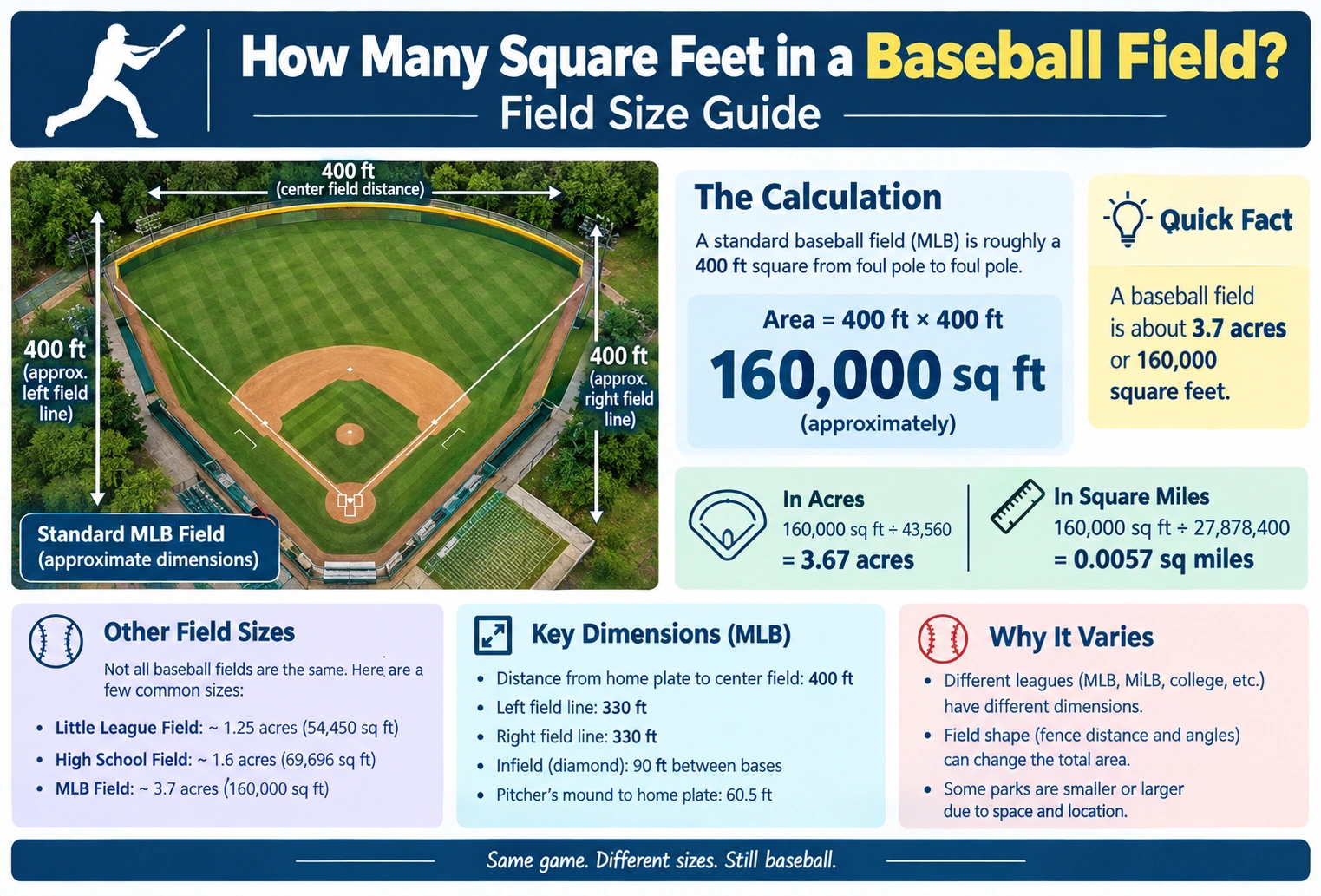
A baseball field does not have one fixed square-footage measurement because its outfield dimensions vary from ballpark to ballpark. A regulation baseball diamond has 90-foot base paths, but the total area of the playing field depends on the outfield shape and fence dimensions.
For a simple estimate, a baseball field can cover roughly 100,000 to 125,000 square feet or more, depending on the stadium and how the playing area is measured.
| Baseball Field Area | Approximate Square Feet |
|---|---|
| Infield diamond only | 8,100 sq ft |
| Typical full playing area | ~100,000–125,000+ sq ft |
| Large outfield | Can exceed 125,000 sq ft |
What Is the Square Footage of a Baseball Field?
When people ask “how many square feet in a baseball field,” they are usually asking about the total playing area from home plate through the outfield.
Unlike a basketball or football field, a baseball field does not have one universal rectangular size. The infield is standardized, but the outfield dimensions can vary.
The main standardized measurement is the distance between bases:
90 feet from base to base
The outfield, however, can be deeper or shallower depending on the ballpark.
How Many Square Feet Is a Baseball Diamond?
The baseball infield is often visualized as a square with 90-foot sides.
Using a simple square-area calculation:
Area = length × width
90 × 90 = 8,100 square feet
So, a simple 90-by-90-foot square has an area of 8,100 square feet.
However, the actual baseball infield is not simply a filled 90-by-90-foot square. The playing surface includes the diamond, base paths, grass, dirt areas, and other portions of the infield.
| Measurement | Value |
|---|---|
| Base-path distance | 90 ft |
| Simple 90 × 90 area | 8,100 sq ft |
| Distance from home to first | 90 ft |
| Distance from first to second | 90 ft |
| Distance from second to third | 90 ft |
| Distance from third to home | 90 ft |
Why Baseball Fields Have Different Square Footages
Baseball stadiums are different from sports venues with standardized rectangular playing surfaces.
The distance from home plate to the outfield wall can vary significantly. The left-field, center-field, and right-field dimensions may also be different within the same stadium.
That means two regulation baseball fields can have noticeably different total playing areas.
| Feature | Standardization |
|---|---|
| Base paths | 90 ft |
| Distance between bases | 90 ft |
| Infield geometry | Generally standardized |
| Outfield dimensions | Vary |
| Outfield fence distance | Varies |
| Total playing area | Varies |
How to Calculate the Square Feet of a Baseball Field
Calculating the exact square footage of a baseball field is more complicated than multiplying length by width because the field is not a simple rectangle.
For a rough estimate, you can divide the field into simpler geometric sections.
Step 1: Measure the Field
Determine the approximate distance from home plate to the outfield fence and the width of the outfield.
Step 2: Break the Field Into Shapes
You can estimate the playing area using rectangles, triangles, sectors, or other simple shapes.
Step 3: Calculate Each Section
For a rectangle:
Area = length × width
For a triangle:
Area = ½ × base × height
Step 4: Add the Areas
Adding the individual sections provides an estimate of the total square footage.
Because baseball fields have curved or angled outfield boundaries, this method provides an approximation unless you have an accurate field plan.
Baseball Field Size in Square Feet Compared With Other Sports Fields
A baseball field’s area is easier to understand when compared with familiar sports surfaces.
| Sports Field | Approximate Playing Area |
|---|---|
| Baseball field | ~100,000–125,000+ sq ft* |
| Basketball court | ~4,700 sq ft |
| Tennis court | ~2,800 sq ft |
| Soccer field | ~70,000–120,000 sq ft |
| American football field | 57,600 sq ft |
| Hockey rink | ~17,000 sq ft |
*Baseball figures are approximate because field dimensions vary.
How Big Is a Baseball Field in Acres?
One acre contains:
43,560 square feet
If a baseball playing area is approximately 100,000 square feet:
100,000 ÷ 43,560 ≈ 2.30 acres
For a 125,000-square-foot playing area:
125,000 ÷ 43,560 ≈ 2.87 acres
| Baseball Field Area | Approximate Acres |
|---|---|
| 80,000 sq ft | 1.84 acres |
| 90,000 sq ft | 2.07 acres |
| 100,000 sq ft | 2.30 acres |
| 110,000 sq ft | 2.53 acres |
| 120,000 sq ft | 2.75 acres |
| 125,000 sq ft | 2.87 acres |
| 150,000 sq ft | 3.44 acres |
Keep in mind that the land occupied by an entire baseball stadium is much larger than the playing field itself because it includes seating, concourses, parking, buildings, walkways, and other facilities.
How Many Square Feet Is a Little League Baseball Field?
Little League fields are smaller than professional baseball fields.
The base paths are commonly 60 feet, rather than the 90-foot base paths used in professional baseball.
Because the dimensions are smaller, the total playing area is also considerably smaller.
| Field Type | Base Path Distance |
|---|---|
| Little League | 60 ft |
| Youth baseball | Varies |
| High school baseball | Generally 90 ft |
| College baseball | Generally 90 ft |
| Professional baseball | 90 ft |
The exact square footage of a youth field still depends on the outfield dimensions.
How Many Square Feet Is a High School Baseball Field?
High school baseball fields generally use a 90-foot base-path configuration, but the outfield dimensions can vary.
Therefore, there is no single square-foot measurement that applies to every high school baseball field.
A particular field should be measured from its actual dimensions to determine its approximate playing area.
| Field Type | Typical Base Paths | Total Area |
|---|---|---|
| Little League | 60 ft | Smaller |
| High school | 90 ft | Varies |
| College | 90 ft | Varies |
| Professional | 90 ft | Varies |
Baseball Field Square Feet vs. Baseball Diamond Square Feet
The baseball diamond and the entire baseball field are not the same thing.
The diamond refers primarily to the area formed by the four bases. The complete playing field extends from the infield into the outfield.
| Area | What It Includes |
|---|---|
| Baseball diamond | Four bases and base-path layout |
| Infield | Diamond plus surrounding infield area |
| Outfield | Grass area beyond the infield |
| Full playing field | Infield + outfield |
This distinction is important when estimating square footage.
How Many Square Feet of Grass Does a Baseball Field Have?
The amount of grass depends on the field design.
Some baseball fields have large grass outfields and substantial dirt infield areas. Others use different turf configurations.
Therefore, total field area and grass area are not necessarily the same.
If you are estimating materials such as sod, seed, fertilizer, or irrigation, you should measure the actual grass sections rather than using the total field area.
| Measurement Type | Should You Include? |
|---|---|
| Outfield grass | Yes |
| Infield grass | Depends on design |
| Dirt base paths | No, for grass calculations |
| Pitcher’s mound | No, for grass calculations |
| Warning track | Usually no |
| Entire playing field | Yes, for total field estimate |
How Much Land Do You Need for a Baseball Field?
The actual playing surface is only part of the land required to build a baseball facility.
A complete baseball complex needs additional space for:
- Dugouts
- Foul territory
- Fencing
- Warning tracks
- Spectator seating
- Walkways
- Concession areas
- Restrooms
- Parking
- Maintenance areas
As a result, the total property required can be considerably larger than the square footage of the playing field.
| Component | Uses Additional Space? |
|---|---|
| Playing field | Yes |
| Dugouts | Yes |
| Spectator areas | Yes |
| Fencing | Yes |
| Parking | Yes |
| Buildings | Yes |
| Walkways | Yes |
Baseball Field Dimensions You Should Know
Several important measurements help explain why baseball fields have different sizes.
| Feature | Typical Measurement |
|---|---|
| Professional base paths | 90 ft |
| Distance between adjacent bases | 90 ft |
| Home plate to second base | About 127.3 ft |
| Little League base paths | 60 ft |
| Outfield fence | Varies by field |
| Total square footage | Varies |
The distance from home plate to second base is greater than 90 feet because it is the diagonal across the diamond.
Using the Pythagorean theorem:
√(90² + 90²) ≈ 127.28 feet
So home plate is approximately 127.3 feet from second base.
Why You Should Not Use 90 × 90 to Find the Whole Field Area
One common mistake is assuming:
90 × 90 = 8,100 square feet
and then calling 8,100 square feet the area of the entire baseball field.
That calculation represents a simple square based on the 90-foot base-path dimension. It does not represent the full baseball playing area.
The outfield extends well beyond the bases, which adds a large amount of area.
| Calculation | What It Represents |
|---|---|
| 90 × 90 = 8,100 sq ft | Simple square using base-path dimension |
| Full field area | Includes infield + outfield |
| Exact field area | Depends on actual field geometry |
How Many Baseball Fields Fit in an Acre?
One acre equals 43,560 square feet.
If you use a 100,000-square-foot estimate for a baseball field:
43,560 ÷ 100,000 ≈ 0.44
So one acre is less than half of a 100,000-square-foot baseball field.
Conversely:
100,000 ÷ 43,560 ≈ 2.30 acres
That means a 100,000-square-foot playing area is about 2.3 acres.
Common Mistakes When Calculating Baseball Field Area
Mistake 1: Assuming Every Baseball Field Is the Same Size
The outfield dimensions vary between fields, so total area varies too.
Mistake 2: Confusing the Diamond With the Whole Field
The 90-foot base paths describe the infield geometry, not the entire outfield.
Mistake 3: Using a Rectangle Formula for an Irregular Field
A baseball field does not have a simple rectangular boundary.
Mistake 4: Counting Stadium Property as Playing Area
Parking lots, seats, buildings, and surrounding property should not be included when calculating the playing surface.
Mistake 5: Assuming Grass Equals Total Field Area
Dirt, warning tracks, and other surfaces may occupy part of the playing area.
How to Estimate Baseball Field Square Footage
If you need a practical estimate rather than an exact engineering measurement, use the field’s actual dimensions.
For example, if a simplified field model gives you an estimated playing area of 110,000 square feet:
110,000 ÷ 43,560 ≈ 2.53 acres
So that playing area would be approximately 2.53 acres.
| Estimated Field Area | Approximate Acres |
|---|---|
| 90,000 sq ft | 2.07 acres |
| 100,000 sq ft | 2.30 acres |
| 110,000 sq ft | 2.53 acres |
| 120,000 sq ft | 2.75 acres |
| 130,000 sq ft | 2.98 acres |
Frequently Asked Questions
How many square feet is a baseball field?
There is no single exact answer because baseball field dimensions vary. A full playing area can be roughly 100,000 to 125,000 square feet or more, depending on the field.
How many square feet is a baseball diamond?
Using a simple 90-by-90-foot square as a reference gives 8,100 square feet. However, the actual diamond and infield geometry should not be treated as a simple filled square.
How many acres is a baseball field?
A baseball playing field can be around 2–3 acres, depending on its dimensions. For example, 100,000 square feet is approximately 2.3 acres.
How long are baseball base paths?
A standard professional baseball diamond has 90-foot base paths. Little League fields commonly use 60-foot base paths.
Are all baseball fields the same size?
No. While important elements such as professional base paths are standardized, outfield dimensions can vary considerably from one baseball field to another.
Conclusion
So, how many square feet in a baseball field? There is no single universal number. A typical full baseball playing area can be roughly 100,000 to 125,000 square feet or more, depending on the field’s outfield dimensions.
The 90-foot base paths are standardized for professional baseball, but the outfield size and shape vary. For that reason, an exact square-foot calculation requires the specific field’s dimensions.
For a general land-area comparison, a baseball playing field is often around 2–3 acres, while the complete property needed for a stadium or baseball complex can be much larger.
Discover More Articles
How Many Feet Is the Pitcher’s Mound to Home Plate?