

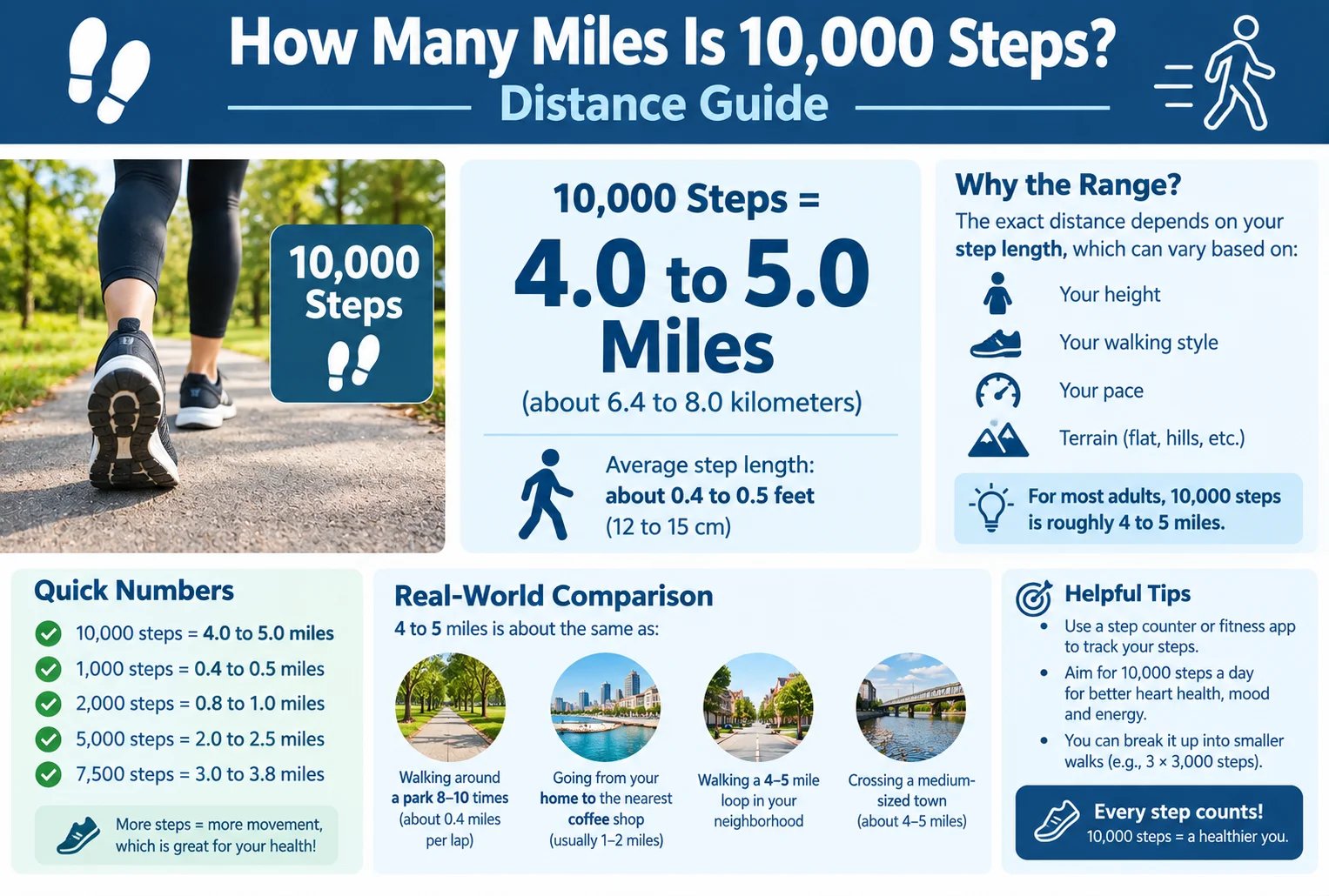
Walking 10,000 steps a day is a popular activity goal for people who want to stay active, build a walking routine, or track their daily movement. However, the distance covered by those steps is not exactly the same for everyone. It depends mainly on stride length, height, walking style, and pace.
Quick Answer
10,000 steps is approximately 4 to 5 miles for many adults.
A commonly used estimate is about 5 miles, assuming an average step length of approximately 2.5 feet.
For a more personalized estimate, use this formula:
Miles = (Number of Steps × Step Length in Feet) ÷ 5,280
For example, if each step measures 2.5 feet:
10,000 × 2.5 = 25,000 feet
25,000 ÷ 5,280 ≈ 4.73 miles
Therefore, 10,000 steps at a 2.5-foot step length equal approximately 4.73 miles.
How Many Miles Do 10,000 Steps Equal?
The distance covered by 10,000 steps varies with step length.
| Average Step Length | Distance for 10,000 Steps |
|---|---|
| 2.0 feet | 3.79 miles |
| 2.1 feet | 3.98 miles |
| 2.2 feet | 4.17 miles |
| 2.3 feet | 4.36 miles |
| 2.4 feet | 4.55 miles |
| 2.5 feet | 4.73 miles |
| 2.6 feet | 4.92 miles |
| 2.7 feet | 5.11 miles |
| 2.8 feet | 5.30 miles |
| 3.0 feet | 5.68 miles |
These figures are estimates. Your actual distance depends on the length of your steps and how accurately your device counts them.
How to Calculate Miles From 10,000 Steps
You can estimate the distance using your average step length.
Formula:
Miles = (Steps × Step Length in Feet) ÷ 5,280
There are 5,280 feet in one mile.
Example Calculation
Suppose your average step length is 2.4 feet.
Step 1: Multiply the steps by the step length.
10,000 × 2.4 = 24,000 feet
Step 2: Convert feet into miles.
24,000 ÷ 5,280 ≈ 4.55 miles
Your estimated distance is 4.55 miles.
If you know your step length in inches instead, convert it to feet by dividing by 12 before using the formula.
How Many Miles Is 10,000 Steps for a Woman?
There is no single distance that applies to all women. Height, stride length, walking style, and terrain can all affect the result.
For illustration, a person with an average step length of 2.2 feet would cover approximately 4.17 miles in 10,000 steps. Someone with a 2.5-foot step length would cover approximately 4.73 miles.
| Example Step Length | Distance for 10,000 Steps |
|---|---|
| 2.1 feet | 3.98 miles |
| 2.2 feet | 4.17 miles |
| 2.3 feet | 4.36 miles |
| 2.4 feet | 4.55 miles |
| 2.5 feet | 4.73 miles |
These are examples of step lengths, not fixed averages for women. Measuring your own steps will provide a more accurate estimate.
How Many Miles Is 10,000 Steps for a Man?
Men also have different stride lengths, so the distance cannot be determined from sex alone. A taller person may take longer steps on average, but individual walking habits make a difference.
For example, a 2.6-foot step length produces a distance of approximately 4.92 miles for 10,000 steps.
| Example Step Length | Distance for 10,000 Steps |
|---|---|
| 2.3 feet | 4.36 miles |
| 2.4 feet | 4.55 miles |
| 2.5 feet | 4.73 miles |
| 2.6 feet | 4.92 miles |
| 2.7 feet | 5.11 miles |
| 2.8 feet | 5.30 miles |
These figures are illustrative rather than fixed values for men. Your actual stride length is the best input for estimating your distance.
How Does Height Affect the Distance of 10,000 Steps?
Height can influence stride length, but it does not determine it completely. Walking speed, leg proportions, terrain, and personal movement patterns also matter.
People with longer steps generally cover more ground in the same number of steps.
| Step Length | Miles Covered in 10,000 Steps |
|---|---|
| 2.0 feet | 3.79 miles |
| 2.2 feet | 4.17 miles |
| 2.4 feet | 4.55 miles |
| 2.6 feet | 4.92 miles |
| 2.8 feet | 5.30 miles |
| 3.0 feet | 5.68 miles |
Use this table as a reference rather than assuming a particular distance based on height alone.
How Long Does It Take to Walk 10,000 Steps?
The time needed to walk 10,000 steps depends on your walking cadence, or steps per minute. Breaks, traffic lights, hills, and other interruptions can increase the total elapsed time.
| Walking Cadence | Approximate Time for 10,000 Steps |
|---|---|
| 80 steps per minute | 125 minutes |
| 90 steps per minute | 111 minutes |
| 100 steps per minute | 100 minutes |
| 110 steps per minute | 91 minutes |
| 120 steps per minute | 83 minutes |
These calculations assume a steady cadence without breaks. For many people, reaching 10,000 steps over the course of a day is more practical than completing them all in one walk.
How Many Calories Do You Burn Walking 10,000 Steps?
Calorie expenditure varies with body weight, walking speed, terrain, stride, and fitness level. The step count alone cannot provide an exact calorie total.
A longer walk or a brisk pace may increase energy expenditure, while a slower pace or frequent stops may reduce it.
| Factor | How It Can Affect Calorie Use |
|---|---|
| Body weight | Heavier bodies generally use more energy for the same activity |
| Walking speed | Faster walking often increases energy use per minute |
| Hills and inclines | Uphill walking generally requires more effort |
| Terrain | Uneven surfaces may change the energy required |
| Duration | Longer activity generally uses more total energy |
Fitness watches and apps can offer estimates, but their calorie figures are not exact measurements.
How Many Steps Are in One Mile?
The number of steps in one mile depends on your average step length.
| Average Step Length | Approximate Steps per Mile |
|---|---|
| 2.0 feet | 2,640 steps |
| 2.2 feet | 2,400 steps |
| 2.4 feet | 2,200 steps |
| 2.5 feet | 2,112 steps |
| 2.6 feet | 2,031 steps |
| 2.8 feet | 1,886 steps |
| 3.0 feet | 1,760 steps |
These figures use 5,280 feet per mile and assume a consistent step length.
How Many Miles Are 5,000, 8,000, and 15,000 Steps?
If you use an average step length of 2.5 feet, you can estimate the distance for other daily step counts.
| Number of Steps | Approximate Miles |
|---|---|
| 1,000 steps | 0.47 miles |
| 2,000 steps | 0.95 miles |
| 3,000 steps | 1.42 miles |
| 4,000 steps | 1.89 miles |
| 5,000 steps | 2.37 miles |
| 6,000 steps | 2.84 miles |
| 7,000 steps | 3.31 miles |
| 8,000 steps | 3.79 miles |
| 9,000 steps | 4.26 miles |
| 10,000 steps | 4.73 miles |
| 12,000 steps | 5.68 miles |
| 15,000 steps | 7.10 miles |
| 20,000 steps | 9.47 miles |
This chart uses the same assumed step length throughout. If your steps are shorter or longer, your actual distances will differ.
How to Measure Your Own Step Length
Measuring your step length can make your steps-to-miles calculation more accurate.
- Find a flat, safe area with a known distance, such as 20 or 30 feet.
- Walk naturally across the measured distance.
- Count the steps you take.
- Divide the distance in feet by the number of steps.
For example, if you take 12 steps to cover 30 feet:
30 ÷ 12 = 2.5 feet per step
You can then estimate your distance for 10,000 steps:
10,000 × 2.5 ÷ 5,280 ≈ 4.73 miles
For a more reliable estimate, repeat the test several times at your normal walking pace and calculate the average.
Is Walking 10,000 Steps a Day a Good Goal?
Ten thousand steps can be a useful activity target because it is easy to remember and track. However, it is not a universal requirement for good health.
The right amount of activity depends on your current fitness, health, age, mobility, and goals. People who are less active may benefit from gradually increasing their daily movement rather than trying to reach 10,000 steps immediately.
Walking can support cardiovascular health, help build an active routine, and contribute to daily energy expenditure. The pace, frequency, and consistency of activity also matter.
If you are starting from a low activity level, consider increasing your steps gradually and choosing a target you can maintain comfortably.
Does a Fitness Tracker Accurately Measure Miles?
Fitness trackers, smartphones, and smartwatches estimate distance using step counts, stride assumptions, GPS, or a combination of these methods.
Accuracy can vary. A device may miscount steps during certain movements, and a default stride length may not match yours.
For better estimates:
- Enter your height and personal details accurately.
- Use GPS during outdoor walks if your device supports it.
- Measure your own stride when possible.
- Compare the device’s distance with a known route.
- Remember that indoor walking may be estimated differently from outdoor walking.
A tracker is useful for monitoring trends, but its distance reading should not be treated as a perfectly exact measurement.
Frequently Asked Questions
Is 10,000 steps exactly 5 miles?
No. Ten thousand steps can equal around 4 to 5 miles for many adults, but the exact distance depends on step length. At 2.5 feet per step, 10,000 steps equal approximately 4.73 miles.
How many miles is 10,000 steps for an average person?
A practical estimate is about 4 to 5 miles. A commonly used calculation gives approximately 4.73 miles when each step is 2.5 feet long.
How long does it take to walk 10,000 steps?
At 100 steps per minute, 10,000 steps take approximately 100 minutes of walking without breaks. Your actual time depends on cadence and interruptions.
Can I split 10,000 steps throughout the day?
Yes. You can accumulate steps through several shorter walks and everyday activities. They do not all need to be completed in one session.
How many kilometers are 10,000 steps?
At a 2.5-foot step length, 10,000 steps cover approximately 4.73 miles, or about 7.62 kilometers. The actual distance varies with stride length.
Does a longer stride mean fewer steps per mile?
Yes. If you cover more distance with each step, you need fewer steps to complete one mile.
Do I need to walk 10,000 steps every day?
Not necessarily. Ten thousand steps is a popular target, not a mandatory minimum for everyone. A suitable activity goal depends on your current fitness, health, and personal circumstances.
Final Answer
10,000 steps is approximately 4 to 5 miles for many adults. Using a step length of 2.5 feet, the calculated distance is about 4.73 miles, or 7.62 kilometers.
For a more accurate result, measure your average step length and use this formula:
Miles = (Steps × Step Length in Feet) ÷ 5,280
Your stride length, walking habits, and the accuracy of your step counter determine how far you actually travel.
Discover More Articles
How Many mL in an Ounce? Easy Conversion Guide