
If you’re planning a landscaping project, one of the first questions you’ll probably ask is how many square feet in a bag of mulch. Buying too little means making another trip to the store, while buying too much can waste money and storage space.
The answer depends on two main factors:
- The size of the mulch bag, usually measured in cubic feet
- The depth at which you spread the mulch
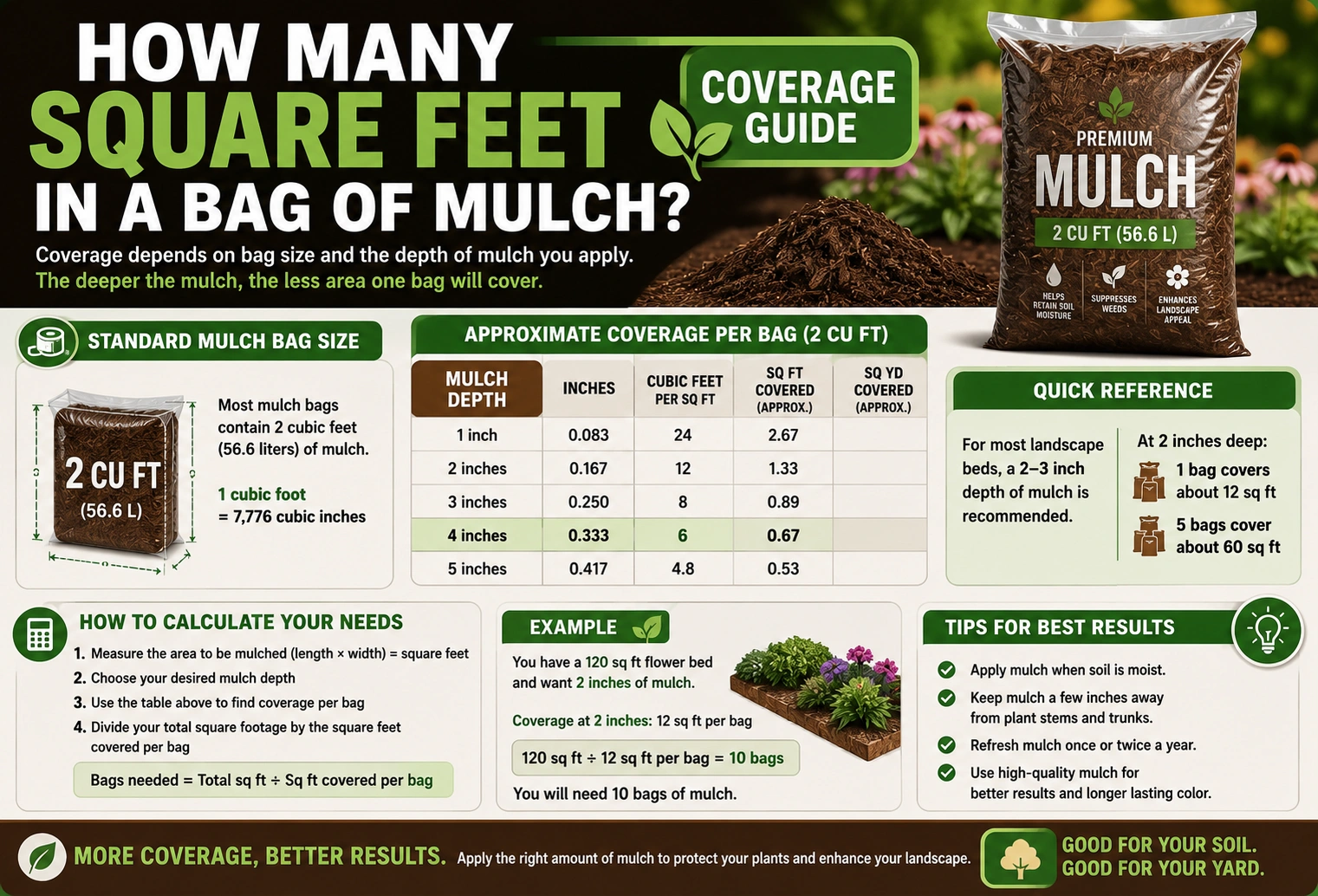
For example, a standard 2 cubic foot bag of mulch covers about 12 square feet at a 2-inch depth or around 8 square feet at a 3-inch depth.
In this guide, you’ll learn exactly how mulch coverage works, how to calculate the number of bags you need, and practical tips for achieving professional landscaping results.
Understanding Mulch Coverage
Mulch is sold by volume, not by area.
Most bags are labeled in cubic feet, while your flower beds or landscaping areas are measured in square feet.
Because mulch has thickness, the area it covers changes depending on how deep you spread it.
Think of pouring sand into a box:
- A thin layer covers more surface.
- A thick layer covers less.
The same principle applies to mulch.
How Many Square Feet Does a Bag of Mulch Cover?
Here are the approximate coverage amounts for common bag sizes.
| Bag Size | 2-inch Depth | 3-inch Depth | 4-inch Depth |
|---|---|---|---|
| 1 Cubic Foot | 6 sq ft | 4 sq ft | 3 sq ft |
| 1.5 Cubic Feet | 9 sq ft | 6 sq ft | 4.5 sq ft |
| 2 Cubic Feet | 12 sq ft | 8 sq ft | 6 sq ft |
| 3 Cubic Feet | 18 sq ft | 12 sq ft | 9 sq ft |
Most homeowners buy 2 cubic foot bags, making these the standard coverage estimates.
Mulch Coverage Chart by Bag Size
Use this quick reference when shopping.
| Bag Size | Approximate Coverage |
|---|---|
| 1 cu ft | 6–12 sq ft |
| 1.5 cu ft | 9–18 sq ft |
| 2 cu ft | 12–24 sq ft |
| 3 cu ft | 18–36 sq ft |
The larger coverage numbers assume a thinner layer, while the smaller numbers represent thicker applications.
Coverage by Recommended Mulch Depth
Depth has the biggest impact on mulch coverage.
1 Inch
- Decorative applications
- Covers the largest area
- Doesn’t suppress weeds well
2 Inches
Recommended for:
- Annual flowers
- Vegetable gardens
- Light landscaping
Coverage:
A 2 cubic foot bag covers about 12 square feet.
3 Inches
This is the most common landscaping depth.
Benefits include:
- Weed control
- Moisture retention
- Attractive appearance
- Temperature regulation
Coverage:
A 2 cubic foot bag covers approximately 8 square feet.
4 Inches
Useful for:
- Playground areas
- High-traffic landscaping
- Sloped areas
Coverage decreases to roughly 6 square feet per 2 cubic foot bag.
How to Calculate How Much Mulch You Need
Calculating mulch is simple.
Step 1: Measure Length
Measure the length of your flower bed.
Example:
20 feet
Step 2: Measure Width
Example:
10 feet
Step 3: Calculate Area
Multiply:
20 × 10 = 200 square feet
Step 4: Decide Mulch Depth
Choose:
- 2 inches
- 3 inches
- 4 inches
Three inches is usually ideal.
Step 5: Divide by Coverage
For 2 cubic foot bags at 3 inches:
200 ÷ 8 = 25 bags
Always round up.
Mulch Coverage Examples
Example 1
Garden:
100 square feet
Desired depth:
2 inches
Coverage:
12 sq ft per bag
100 ÷ 12 = 8.3
You’ll need 9 bags.
Example 2
Flower bed:
150 square feet
Depth:
3 inches
Coverage:
8 sq ft
150 ÷ 8 = 18.75
You’ll need 19 bags.
Example 3
Large landscape
300 square feet
Depth:
2 inches
Coverage:
12 sq ft
300 ÷ 12 = 25
Purchase 25 bags.
Example 4
Playground
500 square feet
Depth:
4 inches
Coverage:
6 sq ft
500 ÷ 6 = 83.3
Buy 84 bags.
Quick Reference Chart
| Landscape Size | Bags Needed (2 cu ft at 2″) | Bags Needed (2 cu ft at 3″) |
|---|---|---|
| 50 sq ft | 5 | 7 |
| 100 sq ft | 9 | 13 |
| 150 sq ft | 13 | 19 |
| 200 sq ft | 17 | 25 |
| 250 sq ft | 21 | 32 |
| 300 sq ft | 25 | 38 |
| 500 sq ft | 42 | 63 |
Factors That Affect Mulch Coverage
Several factors influence the actual coverage you get.
Mulch Type
Different mulch materials settle differently.
Examples include:
- Hardwood mulch
- Pine bark
- Cedar mulch
- Rubber mulch
- Compost mulch
Some compact more than others.
Settling
Fresh mulch often settles after watering.
This reduces its thickness over time.
Uneven Ground
Slopes and rough terrain require extra mulch.
Expect to buy 5–10% more.
Waste
Some mulch stays in the bag or spills during installation.
Adding one or two extra bags prevents shortages.
Benefits of Applying the Right Amount of Mulch
Using the proper depth offers several advantages.
Better Weed Control
A 2–3 inch layer blocks sunlight, making it harder for weeds to grow.
Improved Moisture Retention
Mulch slows evaporation.
Plants need less frequent watering.
Soil Temperature Protection
Mulch keeps roots cooler during summer and warmer in winter.
Reduced Soil Erosion
Rainwater doesn’t wash soil away as easily.
Healthier Plants
Proper mulching encourages stronger root systems and healthier growth.
Common Mulching Mistakes to Avoid
Applying Too Much
More than 4 inches can:
- Suffocate roots
- Trap moisture
- Encourage disease
Applying Too Little
A thin layer won’t:
- Stop weeds
- Hold moisture
- Protect soil
Mulching Against Tree Trunks
Avoid creating “mulch volcanoes.”
Keep mulch 3–6 inches away from trunks.
Ignoring Existing Mulch
Measure the current mulch before adding more.
Often, you only need to top it off.
Forgetting to Measure
Guessing usually leads to buying too many—or too few—bags.
Measure first.
Expert Tips for Buying Mulch
Buy All Bags Together
Color can vary between manufacturing batches.
Buying everything at once keeps your landscape looking consistent.
Compare Price Per Cubic Foot
A larger bag may cost slightly more but provide better value.
Always compare cost by volume rather than bag count.
Purchase Extra
Buying 5–10% more mulch helps cover:
- Spills
- Settling
- Uneven terrain
- Future touch-ups
Choose the Right Type
- Hardwood mulch lasts longer.
- Pine bark has a natural look.
- Cedar mulch offers a pleasant scent and insect resistance.
- Dyed mulch provides long-lasting color.
Install on Weed-Free Soil
Remove weeds before spreading mulch for the best results.
9. Frequently Asked Questions
1. How many square feet does a 2 cubic foot bag of mulch cover?
A 2 cubic foot bag covers approximately 12 square feet at a 2-inch depth or 8 square feet at a 3-inch depth.
2. How many bags of mulch do I need for 100 square feet?
You’ll need about 9 bags at a 2-inch depth or 13 bags at a 3-inch depth when using 2 cubic foot bags.
3. What is the best mulch depth?
For most flower beds and landscaping, 2–3 inches provides excellent weed control, moisture retention, and soil protection.
4. Is it cheaper to buy mulch in bulk?
Yes. Bulk mulch is usually more economical for large landscaping projects, while bagged mulch is more convenient for smaller areas.
5. How often should mulch be replaced?
Most organic mulches should be refreshed every 1–2 years, depending on weather, decomposition, and appearance.
10. Conclusion
Knowing how many square feet in a bag of mulch helps you plan your landscaping project accurately, avoid unnecessary expenses, and achieve a polished, healthy garden.
For most homeowners, a 2 cubic foot bag of mulch covers about 12 square feet at a 2-inch depth or 8 square feet at a 3-inch depth. By measuring your landscape carefully, selecting the right mulch depth, and using the coverage charts in this guide, you can estimate the exact number of bags you’ll need with confidence.
Whether you’re refreshing flower beds, protecting trees, or improving curb appeal, applying mulch at the proper depth delivers lasting benefits—from better moisture retention and weed suppression to healthier soil and more attractive landscaping. With a little planning, your next mulching project can be both efficient and cost-effective.
Discover More Articles
How Many Square Feet Will a 4 Ton AC Cool? Size Guide