
If you’ve ever watched a baseball game or helped set up a field, you may have wondered how many feet is the pitcher’s mound from home plate. This measurement is one of the most important dimensions in baseball because it directly affects pitching speed, player safety, and the overall balance between pitchers and hitters.
The official answer for professional baseball is:
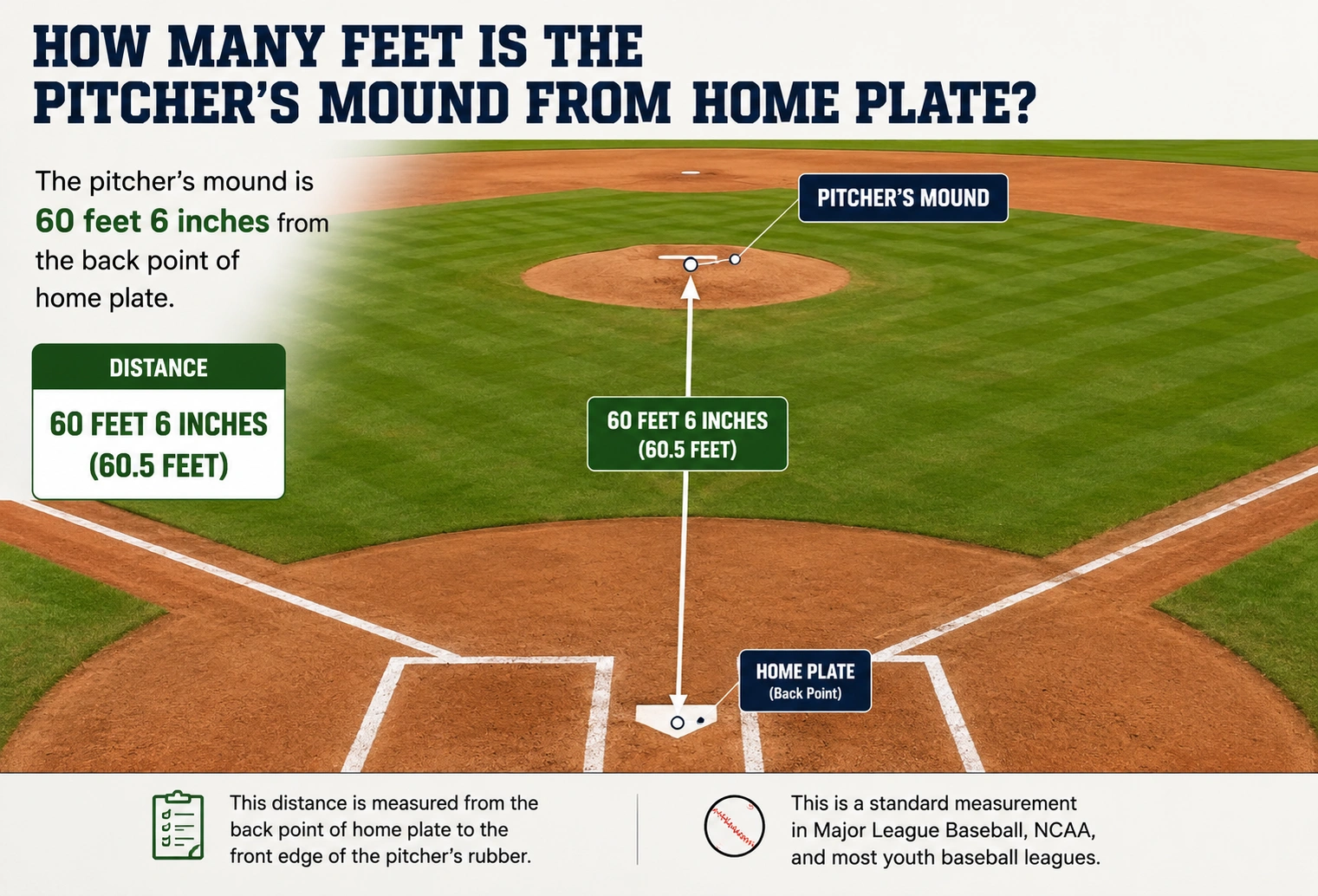
The pitcher’s mound is 60 feet 6 inches (60.5 feet) from home plate.
More precisely, the distance is measured from the front edge of the pitching rubber to the rear point of home plate.
This standard is used in Major League Baseball (MLB), college baseball, and most high school leagues. Younger age groups use shorter distances that are appropriate for developing players.
In this guide, you’ll learn how the distance is measured, why it was chosen, and how pitching distances vary across different baseball leagues.
Quick Answer
| League | Distance From Pitching Rubber to Home Plate |
|---|---|
| MLB | 60 ft 6 in (18.44 m) |
| College Baseball | 60 ft 6 in |
| High School Baseball | 60 ft 6 in |
| Little League (Majors) | 46 ft |
| Intermediate (50/70 Division) | 50 ft |
| Pony Baseball (13–14) | 54 ft |
Official professional baseball uses a pitching distance of 60 feet 6 inches.
Official MLB Pitching Distance
Professional baseball follows a standardized field layout.
The official distance is:
- 60 feet 6 inches
- 18.44 meters
This measurement has remained the professional standard for well over a century and is used in:
- Major League Baseball
- NCAA college baseball
- Most high school baseball associations
- Adult amateur leagues
The consistent distance ensures fairness and allows players to compete under the same conditions.
How the Distance Is Measured
Many people assume the measurement starts from the center of the mound, but that’s incorrect.
The official measurement is taken:
- From the front edge of the pitching rubber
- To the rear point (back tip) of home plate
Because the pitching rubber sits on top of the mound, the mound itself is larger than the measured pitching distance.
Understanding the Pitcher’s Mound
The pitcher’s mound is a raised area located near the center of the infield.
Standard MLB mound specifications include:
| Feature | Official Measurement |
|---|---|
| Distance to Home Plate | 60 ft 6 in |
| Height Above Home Plate | 10 inches |
| Mound Diameter | 18 feet |
| Pitching Rubber Width | 24 inches |
| Pitching Rubber Depth | 6 inches |
These dimensions are carefully regulated to ensure consistent playing conditions.
Pitching Distances by League
Different age groups use different pitching distances to match players’ strength and skill levels.
| League | Pitching Distance |
|---|---|
| Tee Ball | 35–40 ft |
| Coach Pitch | 35–40 ft |
| Little League Majors | 46 ft |
| Intermediate (50/70) | 50 ft |
| Pony Baseball | 54 ft |
| High School | 60 ft 6 in |
| College | 60 ft 6 in |
| MLB | 60 ft 6 in |
Shorter distances help younger athletes develop proper mechanics before transitioning to the full regulation distance.
Why Is the Distance 60 Feet 6 Inches?
The current pitching distance was adopted in 1893, replacing the earlier 50-foot pitching box used in professional baseball.
The change was introduced because pitchers had become increasingly dominant, making it difficult for batters to hit effectively. Moving the pitching rubber farther from home plate gave hitters more reaction time and created a better balance between offense and defense.
More than a century later, 60 feet 6 inches remains one of the defining measurements in baseball.
Real-World Comparisons
Visualizing 60 feet 6 inches is easier when compared to familiar objects.
A distance of about 60½ feet is roughly equal to:
- The length of three standard midsize cars parked end to end
- About ten average adult body lengths
- Slightly longer than the length of a full-size semi-trailer without the tractor cab
- Approximately the width of a small residential lot frontage in some neighborhoods
These comparisons help illustrate the challenge hitters face when reacting to pitches that may exceed 90 mph.
Why the Pitching Distance Matters
The regulation distance influences nearly every aspect of the game.
Pitch Speed
Professional pitchers can throw fastballs exceeding 95 mph, giving batters only fractions of a second to react.
Player Safety
Proper field dimensions reduce the risk of injuries caused by overly short pitching distances.
Fair Competition
A standardized distance allows players and teams to compete under equal conditions.
Skill Development
Youth leagues gradually increase pitching distances as players grow stronger and improve their mechanics.
Common Measurement Mistakes
Measuring From the Center of the Mound
The official measurement starts at the front edge of the pitching rubber, not the center of the mound.
Measuring to the Front of Home Plate
The correct endpoint is the rear point of home plate, not the front edge.
Using Approximate Measurements
Even small errors can affect gameplay, especially on competitive fields.
Confusing Baseball With Softball
Softball uses different pitching distances depending on the level of play, so the measurements are not interchangeable.
Expert Tips for Field Setup
- Use a long measuring tape designed for sports field layouts.
- Measure twice before installing the pitching rubber.
- Ensure the mound height meets league regulations.
- Keep the pitching rubber level and securely anchored.
- Refer to your league’s official rulebook before building or renovating a field.
Baseball Field Measurement Summary
| Feature | Official MLB Measurement |
|---|---|
| Pitching Distance | 60 ft 6 in |
| Base Paths | 90 ft |
| Home Plate Width | 17 in |
| Mound Height | 10 in |
| Mound Diameter | 18 ft |
9. Frequently Asked Questions
1. How many feet is the pitcher’s mound from home plate?
In professional baseball, the pitching distance is 60 feet 6 inches, measured from the front edge of the pitching rubber to the rear point of home plate.
2. Why is the pitching distance 60 feet 6 inches?
The distance was established in 1893 to create a better balance between pitchers and hitters, and it remains the official standard today.
3. Is the distance the same in high school baseball?
Yes. Most high school baseball leagues use the same 60 feet 6 inches pitching distance as college and professional baseball.
4. How far is the mound in Little League?
The standard Little League (Majors Division) pitching distance is 46 feet.
5. Is the mound measured from its center?
No. The official measurement begins at the front edge of the pitching rubber, not the center of the mound.
10. Conclusion
Knowing how many feet is the pitcher’s mound from home plate is essential for understanding baseball field dimensions and setting up a regulation field. In Major League Baseball, college baseball, and most high school leagues, the official pitching distance is 60 feet 6 inches, measured from the front edge of the pitching rubber to the rear point of home plate.
Younger leagues use shorter distances to match players’ age and skill level, but the principles remain the same. Whether you’re coaching, building a baseball field, or simply learning more about the sport, understanding this iconic measurement provides valuable insight into one of baseball’s most important rules.
Discover More Articles
How Many Square Feet Is 8 x 12? Easy Area Calculation Guide