
If you’re planning a move, renting a storage unit, or estimating shipping space, you may be wondering how many cubic feet is a queen mattress. The answer depends on one key measurement: the mattress thickness.
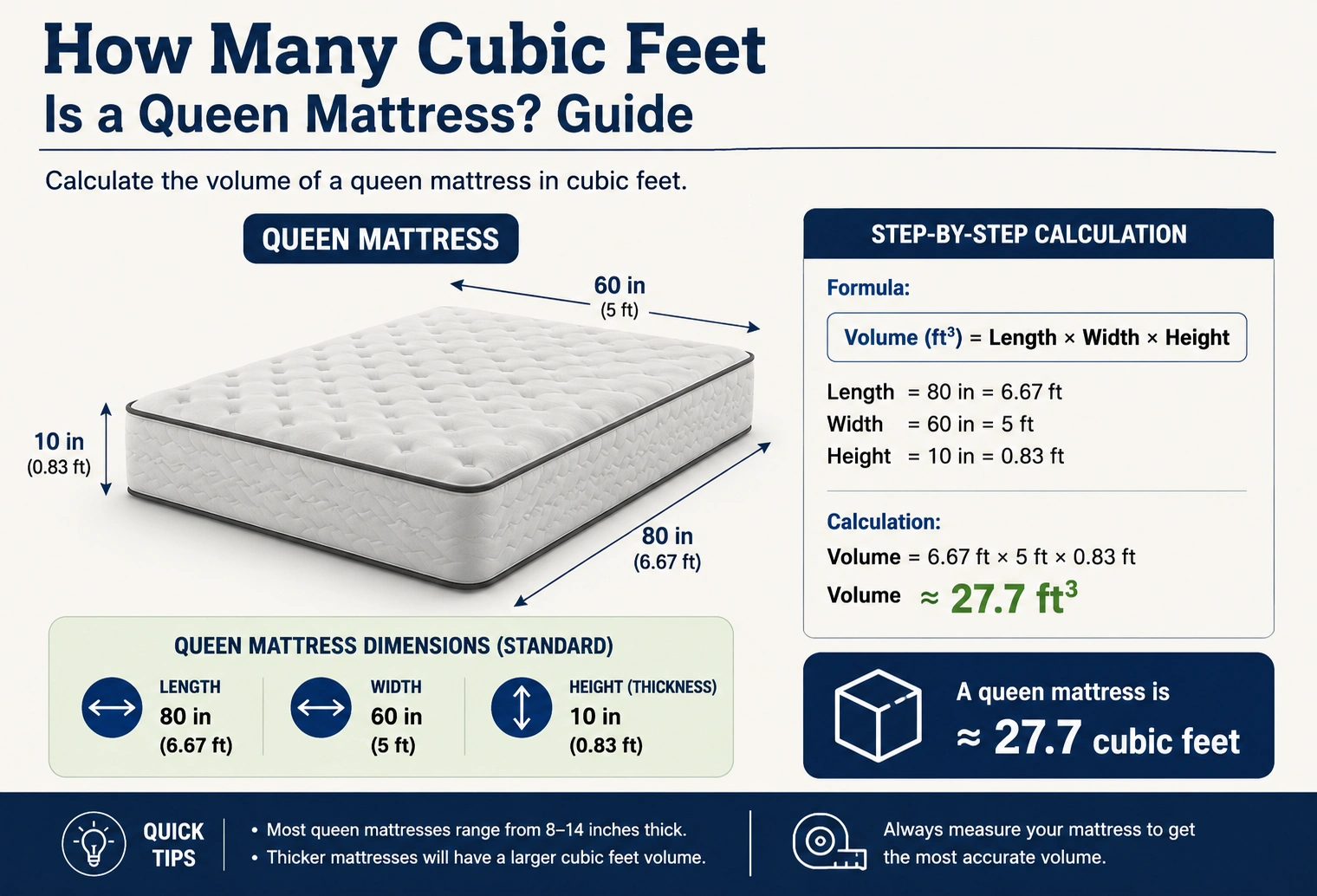
A standard queen mattress measures 60 inches wide by 80 inches long. The thickness varies by manufacturer and mattress type, usually ranging from 8 to 16 inches.
For a common 12-inch-thick queen mattress, the volume is:
- 60 × 80 × 12 = 57,600 cubic inches
- 57,600 ÷ 1,728 = approximately 33.3 cubic feet
So, a standard queen mattress is typically 22 to 44 cubic feet, with about 33 cubic feet being the most common.
This guide explains how to calculate mattress volume, compare different thicknesses, and estimate storage or moving space.
Quick Answer
Here are the approximate cubic feet for common queen mattress thicknesses.
| Mattress Thickness | Approximate Cubic Feet |
|---|---|
| 8 inches | 22.2 cu ft |
| 10 inches | 27.8 cu ft |
| 12 inches | 33.3 cu ft |
| 14 inches | 38.9 cu ft |
| 16 inches | 44.4 cu ft |
Most standard queen mattresses occupy approximately 33 cubic feet.
Standard Queen Mattress Dimensions
A standard queen mattress has the following measurements:
| Dimension | Size |
|---|---|
| Width | 60 inches (5 ft) |
| Length | 80 inches (6 ft 8 in) |
| Typical Thickness | 8–16 inches |
While the width and length remain standard, the thickness varies depending on the mattress design.
How to Calculate Cubic Feet
Volume is calculated using three measurements:
- Length
- Width
- Height (Thickness)
Formula
Volume (cubic feet) = Length × Width × Height ÷ 1,728
(There are 1,728 cubic inches in one cubic foot.)
Example
For a queen mattress measuring:
- Length: 80 inches
- Width: 60 inches
- Thickness: 12 inches
Calculation:
80 × 60 × 12 = 57,600 cubic inches
57,600 ÷ 1,728 = 33.3 cubic feet
Queen Mattress Volume Chart by Thickness
The thickness has the greatest effect on volume.
| Thickness | Cubic Inches | Cubic Feet |
|---|---|---|
| 8 in | 38,400 | 22.2 |
| 10 in | 48,000 | 27.8 |
| 12 in | 57,600 | 33.3 |
| 14 in | 67,200 | 38.9 |
| 16 in | 76,800 | 44.4 |
This chart is useful when comparing foam, hybrid, and innerspring mattresses.
Why Mattress Thickness Matters
Two queen mattresses can have the same width and length but very different volumes.
Foam Mattresses
Many foam mattresses range from 8 to 12 inches thick, resulting in a smaller overall volume.
Hybrid Mattresses
Hybrid models are commonly 12 to 14 inches thick and take up more storage space.
Luxury Mattresses
Premium pillow-top mattresses may be 15 to 16 inches thick, increasing the cubic footage significantly.
Real-World Examples
Example 1: Moving Truck
A queen mattress with a volume of about 33 cubic feet fits easily inside most moving trucks, but it should be secured upright whenever possible to maximize space.
Example 2: Storage Unit
A 5×10-foot storage unit can usually accommodate a queen mattress along with several boxes and small furniture items, depending on how everything is arranged.
Example 3: Shipping Estimate
Freight companies often calculate shipping costs based on the mattress dimensions and cubic volume, especially for mattresses that are not compressed.
Example 4: Mattress-in-a-Box
Many memory foam mattresses are compressed and rolled for shipping, greatly reducing the shipping volume. Once unboxed, they expand to their full dimensions.
Storage and Moving Considerations
Knowing the cubic footage helps you plan more efficiently.
Renting a Storage Unit
Estimate the combined volume of all furniture to choose the right storage size.
Loading a Moving Truck
Place the mattress upright against a wall when possible to save floor space.
Protecting the Mattress
Use a waterproof mattress bag during transport to guard against dirt, moisture, and tears.
Factors That Affect Mattress Volume
Several factors influence the total cubic footage.
- Mattress thickness
- Pillow-top layers
- Foam density
- Protective covers
- Compression during shipping
Remember that compressed mattresses occupy much less space temporarily but return to their original size after opening.
Common Mistakes When Calculating Volume
Forgetting to Include Thickness
Volume requires three dimensions. Using only length and width calculates area, not volume.
Mixing Units
Keep all measurements in inches before converting to cubic feet.
Ignoring Packaging
Shipping cartons and protective materials increase the total space required.
Assuming All Queen Mattresses Are the Same
While width and length are standardized, thickness varies considerably.
Expert Tips
- Measure your mattress yourself before arranging transportation or storage.
- Confirm thickness with the manufacturer if you’re ordering online.
- Add extra space when estimating moving truck capacity.
- Store mattresses flat whenever recommended by the manufacturer to avoid damage.
- Use compressed packaging only if it is approved for your mattress type.
Queen Mattress Dimension Summary
| Feature | Standard Size |
|---|---|
| Width | 60 inches |
| Length | 80 inches |
| Typical Thickness | 8–16 inches |
| Average Volume | 22–44 cubic feet |
| Most Common Volume | Approximately 33 cubic feet |
9. Frequently Asked Questions
1. How many cubic feet is a queen mattress?
A standard queen mattress typically ranges from 22 to 44 cubic feet, depending on its thickness. A 12-inch-thick queen mattress is approximately 33.3 cubic feet.
2. What are the dimensions of a queen mattress?
A standard queen mattress measures 60 inches wide by 80 inches long. Thickness usually ranges from 8 to 16 inches.
3. Does mattress thickness affect cubic feet?
Yes. Thicker mattresses have a greater volume, even though the width and length remain the same.
4. How do I calculate the volume of my mattress?
Multiply the length × width × thickness (in inches), then divide by 1,728 to convert cubic inches into cubic feet.
5. Why do I need to know the cubic feet of a mattress?
Knowing the volume helps when planning moving, shipping, storage, freight estimates, or selecting the right storage unit.
10. Conclusion
Understanding how many cubic feet is a queen mattress is helpful when moving, storing, or shipping your bed. A standard queen mattress measures 60 inches by 80 inches, and its volume depends primarily on thickness. Most queen mattresses range from 22 to 44 cubic feet, with a 12-inch model occupying approximately 33.3 cubic feet.
By measuring your mattress accurately and using the simple volume formula, you can estimate storage requirements, compare mattress sizes, and plan transportation with confidence. Whether you’re purchasing a new mattress or organizing a move, knowing its cubic footage makes planning easier and more efficient.
Discover More Articles
How Many Square Feet Is 8 x 12? Easy Area Calculation Guide