

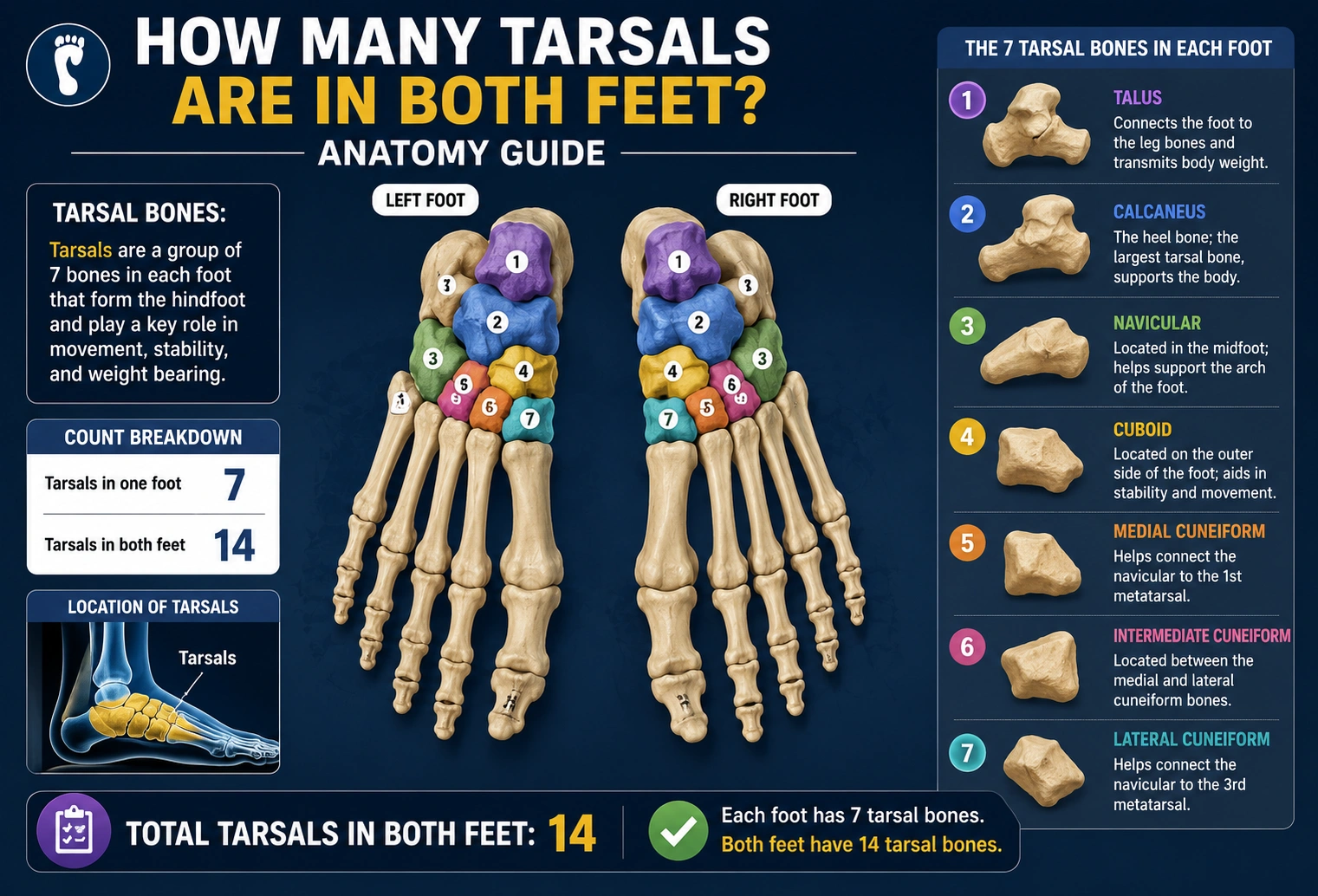
There are 14 tarsal bones in both feet combined.
Each foot contains 7 tarsal bones, so:
7 + 7 = 14 tarsals
The tarsal bones are located primarily in the back and middle portions of the foot and connect the lower leg and ankle region with the metatarsal bones farther forward in the foot.
Quick Answer
| Location | Number of Tarsal Bones |
|---|---|
| Right foot | 7 |
| Left foot | 7 |
| Both feet | 14 |
So, if you are asking how many tarsals are in both feet, the answer is 14.
How Many Tarsals Are in One Foot?
Each human foot has 7 tarsal bones.
The seven are:
- Talus
- Calcaneus
- Navicular
- Cuboid
- Medial cuneiform
- Intermediate cuneiform
- Lateral cuneiform
Because the left and right feet each contain the same basic set of seven tarsal bones, the total is:
7 × 2 = 14
What Are the 7 Tarsal Bones?
The tarsals can be grouped according to their location within the foot.
| Tarsal Bone | General Location | Main Role |
| Talus | Upper rear foot | Connects foot with lower leg |
| Calcaneus | Heel | Forms the heel and bears weight |
| Navicular | Midfoot | Helps form the medial arch |
| Cuboid | Outer midfoot | Supports the lateral side |
| Medial cuneiform | Inner midfoot | Supports the medial foot |
| Intermediate cuneiform | Central midfoot | Helps connect to the second metatarsal |
| Lateral cuneiform | Outer midfoot | Connects with the third metatarsal |
These seven bones work together to provide stability, support, and movement.
Where Are the Tarsal Bones Located?
The tarsal bones are found in the hindfoot and midfoot.
The talus and calcaneus are located toward the rear of the foot.
The navicular, cuboid, and three cuneiform bones are positioned farther forward in the midfoot.
Together, the tarsals form important joints and help create the arches of the foot.
What Does the Talus Do?
The talus is one of the most important bones in the ankle region.
It sits between the lower leg bones and the other bones of the foot.
The talus helps transfer body weight from the lower leg into the foot and participates in ankle and foot movement.
Unlike many other bones, the talus has no direct muscle attachment.
What Does the Calcaneus Do?
The calcaneus is the heel bone and is the largest tarsal bone.
It helps support body weight and provides an attachment point for the Achilles tendon.
The calcaneus also plays an important role in walking, running, jumping, and other weight-bearing activities.
What Is the Navicular Bone?
The navicular is a boat-shaped bone located in the middle of the foot.
It sits between the talus and the cuneiform bones.
The navicular contributes to the structure of the medial longitudinal arch of the foot.
What Is the Cuboid Bone?
The cuboid is located on the outer side of the midfoot.
It connects with the calcaneus toward the back and the fourth and fifth metatarsals toward the front.
The cuboid contributes to the stability of the lateral side of the foot.
What Are the Cuneiform Bones?
There are three cuneiform bones:
- Medial cuneiform
- Intermediate cuneiform
- Lateral cuneiform
They are located between the navicular and the first three metatarsals.
The three cuneiforms help connect the midfoot with the front portion of the foot and contribute to the arches and overall stability of the foot.
Tarsals vs. Metatarsals
Tarsals and metatarsals are both bones of the foot, but they occupy different regions.
| Feature | Tarsals | Metatarsals |
| Number in each foot | 7 | 5 |
| Location | Rear and middle foot | Front/middle foot |
| Both feet | 14 | 10 |
| Includes | Talus, calcaneus, navicular, cuboid, cuneiforms | Five numbered metatarsals |
| Main role | Ankle connection, support, movement | Supports and connects to toes |
The metatarsals are located between the tarsal bones and the toe bones, called phalanges.
How Many Bones Are in Both Feet?
Each foot contains 26 bones.
Therefore:
26 × 2 = 52 bones
The 26 bones in one foot include:
- 7 tarsals
- 5 metatarsals
- 14 phalanges
For both feet:
| Bone Group | One Foot | Both Feet |
| Tarsals | 7 | 14 |
| Metatarsals | 5 | 10 |
| Phalanges | 14 | 28 |
| Total | 26 | 52 |
This means the 14 tarsals make up part of the 52 bones found in both feet.
Why Are Tarsal Bones Important?
Tarsal bones provide a combination of stability and mobility.
They help the foot:
- Support body weight
- Absorb forces during walking
- Maintain its arches
- Transfer forces between the leg and foot
- Adapt to different surfaces
- Participate in ankle and foot movement
The arrangement of the tarsal bones allows the foot to be both strong enough for weight bearing and flexible enough for movement.
Are Tarsals Part of the Ankle?
Some tarsal bones are directly involved in the ankle joint.
The talus is particularly important because it connects with the tibia and fibula to form the ankle joint.
However, the tarsal bones extend beyond the ankle into the midfoot, so not all tarsals are part of the ankle joint itself.
Frequently Asked Questions
How many tarsals are in both feet?
There are 14 tarsal bones in both feet, with 7 in each foot.
How many tarsals are in one foot?
There are 7 tarsal bones in each foot.
What are the seven tarsal bones?
The seven tarsals are the talus, calcaneus, navicular, cuboid, medial cuneiform, intermediate cuneiform, and lateral cuneiform.
How many bones are in both feet?
There are 52 bones in both feet combined, with 26 bones in each foot.
How many metatarsals are in both feet?
There are 10 metatarsals in both feet, with 5 in each foot.
How many phalanges are in both feet?
There are 28 phalanges in both feet, with 14 in each foot.
Is the heel a tarsal bone?
The heel bone is the calcaneus, and it is one of the seven tarsal bones in each foot.
Is the talus a tarsal?
Yes. The talus is one of the seven tarsal bones in each foot and is an important part of the ankle joint.
Conclusion
So, how many tarsals are in both feet?
There are 14 tarsal bones in both feet combined.
Each foot contains 7 tarsals:
- Talus
- Calcaneus
- Navicular
- Cuboid
- Medial cuneiform
- Intermediate cuneiform
- Lateral cuneiform
The calculation is simple:
7 tarsals per foot × 2 feet = 14 tarsals
The tarsals form the rear and middle portions of the foot and help provide weight support, stability, arch structure, and movement. Together with the metatarsals and phalanges, they make up the 52 bones found in both human feet.
Discover More Articles
How Many Tons for 1,600 Square Feet? AC Size Guide