

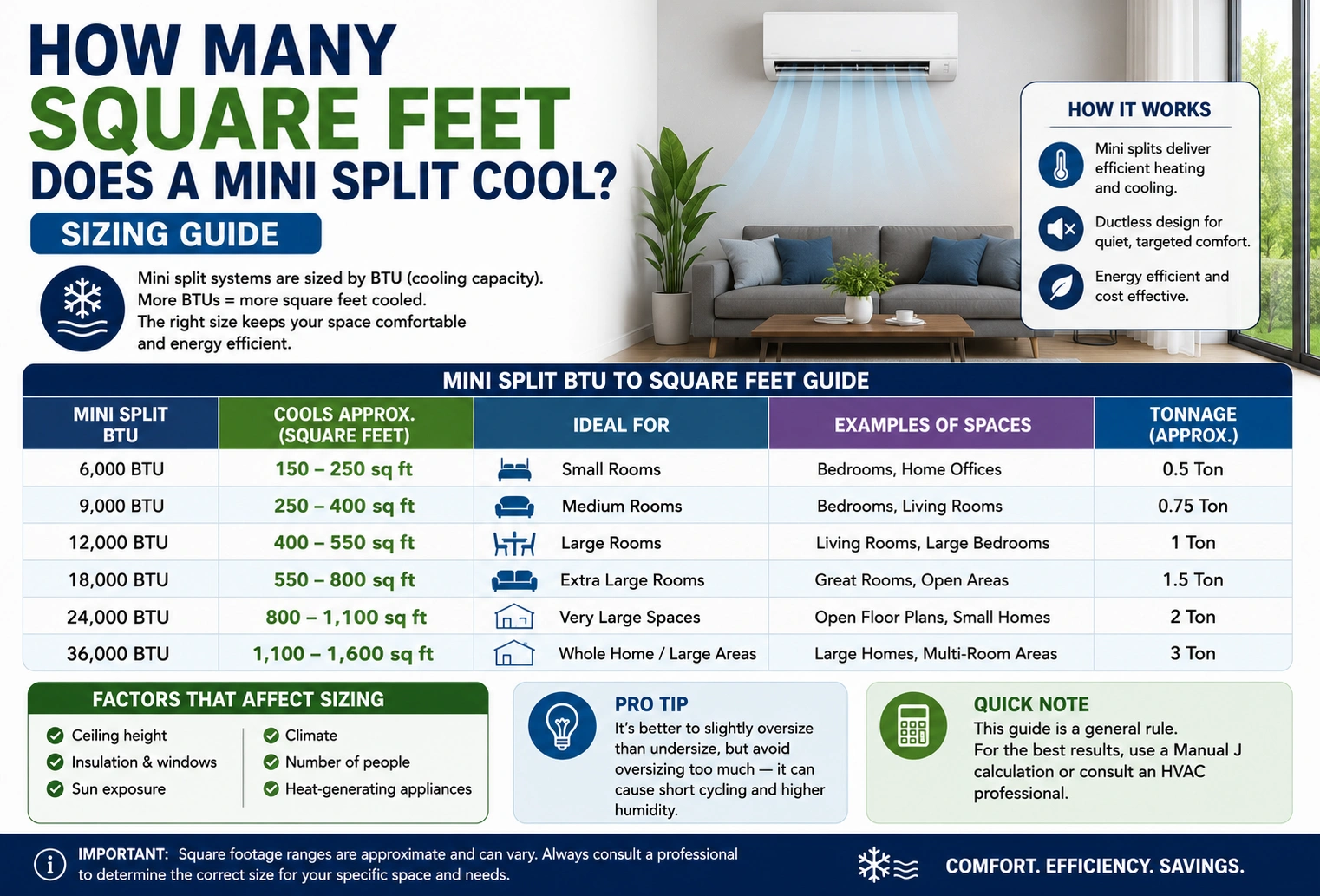
So, how many square feet does a mini split cool? It depends mainly on the mini split’s BTU capacity, room conditions, insulation, ceiling height, windows, and local climate.
As a general starting point, a mini split may cool approximately:
| Mini Split Capacity | Approximate Area |
|---|---|
| 6,000 BTU | 150–250 sq ft |
| 9,000 BTU | 250–400 sq ft |
| 12,000 BTU | 400–600 sq ft |
| 18,000 BTU | 600–900 sq ft |
| 24,000 BTU | 900–1,200 sq ft |
| 30,000 BTU | 1,200–1,500 sq ft |
| 36,000 BTU | 1,500–1,800+ sq ft |
These are general estimates, not universal sizing rules. A well-insulated room in a mild climate can require less capacity, while a poorly insulated space with high sun exposure may require more.
For the most accurate result, the home’s actual cooling load should be calculated.
What Is a Mini Split?
A mini split is a ductless heating and cooling system that typically consists of an outdoor condenser and one or more indoor air-handling units.
Unlike a central air conditioner, a ductless mini split does not need a traditional network of supply and return ducts throughout the building.
This makes mini splits useful for:
- Bedrooms
- Home additions
- Garages
- Offices
- Workshops
- Apartments
- Finished basements
- Sunrooms
- Small homes
The cooling capacity of a mini split is commonly measured in BTUs per hour, or BTU/h.
BTU stands for British thermal unit and is used to describe the system’s heating or cooling capacity.
How Many Square Feet Does a Mini Split Cool?
There is no single square-foot number for every mini split.
Instead, the approximate cooling area depends on the unit’s capacity.
For example, a 9,000-BTU system may be appropriate for a smaller space, while a 24,000-BTU system can generally handle a substantially larger area under suitable conditions.
However, simply matching BTUs to square footage can sometimes result in an incorrectly sized system.
A room’s heat gain matters too.
Mini Split BTU and Square Footage Chart
The following chart provides a useful starting point.
| BTU Capacity | Approximate Cooling Area |
|---|---|
| 6,000 BTU | 150–250 sq ft |
| 9,000 BTU | 250–400 sq ft |
| 12,000 BTU | 400–600 sq ft |
| 15,000 BTU | 500–750 sq ft |
| 18,000 BTU | 600–900 sq ft |
| 24,000 BTU | 900–1,200 sq ft |
| 30,000 BTU | 1,200–1,500 sq ft |
| 36,000 BTU | 1,500–1,800+ sq ft |
These ranges should be used for initial planning only.
Manufacturers may specify different recommended room sizes for their particular models.
How Many Square Feet Does a 9,000 BTU Mini Split Cool?
A 9,000-BTU mini split may cool approximately 250–400 square feet in many typical applications.
For example, it could potentially be suitable for:
- A bedroom
- Small studio
- Home office
- Small living area
- Finished room
However, the actual cooling area depends on the room’s heat load.
A 300-square-foot heavily insulated room may have very different requirements from a 300-square-foot room with large south-facing windows and poor insulation.
How Many Square Feet Does a 12,000 BTU Mini Split Cool?
A 12,000-BTU mini split can often serve approximately 400–600 square feet under typical conditions.
For example, a 500-square-foot open room may fall within this general range.
But room configuration matters.
A single open 500-square-foot space is different from five separate rooms totaling 500 square feet.
Air from one indoor unit does not necessarily distribute evenly through multiple enclosed rooms.
How Many Square Feet Does an 18,000 BTU Mini Split Cool?
An 18,000-BTU mini split can generally serve around 600–900 square feet as a broad estimate.
This capacity may be considered for spaces such as:
- Large living areas
- Open-plan rooms
- Larger apartments
- Workshops
- Garages
The actual recommendation depends on the building envelope, climate, ceiling height, and other heat-load factors.
How Many Square Feet Does a 24,000 BTU Mini Split Cool?
A 24,000-BTU mini split may cool approximately 900–1,200 square feet under suitable conditions.
For example, an open 1,000-square-foot area could potentially fall within this range.
However, a 1,000-square-foot building divided into several bedrooms may be better served by a multi-zone system with multiple indoor units.
How Many Square Feet Does a 30,000 BTU Mini Split Cool?
A 30,000-BTU system can often be considered for approximately 1,200–1,500 square feet, depending on the cooling load.
Larger capacities may be useful for:
- Large open spaces
- Workshops
- Large additions
- Homes with substantial cooling requirements
However, bigger is not always better.
Oversizing a system can cause short cycling, which may reduce comfort and affect humidity control.
How Climate Affects Mini Split Sizing
Climate is one of the most important factors in air-conditioner sizing.
A room in a mild climate may need less cooling capacity than the same room in a very hot climate.
Two homes with exactly the same floor area can therefore require different mini splits.
Climate affects:
- Outdoor temperature
- Heat entering through walls
- Roof heat gain
- Cooling demand
- Indoor comfort
- System runtime
This is why square footage should only be the starting point.
How Insulation Affects Cooling Requirements
Insulation helps slow the movement of heat into a building.
A well-insulated room may require less cooling capacity than a poorly insulated room of the same size.
Consider two 600-square-foot spaces:
| Feature | Space A | Space B |
|---|---|---|
| Area | 600 sq ft | 600 sq ft |
| Insulation | Good | Poor |
| Windows | Few | Many |
| Sun exposure | Low | High |
| Cooling requirement | Lower | Higher |
The same mini split may perform very differently in these two spaces.
Windows and Sun Exposure Matter
Windows can contribute significant heat gain.
Large windows that receive direct sunlight may increase cooling requirements.
Important factors include:
- Number of windows
- Window size
- Glass type
- Window orientation
- Exterior shading
- Curtains or blinds
A room with large sun-facing windows may need more cooling capacity than a room of the same size with limited window area.
Ceiling Height Matters Too
Square footage only measures floor area.
It does not tell you how much air is inside the room.
For example:
20 × 20 feet = 400 square feet
But a room with an 8-foot ceiling contains much less air volume than the same 400-square-foot room with a 14-foot ceiling.
Higher ceilings can increase the cooling load and affect how air circulates.
One Mini Split vs. Multiple Indoor Units
A single mini split is often effective in an open space.
However, multiple indoor units may be better for buildings with separate rooms.
For example, imagine a home with:
- 500 sq ft living room
- 200 sq ft bedroom
- 150 sq ft bedroom
- 150 sq ft office
The total is:
500 + 200 + 150 + 150 = 1,000 square feet
A single large indoor unit might not distribute air effectively to every enclosed room.
A multi-zone mini split could provide separate indoor units for different areas.
Open Floor Plan vs. Multiple Rooms
This is an important distinction.
A 1,000-square-foot open room can be easier to cool with one indoor unit than a 1,000-square-foot home divided into several rooms.
Air movement is restricted by:
- Walls
- Doors
- Hallways
- Furniture
- Room orientation
Therefore, don’t choose a mini split based only on the total square footage.
Mini Split Size Examples
Here are some simplified examples.
| Space Size | Possible Starting Capacity |
|---|---|
| 200 sq ft | 6,000–9,000 BTU |
| 300 sq ft | 9,000 BTU |
| 500 sq ft | 9,000–12,000 BTU |
| 600 sq ft | 12,000–18,000 BTU |
| 800 sq ft | 18,000 BTU |
| 1,000 sq ft | 24,000 BTU |
| 1,200 sq ft | 24,000–30,000 BTU |
| 1,500 sq ft | 30,000–36,000 BTU |
These are broad estimates. A professional load calculation can produce a more accurate result.
What Happens if a Mini Split Is Too Small?
An undersized mini split may struggle to keep the room comfortable during very hot weather.
Possible symptoms include:
- Long or continuous operation
- Room never reaching the desired temperature
- Reduced comfort
- Higher energy use
- Increased system strain
If the unit cannot remove heat as quickly as heat enters the space, the room can remain too warm.
What Happens if a Mini Split Is Too Large?
Oversizing can also create problems.
A system that is significantly larger than necessary may cool the room very quickly and shut off before adequately controlling humidity.
Potential issues include:
- Short cycling
- Uneven temperatures
- Poor humidity control
- Reduced comfort
- Less efficient operation in some conditions
The goal is not simply to buy the biggest system available.
The goal is to choose an appropriate capacity for the actual cooling load.
Common Mini Split Sizing Mistakes
Mistake 1: Using Only Square Footage
Square footage is important, but it is not the only factor.
Mistake 2: Ignoring Climate
A cooling system designed for a mild climate may not be appropriate for a very hot region.
Mistake 3: Forgetting Windows
Large sun-exposed windows can increase heat gain.
Mistake 4: Ignoring Ceiling Height
A room with high ceilings has more air volume.
Mistake 5: Installing One Unit for Many Closed Rooms
A single indoor unit may not distribute conditioned air effectively throughout a building with many separate rooms.
Mistake 6: Automatically Choosing the Largest Unit
Oversizing can cause comfort and humidity-control problems.
How to Choose the Right Mini Split Size
Use this process as a starting point:
Step 1: Measure the room’s length and width.
Step 2: Calculate the floor area.
Step 3: Check ceiling height.
Step 4: Consider insulation quality.
Step 5: Count and evaluate windows.
Step 6: Consider sun exposure.
Step 7: Consider your local climate.
Step 8: Determine whether the area is open or divided into multiple rooms.
Step 9: Compare the calculated requirements with the manufacturer’s specifications.
Step 10: For a permanent installation, consider a professional cooling-load calculation.
FAQs
1. How many square feet does a mini split cool?
It depends on the BTU capacity and building conditions. As a general starting point, a 12,000-BTU mini split may serve around 400–600 square feet, while a 24,000-BTU system may serve around 900–1,200 square feet.
2. How many square feet does a 12,000 BTU mini split cool?
A 12,000-BTU mini split may cool approximately 400–600 square feet under typical conditions. Climate, insulation, windows, ceiling height, and room layout can change the requirement.
3. How many square feet does an 18,000 BTU mini split cool?
An 18,000-BTU mini split may serve approximately 600–900 square feet in many applications. Always check the manufacturer’s specifications and actual cooling load.
4. How many square feet does a 24,000 BTU mini split cool?
A 24,000-BTU mini split may cool approximately 900–1,200 square feet under suitable conditions. A professional load calculation can provide a more precise recommendation.
5. Can one mini split cool an entire house?
Sometimes, but it depends on the home’s layout. One indoor unit works best in an open area. A house with multiple enclosed rooms may need a multi-zone mini split system or multiple indoor units for more even cooling.
Conclusion
So, how many square feet does a mini split cool? The answer depends on the system’s BTU capacity and the conditions of the space.
As a general starting point:
- 9,000 BTU: about 250–400 sq ft
- 12,000 BTU: about 400–600 sq ft
- 18,000 BTU: about 600–900 sq ft
- 24,000 BTU: about 900–1,200 sq ft
- 30,000 BTU: about 1,200–1,500 sq ft
However, square footage alone should not determine your mini-split size. Climate, insulation, windows, ceiling height, sun exposure, and room layout can all change the cooling requirement.
For the best results, use these ranges as an initial guide and verify the final size against the manufacturer’s specifications or a professional cooling-load calculation.
Discover More Articles
How Many Feet of Lateral Line Do I Need? Easy Irrigation Guide