
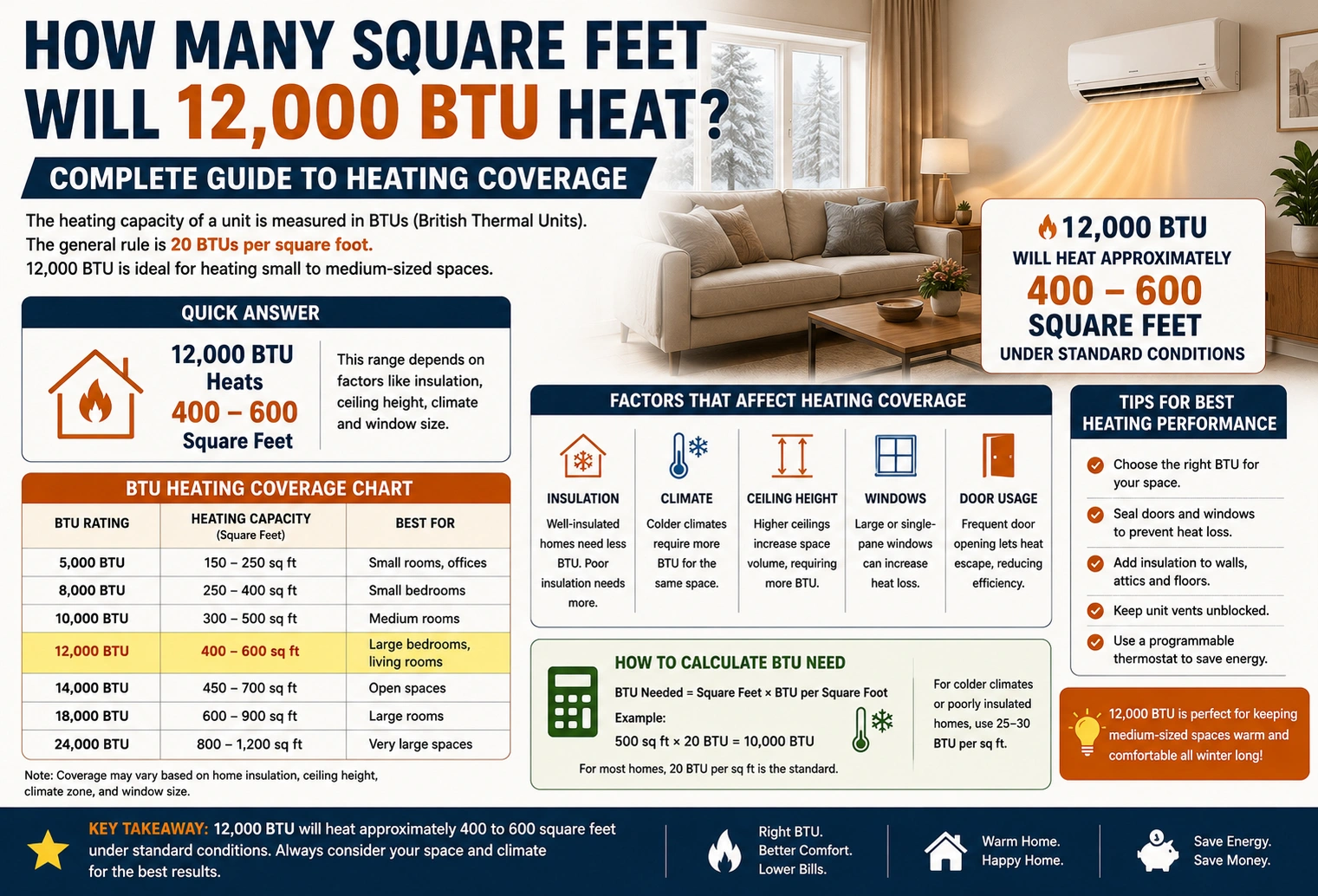
A 12,000 BTU heater can typically heat about 300–600 square feet, depending on the climate, insulation, ceiling height, windows, and heat loss of the space.
For a basic estimate, many heating applications use approximately 20–40 BTUs per square foot.
At 20 BTUs per square foot:
12,000 ÷ 20 = 600 square feet
At 30 BTUs per square foot:
12,000 ÷ 30 = 400 square feet
At 40 BTUs per square foot:
12,000 ÷ 40 = 300 square feet
So, 400–600 square feet is a useful starting range for a reasonably insulated space, while colder climates or poorly insulated buildings may require more BTUs per square foot.
Quick Answer
A 12,000 BTU heating system may heat approximately 300–600 square feet.
| Heating Requirement | Approx. Coverage |
|---|---|
| 20 BTU/sq ft | 600 sq ft |
| 25 BTU/sq ft | 480 sq ft |
| 30 BTU/sq ft | 400 sq ft |
| 35 BTU/sq ft | 343 sq ft |
| 40 BTU/sq ft | 300 sq ft |
These are general estimates. Actual heating capacity depends on the building’s heat loss and local conditions.
How Do You Calculate 12,000 BTU Heating Coverage?
The basic calculation is:
Square Feet = BTUs ÷ BTUs Required per Square Foot
For example, if the space requires 30 BTUs per square foot:
12,000 ÷ 30 = 400 square feet
Therefore, a 12,000 BTU heater could potentially heat approximately 400 square feet under those conditions.
If the space requires only 20 BTUs per square foot:
12,000 ÷ 20 = 600 square feet
This shows why there is no single square-foot coverage number for every 12,000 BTU heater.
Is 12,000 BTU Enough for 500 Square Feet?
A 12,000 BTU heater can potentially heat a 500-square-foot space.
The required capacity would be:
12,000 ÷ 500 = 24 BTUs per square foot
A requirement of approximately 24 BTUs per square foot may be reasonable for some moderately insulated spaces.
However, a poorly insulated room in a very cold climate may require more heating capacity.
A well-insulated space in a mild climate may require less.
Is 12,000 BTU Enough for 600 Square Feet?
It can be, depending on the building.
For 600 square feet:
12,000 ÷ 600 = 20 BTUs per square foot
That corresponds to the lower end of the general heating estimate.
A 12,000 BTU system may therefore heat 600 square feet if the space has relatively low heat loss.
If the building is poorly insulated or exposed to severe winter temperatures, 12,000 BTUs may not be sufficient.
Is 12,000 BTU Enough for 300 Square Feet?
Yes, a 12,000 BTU heater can generally provide substantial heating capacity for a 300-square-foot room.
The calculation is:
12,000 ÷ 300 = 40 BTUs per square foot
That provides considerably more heating capacity per square foot than the 600-square-foot example.
A system of this size may therefore be appropriate for a smaller room with significant heat loss.
However, an oversized heater can also cycle more frequently than necessary, depending on the equipment and controls.
12,000 BTU Heating Coverage by Room Size
| Space Size | BTUs Available per Sq Ft |
| 250 sq ft | 48 BTU/sq ft |
| 300 sq ft | 40 BTU/sq ft |
| 350 sq ft | 34.3 BTU/sq ft |
| 400 sq ft | 30 BTU/sq ft |
| 450 sq ft | 26.7 BTU/sq ft |
| 500 sq ft | 24 BTU/sq ft |
| 600 sq ft | 20 BTU/sq ft |
| 700 sq ft | 17.1 BTU/sq ft |
As the heated area increases, the available BTUs per square foot decrease.
What Factors Affect 12,000 BTU Heating Coverage?
The same heater can heat different amounts of space depending on the building.
Climate
Cold climates require more heating capacity.
A room in a region with very cold winters can require substantially more BTUs than the same room in a mild climate.
Insulation
Insulation helps slow heat loss through walls, ceilings, floors, and attics.
A well-insulated room generally requires less heating capacity than a poorly insulated one.
Windows and Doors
Drafty windows and doors can allow heated air to escape and cold air to enter.
Older single-pane windows can also contribute to greater heat loss.
Ceiling Height
A room with an 8-foot ceiling has less air volume than a room with a 12-foot ceiling.
Higher ceilings can therefore increase the amount of heating required.
Exterior Walls
A room with several exterior walls can lose more heat than an interior room surrounded by conditioned spaces.
Air Leakage
Cracks around windows, doors, vents, and other openings can increase heat loss.
Does 12,000 BTU Mean the Heater Uses 12,000 BTUs of Energy?
Not necessarily.
BTU ratings can describe the heating output or capacity of a heating appliance.
For example, a heat pump may be rated at 12,000 BTU/hour of heating capacity under specified conditions.
The amount of electricity or fuel the equipment consumes depends on its efficiency and operating conditions.
Therefore, a 12,000 BTU rating should not automatically be interpreted as 12,000 BTUs of fuel or electricity consumption every hour.
How Does a 12,000 BTU Heat Pump Compare?
A 12,000 BTU heat pump can provide approximately 12,000 BTU/hour of rated heating capacity under specified conditions, but heat pump output can change as outdoor temperatures change.
In colder weather, some heat pumps may have reduced heating capacity and may require supplemental heat depending on the system.
For this reason, the manufacturer’s performance specifications are important when selecting a heat pump for cold-weather heating.
12,000 BTU Heating vs. Cooling
A 12,000 BTU rating does not necessarily provide the same square-foot coverage for heating and cooling.
Heating and cooling loads are affected by different environmental conditions.
For example, a 12,000 BTU air conditioner may cool a larger area than a 12,000 BTU heater can comfortably heat in a cold climate.
The required heating capacity depends on the building’s heat loss, while cooling capacity depends on its heat gain.
Therefore, heating and cooling equipment should be sized separately when necessary.
How Many BTUs Do You Need for 400 Square Feet?
For a 400-square-foot space, the estimated heating requirement varies with the BTU-per-square-foot assumption.
| BTU per Sq Ft | BTUs Needed for 400 Sq Ft |
| 20 | 8,000 BTU |
| 25 | 10,000 BTU |
| 30 | 12,000 BTU |
| 35 | 14,000 BTU |
| 40 | 16,000 BTU |
At 30 BTUs per square foot, a 400-square-foot room would require approximately 12,000 BTUs.
How Many BTUs Do You Need for 500 Square Feet?
Using the same approach:
| BTU per Sq Ft | BTUs Needed for 500 Sq Ft |
| 20 | 10,000 BTU |
| 25 | 12,500 BTU |
| 30 | 15,000 BTU |
| 35 | 17,500 BTU |
| 40 | 20,000 BTU |
At 20–25 BTUs per square foot, 12,000 BTUs could potentially heat approximately 480–600 square feet.
How Many BTUs Do You Need for 600 Square Feet?
For 600 square feet:
| BTU per Sq Ft | BTUs Needed |
| 20 | 12,000 BTU |
| 25 | 15,000 BTU |
| 30 | 18,000 BTU |
| 35 | 21,000 BTU |
| 40 | 24,000 BTU |
This means a 12,000 BTU heater is most suitable for a 600-square-foot space when the building has a relatively low heating requirement of about 20 BTUs per square foot.
What Happens If 12,000 BTUs Is Too Small?
If the heater does not provide enough capacity, it may run continuously or for very long periods while failing to maintain the desired indoor temperature.
Signs can include:
- Room remains cold
- Heater runs continuously
- Temperature drops during very cold weather
- Some areas remain colder than others
- System struggles to reach the thermostat setting
An undersized heater can be particularly noticeable during the coldest outdoor temperatures.
What Happens If 12,000 BTUs Is Too Large?
An oversized heating system may reach the thermostat setting quickly and shut off repeatedly.
Depending on the equipment, frequent cycling can reduce comfort and increase wear.
The goal is to choose a heating system that provides sufficient capacity without being unnecessarily oversized.
Frequently Asked Questions
How many square feet will 12,000 BTU heat?
A 12,000 BTU heater can generally heat approximately 300–600 square feet, depending on climate, insulation, ceiling height, windows, and heat loss.
Will 12,000 BTU heat 500 square feet?
It can. For 500 square feet, 12,000 BTUs provides 24 BTUs per square foot, which may be appropriate for many moderately insulated spaces.
Will 12,000 BTU heat 600 square feet?
It can in a relatively efficient space. At 600 square feet, 12,000 BTUs equals 20 BTUs per square foot.
Will 12,000 BTU heat 300 square feet?
Yes. At 300 square feet, a 12,000 BTU heater provides 40 BTUs per square foot, although the actual requirement depends on heat loss.
Is 12,000 BTU enough for a bedroom?
It may be, depending on the bedroom’s size and insulation. A small bedroom may require considerably less than 12,000 BTUs, while a large or poorly insulated room may require more.
Does climate affect how much space 12,000 BTU can heat?
Yes. Colder climates generally require more BTUs per square foot.
Does insulation affect heating requirements?
Yes. Good insulation reduces heat loss and can allow the same heater to cover more square footage.
Does ceiling height matter?
Yes. Higher ceilings increase the volume of space being heated and can affect the heating requirement.
Can I choose a heater based only on square footage?
Square footage can provide a preliminary estimate, but a proper heat-loss calculation is more accurate, especially in very cold climates or poorly insulated buildings.
Conclusion
So, how many square feet will 12,000 BTU heat? A reasonable general estimate is approximately 300–600 square feet, depending on the building and climate.
Using common planning assumptions:
- 20 BTUs/sq ft → 600 sq ft
- 25 BTUs/sq ft → 480 sq ft
- 30 BTUs/sq ft → 400 sq ft
- 40 BTUs/sq ft → 300 sq ft
For many moderately insulated spaces, 400–500 square feet can be a useful starting estimate.
However, the actual heating requirement depends on climate, insulation, windows, ceiling height, air leakage, exterior walls, and other sources of heat loss. For a permanent heating installation, use the equipment manufacturer’s specifications or a professional heat-loss calculation rather than relying on square footage alone.
Discover More Articles
How Many Square Feet Does a Mini Split Cool? Sizing Guide