

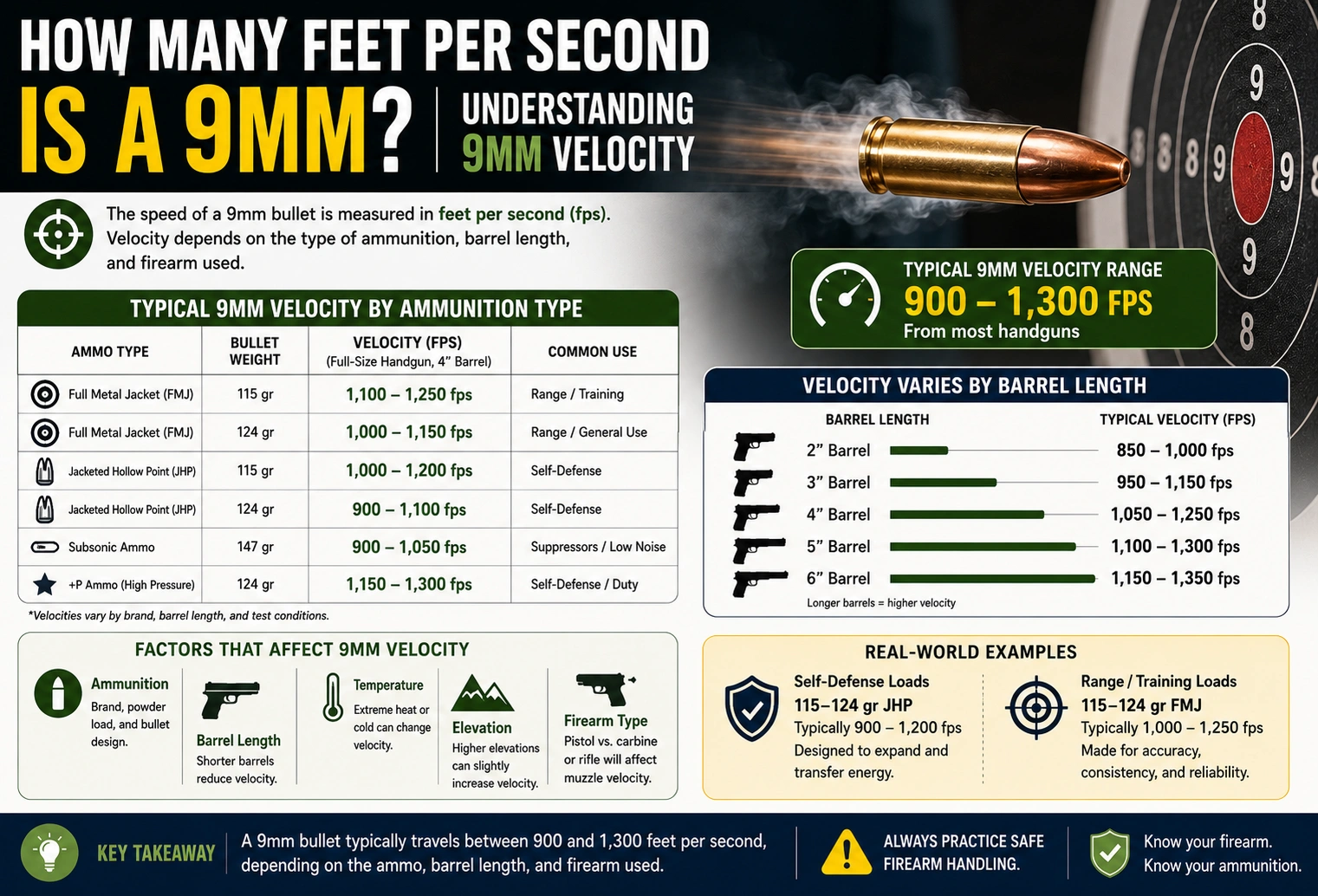
A typical 9mm Luger (9×19mm) cartridge has a muzzle velocity of roughly 1,000–1,300 feet per second (FPS), depending on the ammunition, projectile weight, barrel length, and testing conditions.
There is no single FPS value for every 9mm cartridge.
| 9mm Load Type | Typical Approximate Velocity |
|---|---|
| Heavier projectile | ~950–1,150 FPS |
| Common 115-grain load | ~1,100–1,300 FPS |
| Common 124-grain load | ~1,000–1,200 FPS |
| Lighter/high-velocity loads | Can exceed ~1,300 FPS |
Published figures are generally measured under specific test conditions, so real-world velocity can differ.
What Does 9mm Velocity Mean?
When people ask how many feet per second is a 9mm, they are usually asking about the projectile’s velocity.
Velocity describes how quickly the projectile is moving.
It is commonly expressed in:
Feet per second (FPS)
For example, if a projectile is traveling at 1,200 FPS, that means it covers approximately 1,200 feet in one second under the stated conditions.
The term “9mm” refers to the cartridge family and projectile diameter designation, not one specific velocity.
Typical 9mm Velocity Range
A broad range of approximately 1,000–1,300 FPS is useful for understanding many common 9mm loads.
However, ammunition manufacturers can publish different velocities for different products.
Velocity can change based on:
- Projectile weight
- Powder charge
- Barrel length
- Ammunition design
- Temperature
- Test equipment
- Testing distance
- Firearm configuration
Therefore, the velocity printed by the ammunition manufacturer is generally more useful than relying on a single “average” 9mm FPS number.
Why 9mm FPS Varies
Two boxes of 9mm ammunition can have noticeably different velocity ratings even though both are labeled 9mm.
The biggest factors include the following.
1. Projectile Weight
Projectile weight is one of the most important variables.
A lighter projectile can often achieve a higher velocity with an otherwise similar cartridge design, while a heavier projectile may travel more slowly.
Common 9mm projectile weights include approximately:
- 115 grains
- 124 grains
- 147 grains
These are not the only available weights, but they are common reference points.
2. Barrel Length
Velocity can change when the same ammunition is fired through different barrel lengths.
A longer barrel can allow expanding gases to accelerate the projectile for a longer period, although the relationship is not unlimited or perfectly linear.
This means a manufacturer’s advertised velocity may not match the velocity from a different firearm.
3. Ammunition Design
Different ammunition manufacturers and product lines can use different propellant and projectile combinations.
Consequently, two loads with the same projectile weight can have different published velocities.
4. Environmental Conditions
Temperature, altitude, and other conditions can influence ballistic performance.
This is one reason laboratory or manufacturer velocity figures should not automatically be treated as universal real-world measurements.
9mm Velocity by Projectile Weight
A useful way to understand 9mm velocity is to compare common projectile weights.
| Projectile Weight | General Velocity Tendency |
|---|---|
| 115 grains | Often faster |
| 124 grains | Moderate |
| 147 grains | Often slower |
These categories are general tendencies rather than fixed velocity specifications.
A particular 147-grain load can have a different velocity from another 147-grain load, for example.
The ammunition’s published specification is the best source for that specific product.
How 9mm Velocity Is Measured
Velocity is commonly measured using a device called a chronograph.
A chronograph measures how quickly a projectile passes between sensors.
The resulting number is generally reported in feet per second.
For example:
1,150 FPS
means the measured velocity was approximately 1,150 feet per second under that test setup.
Testing conditions matter because velocity can change depending on the firearm, ammunition, barrel length, temperature, and measurement position.
Muzzle Velocity vs. Downrange Velocity
Another important distinction is between muzzle velocity and velocity farther downrange.
Muzzle velocity is the projectile’s speed near the point where it leaves the barrel.
After leaving the barrel, the projectile encounters air resistance.
As a result, velocity generally decreases as distance increases.
So if a cartridge has a published muzzle velocity of 1,200 FPS, that does not mean it maintains exactly 1,200 FPS throughout its flight.
Why Published Velocity Numbers Differ
You may see one manufacturer list a 9mm load at approximately 1,150 FPS and another list a similar load at approximately 1,200 FPS.
That does not necessarily mean one specification is incorrect.
The measurements could have been obtained using different:
- Barrel lengths
- Firearms
- Testing equipment
- Ammunition components
- Environmental conditions
This is why velocity comparisons are most useful when the testing conditions are similar.
9mm Velocity Compared With Other Common Ammunition
Velocity alone does not tell the whole story when comparing cartridges.
Different ammunition types use different projectile weights and designs.
| Cartridge | General Velocity Range* |
|---|---|
| 9mm Luger | ~1,000–1,300 FPS |
| .45 ACP | ~750–1,000 FPS |
| .380 ACP | ~850–1,050 FPS |
| .40 S&W | ~950–1,200 FPS |
| .357 Magnum | Often 1,200+ FPS |
*Broad illustrative ranges only. Actual ammunition specifications vary considerably.
This comparison demonstrates why cartridge names alone cannot predict a precise velocity.
FPS and Miles Per Hour
You can also convert feet per second into miles per hour.
There are 5,280 feet in a mile and 3,600 seconds in an hour.
The conversion is:
MPH = FPS × 0.681818
For example, a velocity of 1,200 FPS corresponds mathematically to approximately:
1,200 × 0.681818 ≈ 818.2 MPH
This is simply a unit conversion.
It does not mean the projectile maintains that velocity throughout its entire flight.
| Velocity | Approx. MPH |
|---|---|
| 900 FPS | 614 MPH |
| 1,000 FPS | 682 MPH |
| 1,100 FPS | 750 MPH |
| 1,200 FPS | 818 MPH |
| 1,300 FPS | 886 MPH |
FPS Is Not the Same as Energy
Velocity is only one part of ballistic performance.
Another measurement is kinetic energy, which depends on both mass and velocity.
This means two projectiles traveling at the same FPS can have different kinetic energies if their masses differ.
Likewise, a heavier projectile traveling at a lower velocity can have a different energy value from a lighter projectile traveling faster.
Therefore, comparing ammunition based only on FPS can give an incomplete picture.
Common Mistakes When Comparing 9mm Velocity
Mistake 1: Assuming Every 9mm Is the Same
“9mm” does not identify one exact load.
Different ammunition products can have different projectile weights and velocity ratings.
Mistake 2: Ignoring Barrel Length
Published velocity may be measured using a barrel length different from the firearm being considered.
Mistake 3: Treating Advertised FPS as Universal
Manufacturer velocity figures are measured under particular test conditions.
Actual results can vary.
Mistake 4: Comparing Different Projectile Weights Without Context
A 115-grain load and a 147-grain load should not be compared solely by their FPS numbers.
Mistake 5: Confusing Muzzle Velocity With Downrange Velocity
The projectile normally loses velocity as it travels through the air.
FAQs
1. How many feet per second is a 9mm?
A typical 9mm Luger load may have a muzzle velocity of approximately 1,000–1,300 FPS, depending on projectile weight, ammunition, barrel length, and testing conditions.
2. Is 9mm faster than 1,000 FPS?
Many 9mm loads are capable of exceeding 1,000 FPS, but the exact velocity depends on the specific ammunition.
3. Does a heavier 9mm projectile travel slower?
Generally, heavier projectiles tend to have lower velocities when comparing otherwise similar loads, although ammunition design can produce exceptions.
4. Does barrel length affect 9mm velocity?
Yes. The same ammunition can produce different velocities from different barrel lengths and firearms.
5. Is 9mm velocity the same at every distance?
No. A projectile generally loses velocity as it travels through the air, so muzzle velocity and downrange velocity are different measurements.
Conclusion
So, how many feet per second is a 9mm? A broad estimate for many common 9mm Luger loads is approximately 1,000–1,300 feet per second at the muzzle.
However, there is no single FPS value for every 9mm cartridge. Projectile weight, barrel length, ammunition design, environmental conditions, and testing methods can all affect the measured velocity.
For an exact figure, use the manufacturer’s published specification for the specific ammunition rather than relying on a general 9mm average.
Discover More Articles
How Many Square Feet Does a Mini Split Cool? Sizing Guide