
If you’re shopping for a ductless air conditioner, you may be wondering how many square feet a 1 ton mini split will cool.
A 1-ton mini split provides approximately 12,000 BTUs (British Thermal Units) of cooling capacity.
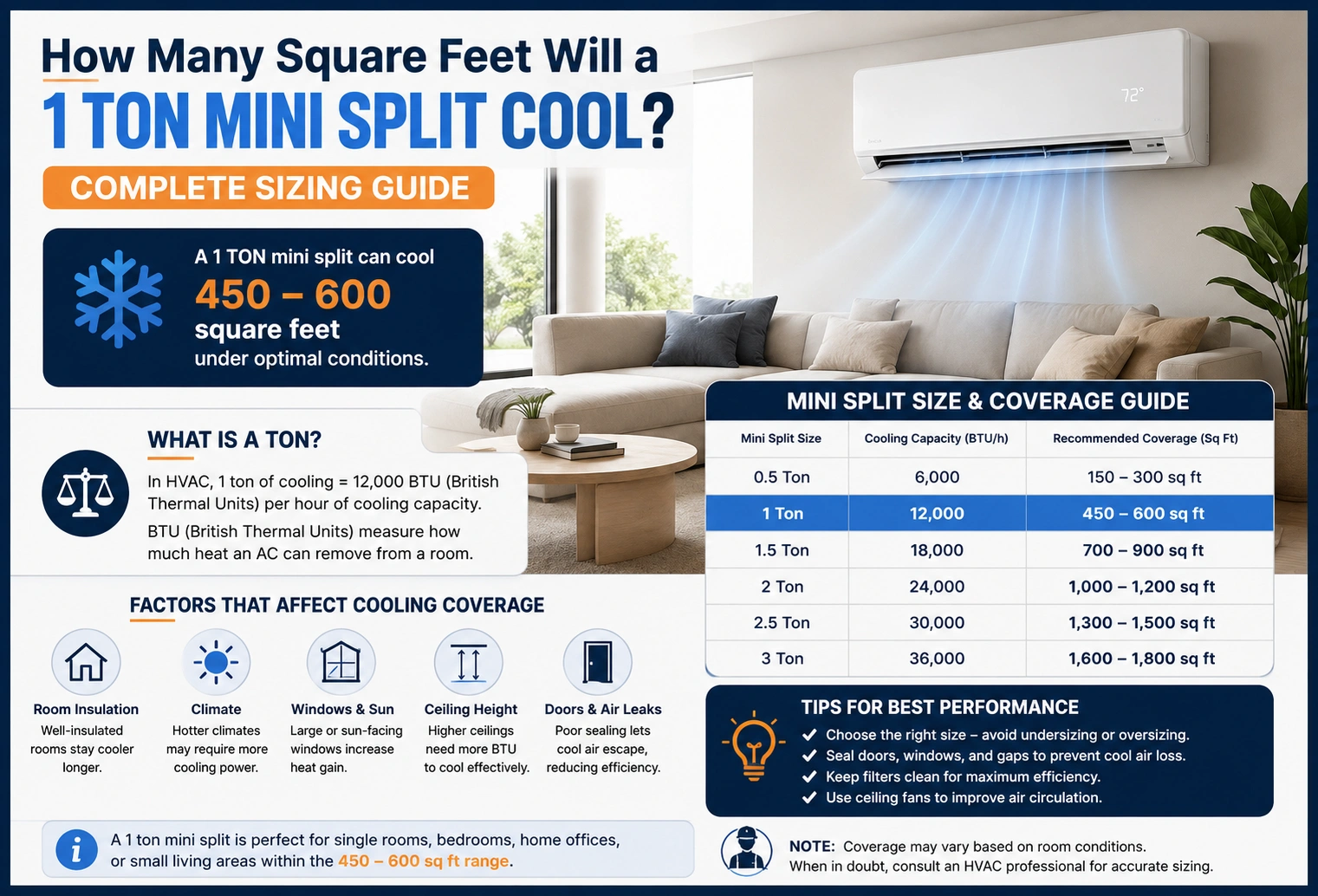
Under typical residential conditions, a 1-ton (12,000 BTU) mini split can cool approximately 450 to 600 square feet.
Answer:
✅ A 1-ton mini split typically cools between 450 and 600 square feet, depending on insulation, ceiling height, climate, sun exposure, and room layout.
Quick Answer
| Mini Split Size | BTU Rating | Typical Coverage |
|---|---|---|
| 1 Ton | 12,000 BTU | 450–600 sq ft |
A properly sized 1-ton mini split delivers efficient cooling and improved comfort for medium-sized rooms.
What Is a 1 Ton Mini Split?
The term “1 ton” refers to the cooling capacity of an air conditioning system—not its weight.
- 1 Ton = 12,000 BTUs per hour
This capacity is commonly used for:
- Bedrooms
- Living rooms
- Home offices
- Studio apartments
- Small retail spaces
Mini splits are popular because they provide efficient heating and cooling without requiring ductwork.
Typical Cooling Coverage
Although 450–600 square feet is a common guideline, actual coverage depends on your home’s characteristics.
General recommendations:
| Room Size | Suitable? |
| 300 sq ft | ✅ Excellent |
| 400 sq ft | ✅ Excellent |
| 500 sq ft | ✅ Ideal |
| 600 sq ft | ✅ Suitable under normal conditions |
| 700+ sq ft | ⚠ May require a larger system |
A professional load calculation is the best way to determine the correct unit size.
Factors That Affect Cooling Capacity
Several variables influence how much area a 1-ton mini split can cool effectively.
Insulation
Well-insulated homes retain cool air better and allow the unit to cool larger spaces.
Ceiling Height
Higher ceilings increase the volume of air that must be cooled.
Climate
Homes in hotter climates may require additional cooling capacity.
Sun Exposure
Rooms with large west- or south-facing windows often need more BTUs because of increased solar heat gain.
Occupancy
More people and heat-producing appliances increase the cooling load.
Coverage Chart by Mini Split Size
| Mini Split Size | BTUs | Typical Coverage |
| ½ Ton | 6,000 | 150–300 sq ft |
| ¾ Ton | 9,000 | 300–450 sq ft |
| 1 Ton | 12,000 | 450–600 sq ft |
| 1½ Ton | 18,000 | 700–1,000 sq ft |
| 2 Ton | 24,000 | 1,000–1,400 sq ft |
These ranges are estimates and may vary based on home construction and environmental conditions.
Signs You Need a Larger Unit
Your mini split may be undersized if:
- It runs continuously.
- Rooms never reach the desired temperature.
- Humidity remains high.
- Electricity bills increase unexpectedly.
- Some areas stay noticeably warmer than others.
An HVAC professional can perform a Manual J load calculation to determine the correct system size.
Mini Split Sizing Tips
To get the best performance:
- Measure the room accurately.
- Consider insulation quality.
- Account for large windows and direct sunlight.
- Include ceiling height in your calculations.
- Don’t oversize the system, as this can reduce efficiency and humidity control.
- Choose an ENERGY STAR®-certified unit when possible.
Proper sizing improves comfort, efficiency, and equipment lifespan.
Common Mistakes
Choosing Based Only on Square Footage
Square footage is only one factor. Heat gain, insulation, and occupancy also affect the required cooling capacity.
Oversizing the Unit
A system that’s too large may short-cycle, reducing humidity removal and overall efficiency.
Ignoring Climate
Homes in very hot or humid regions often require more BTUs than homes in milder climates.
9. FAQs
1. How many square feet will a 1 ton mini split cool?
A 1-ton (12,000 BTU) mini split typically cools between 450 and 600 square feet under normal residential conditions.
2. Is a 12,000 BTU mini split the same as a 1-ton unit?
Yes. 1 ton of cooling capacity equals 12,000 BTUs per hour.
3. Can a 1 ton mini split cool 700 square feet?
It may struggle in many situations. For 700 square feet or more, a larger unit—such as an 18,000 BTU (1½-ton) system—may be more appropriate.
4. What factors affect mini split sizing?
Important factors include insulation, ceiling height, local climate, window size, sun exposure, occupancy, and heat-producing appliances.
5. Should I oversize a mini split for better cooling?
No. Oversizing can reduce energy efficiency, increase cycling, and provide less effective humidity control. Proper sizing is the best approach.
10. Conclusion
If you’re asking how many square feet will a 1 ton mini split cool, the typical answer is 450 to 600 square feet under standard residential conditions. Since a 1-ton system provides 12,000 BTUs of cooling, it’s well suited for medium-sized bedrooms, living rooms, home offices, and studio apartments.
While square footage is a useful starting point, insulation, ceiling height, climate, sun exposure, and room layout all influence cooling performance. For the most accurate results, consider a professional HVAC load calculation before purchasing your mini split system.
Discover More Articles
How Many Square Feet Is One Sheet of Drywall? Complete Guide
How Many Nerve Endings Are in the Feet? Facts & Foot Guide
How Many Square Feet in a Box of Tile? Complete Coverage Guide