
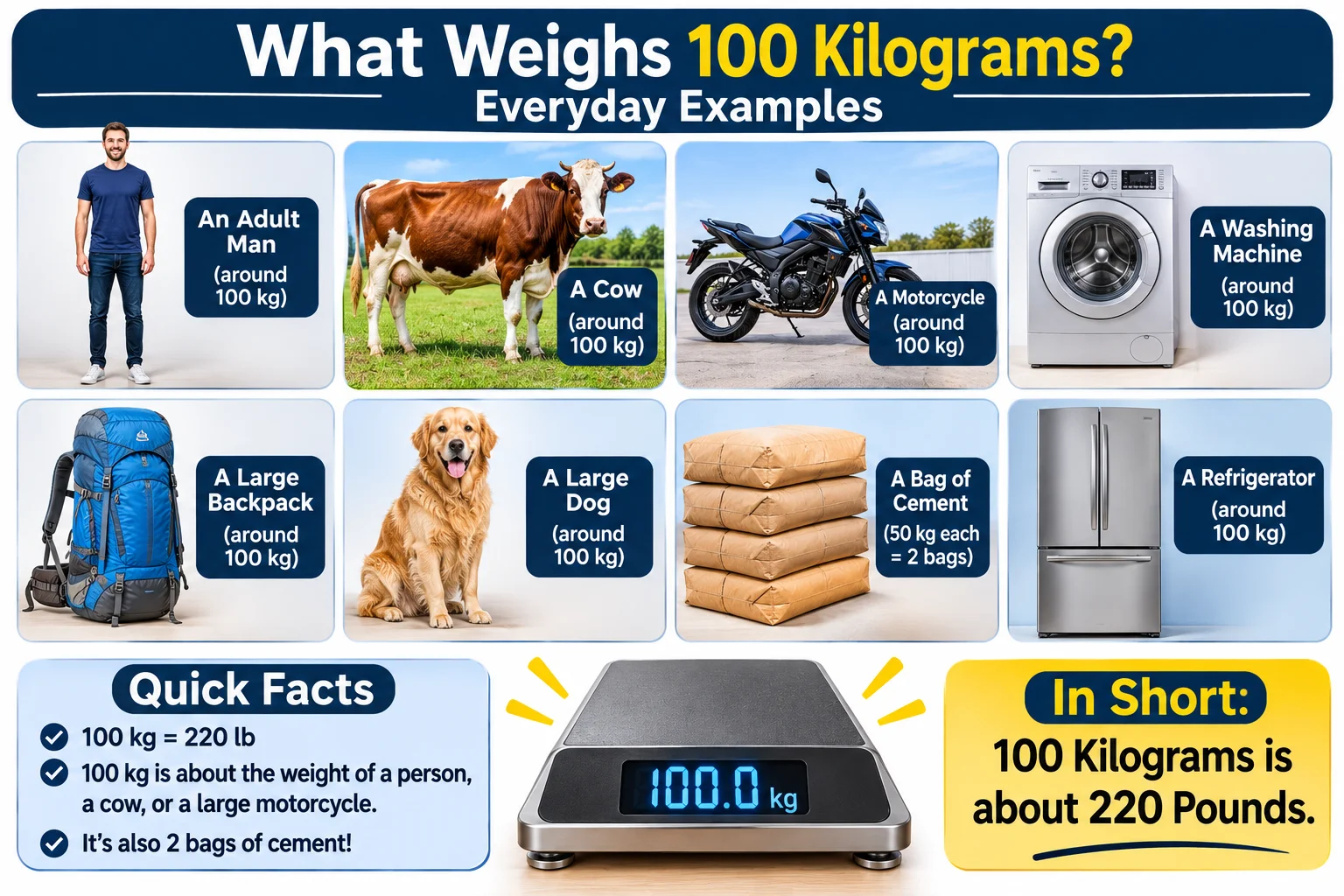
One hundred kilograms is a substantial amount of weight, equal to approximately 220.46 pounds or 3,527 ounces. It is about the weight of a large refrigerator, a heavy piece of gym equipment, or several packed suitcases combined.
Although 100 kilograms may be difficult to imagine as a number, comparing it with familiar objects makes it easier to understand. From household appliances to commercial equipment, several everyday items can weigh close to 100 kg.
How Heavy Is 100 Kilograms?
A kilogram is a standard metric unit used to measure mass. One kilogram equals 1,000 grams, so 100 kilograms equals 100,000 grams.
Here are the main conversions:
| Measurement Unit | Equivalent of 100 Kilograms |
|---|---|
| Kilograms | 100 kg |
| Grams | 100,000 g |
| Milligrams | 100,000,000 mg |
| Pounds | 220.46 lb |
| Ounces | 3,527.4 oz |
| Metric tonnes | 0.1 tonnes |
| US short tons | 0.1102 tons |
For a simple comparison, 100 kilograms is slightly more than 220 pounds. It is also one-tenth of a metric tonne.
This is a heavy load that generally requires appropriate lifting equipment or multiple people to move safely, depending on its shape and handling requirements.
Everyday Objects That Weigh Around 100 Kilograms
Several familiar objects can help you picture what 100 kilograms looks like. Some may weigh close to this amount individually, while others can be combined to reach the same weight.
The exact weight of each item depends on its size, model, materials, and contents.
1. A Large Refrigerator
A large refrigerator can weigh around 100 kilograms, although many models are lighter or heavier.
Its weight depends on its capacity, door design, insulation, compressor, and construction materials.
A large refrigerator with a freezer section may be a useful comparison for understanding a 100 kg object.
2. A Heavy Gym Machine
Some commercial exercise machines can weigh close to or more than 100 kilograms.
For example, certain multi-gym machines, weight-training equipment, and commercial fitness stations have heavy steel frames and built-in weight systems.
Their total weight varies by design and whether removable weights are included.
3. Four Large Suitcases
If four packed suitcases each weigh 25 kilograms, their combined weight is exactly 100 kilograms.
25 + 25 + 25 + 25 = 100 kg
This is a simple way to visualize the weight because luggage is commonly measured in kilograms.
However, individual suitcase weights vary depending on their contents.
4. A Large Industrial Battery
Some industrial batteries and battery banks can weigh around 100 kilograms.
Their weight depends on battery chemistry, capacity, casing, and construction. Smaller household batteries are much lighter, so this comparison applies to larger industrial models.
5. A Heavy Workbench
A sturdy metal workbench may weigh close to 100 kilograms, especially if it has a thick steel frame, drawers, and a heavy worktop.
This is a useful comparison for workshops and garages.
Household and Commercial Items That Weigh 100 kg
Many household and commercial items can approach 100 kilograms. Some are close to this weight individually, while others need to be combined.
| Object | Approximate Weight | Notes |
|---|---|---|
| Large refrigerator | Around 80–120 kg | Depends on model |
| Commercial gym machine | Around 100 kg or more | Depends on equipment |
| Four packed suitcases | 100 kg combined | 25 kg each |
| Heavy metal workbench | Around 100 kg | Depends on construction |
| Large industrial battery | Around 100 kg | Depends on capacity |
| 100 liters of water | Approximately 100 kg | Excludes container |
| 20 bags of 5 kg rice | 100 kg combined | Based on labeled weight |
| Large equipment cabinet | Around 100 kg | Depends on materials |
These examples help demonstrate the weight of 100 kilograms in familiar settings.
Remember that an object’s appearance does not always reveal its actual weight. A compact metal object can weigh much more than a larger object made from lightweight materials.
100 Kilograms Compared to Other Weights
Comparing 100 kilograms with smaller and larger measurements can make the number easier to understand.
| Weight | Comparison with 100 kg |
|---|---|
| 1 kg | 100 kg is 100 times heavier |
| 5 kg | 100 kg is 20 times heavier |
| 10 kg | 100 kg is 10 times heavier |
| 20 kg | 100 kg is 5 times heavier |
| 25 kg | 100 kg is 4 times heavier |
| 50 kg | 100 kg is twice as heavy |
| 75 kg | 100 kg is 25 kg heavier |
| 100 kg | Reference weight |
| 150 kg | 50 kg heavier |
| 200 kg | Twice as heavy |
For example, five 20-kilogram bags have a combined weight of exactly 100 kilograms.
Similarly, ten 10-kilogram packages also add up to 100 kilograms.
These comparisons are useful when estimating the weight of packaged materials, equipment, luggage, and other heavy items.
What Does 100 Kilograms Feel Like?
A 100-kilogram object is heavy enough that moving it requires careful handling.
However, the difficulty of lifting or carrying it depends on more than the number on the scale.
Several factors influence how heavy an object feels.
- Size and shape: A large object may be difficult to grip, even if its weight is evenly distributed.
- Weight distribution: An object with unevenly distributed weight can be harder to control and move.
- Handles and grip: Equipment with suitable handles or lifting points is generally easier to move than an object with smooth or awkward surfaces.
- Distance: Moving a heavy object a short distance is different from transporting it over a long distance.
- Lifting equipment: A trolley, pallet jack, forklift, or other suitable equipment can make moving heavy objects safer.
For most people, lifting 100 kilograms without assistance is not a practical or safe task. Heavy objects should be moved using appropriate equipment and trained assistance.
How to Visualize 100 Kilograms Without a Scale
If you do not have access to a weighing scale, you can estimate 100 kilograms by using familiar objects or materials with known weights.
These methods are useful for visualization, but they should not replace accurate weighing.
1. Use Water as a Reference
Water provides one of the simplest weight comparisons.
At ordinary temperatures, one liter of water weighs approximately one kilogram.
Therefore:
- 1 liter of water = approximately 1 kg
- 10 liters of water = approximately 10 kg
- 50 liters of water = approximately 50 kg
- 100 liters of water = approximately 100 kg
This means 100 liters of water weighs approximately 100 kilograms, excluding the container.
For an easy comparison, imagine ten 10-liter containers filled with water. Their combined water weight is approximately 100 kg.
2. Combine Smaller Packages
You can use packages with known weights to create a 100 kg comparison.
For example:
- 10 bags of 10 kg = 100 kg
- 5 bags of 20 kg = 100 kg
- 4 bags of 25 kg = 100 kg
- 20 bags of 5 kg = 100 kg
This method is useful for estimating the weight of rice, flour, cement, animal feed, and other packaged materials.
3. Compare It With Packed Luggage
Four suitcases weighing 25 kilograms each have a combined weight of 100 kilograms.
This is an easy way to imagine the total weight of a large load, especially when planning transportation or storage.
4. Use a Weighing Scale
If you need an accurate measurement, use a suitable platform scale or industrial weighing scale.
A household bathroom scale may not have the capacity or accuracy needed for heavy objects.
For large equipment, commercial goods, or construction materials, choose a scale designed for the expected weight.
100 Kilograms in Pounds and Other Units
Kilograms and pounds are two common units used to measure weight.
Kilograms are part of the metric system, while pounds are commonly used in the United States and some other countries.
To convert kilograms into pounds, use this formula:
Pounds = Kilograms × 2.20462
For 100 kilograms:
100 × 2.20462 = 220.462 pounds
Therefore, 100 kilograms is approximately 220.46 pounds.
Here are some additional conversions:
| Kilograms | Pounds | Grams |
|---|---|---|
| 10 kg | 22.05 lb | 10,000 g |
| 20 kg | 44.09 lb | 20,000 g |
| 30 kg | 66.14 lb | 30,000 g |
| 40 kg | 88.18 lb | 40,000 g |
| 50 kg | 110.23 lb | 50,000 g |
| 75 kg | 165.35 lb | 75,000 g |
| 100 kg | 220.46 lb | 100,000 g |
| 125 kg | 275.58 lb | 125,000 g |
| 150 kg | 330.69 lb | 150,000 g |
| 200 kg | 440.92 lb | 200,000 g |
These conversions are useful when reading product specifications, comparing shipping weights, buying equipment, and checking luggage limits.
Frequently Asked Questions
1. What everyday object weighs 100 kilograms?
A large refrigerator, heavy workbench, or commercial gym machine may weigh close to 100 kilograms. Four packed suitcases weighing 25 kilograms each also have a combined weight of exactly 100 kg.
2. How many pounds are in 100 kilograms?
There are approximately 220.46 pounds in 100 kilograms. To convert kilograms into pounds, multiply the kilogram value by 2.20462.
3. Is 100 kilograms heavy?
Yes. One hundred kilograms is a substantial amount of weight. It is equal to approximately 220 pounds and is generally too heavy for most people to move safely without suitable equipment or assistance.
4. How much water weighs 100 kilograms?
Approximately 100 liters of water weigh 100 kilograms at ordinary temperatures. This does not include the weight of the containers.
5. How many grams are in 100 kilograms?
There are exactly 100,000 grams in 100 kilograms. Since one kilogram contains 1,000 grams, multiply 100 by 1,000.
6. How many 20 kg bags make 100 kilograms?
Five bags weighing 20 kilograms each make a total of 100 kilograms.
100 ÷ 20 = 5 bags.
7. Is 100 kilograms the same as one tonne?
No. One hundred kilograms is one-tenth of a metric tonne. One metric tonne equals 1,000 kilograms, so 100 kilograms is 900 kilograms less than one tonne.
Conclusion
One hundred kilograms is a substantial weight equal to approximately 220.46 pounds, 100,000 grams, or 3,527 ounces. Familiar comparisons include a large refrigerator, heavy gym equipment, four 25-kilogram suitcases, or 100 liters of water.
These examples make it easier to understand how heavy 100 kilograms really is. For accurate measurements, use a suitable weighing scale, and always use appropriate equipment when moving heavy objects.
Discover More Articles
Measuring 30 Inches: Easy Guide With Size Comparisons
What Weighs 20 Pounds? Everyday Objects and Examples
What Weighs 50 Pounds? 15 Common Examples to Understand the Weight