
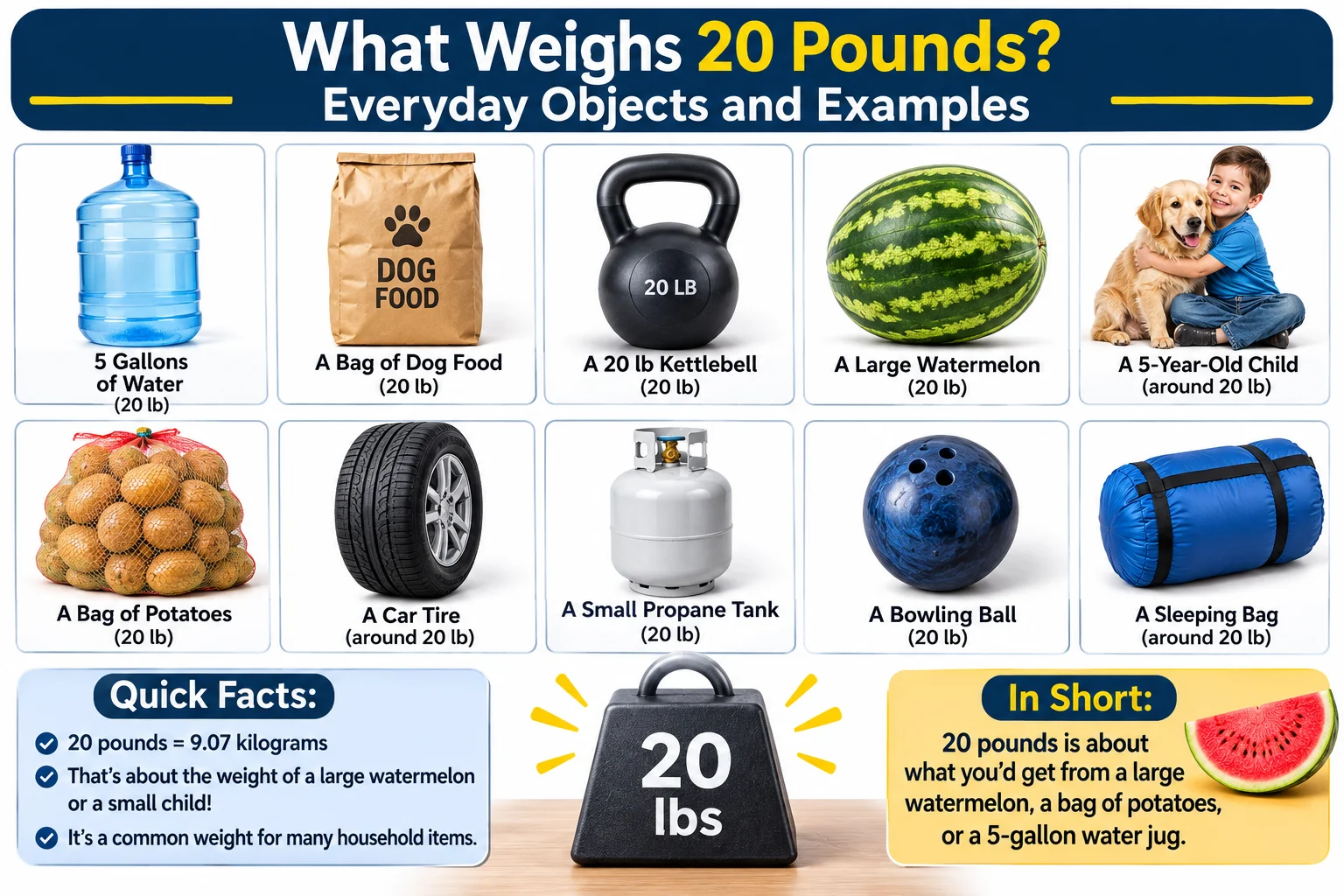
Twenty pounds is a moderate amount of weight, equal to approximately 9.07 kilograms or 320 ounces. It is heavier than many everyday household items but light enough for most adults to lift and carry for a short distance.
If you want to understand what 20 pounds feels like, comparing it with familiar objects can make the measurement easier to imagine. Items such as a large bag of pet food, a small piece of luggage, or a weighted exercise object can help you visualize this amount of weight.
How Heavy Is 20 Pounds?
Twenty pounds is a unit of weight commonly used in the United States and other places that follow the imperial measurement system.
In the metric system, 20 pounds is approximately 9.07 kilograms.
Here are the main conversions:
| Measurement Unit | Equivalent of 20 Pounds |
|---|---|
| Pounds | 20 lb |
| Kilograms | 9.07 kg |
| Ounces | 320 oz |
| Grams | 9,071.85 g |
| Milligrams | 9,071,847 mg |
| Stones | 1.43 st |
| Metric tonnes | 0.00907 tonnes |
For a simple comparison, 20 pounds is slightly more than 9 kilograms. It is also equal to 320 ounces because one pound contains 16 ounces.
This weight can feel manageable when carried briefly, but holding it for an extended period may become tiring.
Everyday Things That Weigh Around 20 Pounds
Several familiar objects can help you understand how much 20 pounds weighs. Some products are sold in packages close to this weight, while others may vary depending on their size and contents.
1. A 20-Pound Bag of Dog Food
A 20-pound bag of dog food is one of the easiest ways to visualize this weight.
Pet food is commonly sold in different package sizes, including 5-pound, 10-pound, 20-pound, and larger bags.
A full 20-pound bag gives you a direct example of the measurement.
2. A 20-Pound Bag of Rice
Large packages of rice are another useful comparison.
A bag labeled 20 pounds contains 20 pounds of rice before accounting for packaging. The actual total weight may be slightly higher if the packaging is included.
This is a practical example because rice is commonly purchased in bulk for household use.
3. A Small Dumbbell or Weight Plate
A 20-pound dumbbell or exercise weight plate is designed to weigh 20 pounds.
This makes it a useful comparison for understanding the weight used in strength training.
A dumbbell may feel heavier than a bag of rice because its weight is concentrated in a smaller object and its handle changes how you hold it.
4. A Large Water Container
Water provides another simple weight comparison.
One US gallon of water weighs approximately 8.34 pounds at ordinary temperatures.
Therefore, around 2.4 gallons of water weighs approximately 20 pounds.
The container itself adds a little extra weight.
5. A Medium-Sized Suitcase
A packed suitcase can weigh approximately 20 pounds, depending on its contents.
For example, clothing, shoes, toiletries, and accessories can quickly add up.
However, empty suitcases vary considerably in weight, so the total depends on the model and what you pack.
Household Items That Weigh 20 Pounds
Many household products can weigh close to 20 pounds, either individually or when combined.
The following table provides useful comparisons. These are approximate examples, not guaranteed weights for every product.
| Household Item | Approximate Weight | Notes |
|---|---|---|
| 20-pound pet food bag | 20 lb | Package weight may be additional |
| 20-pound rice bag | 20 lb | Depends on labeled net weight |
| 2.4 gallons of water | About 20 lb | Excludes container |
| Medium packed suitcase | Around 20 lb | Depends on contents |
| 20-pound dumbbell | 20 lb | Manufacturer-rated weight |
| Small box of books | Around 20 lb | Depends on number and size |
| Several large detergent bottles | Around 20 lb combined | Depends on bottle sizes |
| A collection of canned food | Around 20 lb combined | Depends on can sizes |
These examples can help you estimate 20 pounds without needing to picture the number alone.
20 Pounds Compared to Other Weights
Another way to understand 20 pounds is to compare it with smaller and larger measurements.
| Weight | Comparison with 20 Pounds |
|---|---|
| 1 lb | 20 pounds is 20 times heavier |
| 2 lb | 20 pounds is 10 times heavier |
| 5 lb | 20 pounds is 4 times heavier |
| 10 lb | 20 pounds is twice as heavy |
| 15 lb | 20 pounds is 5 pounds heavier |
| 20 lb | Reference weight |
| 25 lb | 5 pounds heavier |
| 40 lb | Twice as heavy |
| 50 lb | 2.5 times heavier |
| 100 lb | 5 times heavier |
For example, two 10-pound bags together weigh exactly 20 pounds.
Similarly, four 5-pound bags have the same combined weight.
These comparisons are useful when estimating grocery loads, luggage, packages, and exercise equipment.
What Does 20 Pounds Feel Like?
Twenty pounds can feel different depending on the shape, size, and distribution of an object.
A compact 20-pound dumbbell may feel more difficult to lift than a larger bag with the same weight because its mass is concentrated in a smaller area.
Here are some factors that affect how heavy an object feels:
- Size and shape: A small, dense object can be harder to grip than a larger object with comfortable handles.
- Weight distribution: An object with uneven weight distribution can feel more difficult to carry because it may pull to one side.
- Grip: A bag with strong handles is generally easier to carry than a slippery object without a proper grip.
- Carrying duration: Holding 20 pounds for a few seconds is different from carrying it for several minutes.
- Physical strength: People with different strength levels may experience the same weight differently.
For everyday activities, 20 pounds is a noticeable load. You may be able to lift it easily, but carrying it over a long distance can become tiring.
How to Estimate 20 Pounds Without a Scale
If you do not have a weighing scale, you can use familiar objects to estimate a weight of 20 pounds.
These methods are useful for rough comparisons, but they are not substitutes for accurate weighing.
1. Use Two 10-Pound Bags
Two objects that each weigh 10 pounds have a combined weight of 20 pounds.
For example:
10 + 10 = 20 pounds
If you have two labeled 10-pound bags of material, you can use them as a simple reference.
2. Use Water as a Reference
Water has a predictable relationship between volume and weight.
One US gallon of water weighs approximately 8.34 pounds.
Therefore:
- 1 gallon = approximately 8.34 pounds
- 2 gallons = approximately 16.68 pounds
- 2.4 gallons = approximately 20 pounds
This provides a practical way to estimate 20 pounds using measured water.
Remember that the weight of the container must be added if you are weighing the complete container.
3. Compare It With a 20-Pound Exercise Weight
If you have access to a gym, a dumbbell or weight plate labeled 20 pounds can provide a direct comparison.
You can hold it briefly to understand the amount of resistance and effort associated with this weight.
4. Combine Smaller Packages
You can also combine smaller packages with known weights.
For example:
- Four 5-pound packages = 20 pounds
- Two 10-pound packages = 20 pounds
- One 15-pound package plus one 5-pound package = 20 pounds
This method is useful when handling groceries, pet food, or other packaged products.
Pounds vs. Kilograms and Other Weight Units
Pounds and kilograms are two common units used to measure weight.
Pounds are part of the imperial system, while kilograms belong to the metric system.
The conversion formula is:
Kilograms = Pounds × 0.453592
For 20 pounds:
20 × 0.453592 = 9.07184 kilograms
Therefore, 20 pounds is approximately 9.07 kilograms.
Here is a comparison of nearby weights:
| Pounds | Kilograms | Grams |
|---|---|---|
| 5 lb | 2.27 kg | 2,268 g |
| 10 lb | 4.54 kg | 4,536 g |
| 15 lb | 6.80 kg | 6,804 g |
| 20 lb | 9.07 kg | 9,072 g |
| 25 lb | 11.34 kg | 11,340 g |
| 30 lb | 13.61 kg | 13,608 g |
| 40 lb | 18.14 kg | 18,144 g |
| 50 lb | 22.68 kg | 22,680 g |
These conversions are helpful when reading product labels, comparing luggage weights, buying packaged goods, or following measurements from different countries.
Frequently Asked Questions
1. What everyday object weighs 20 pounds?
A 20-pound bag of dog food, a 20-pound bag of rice, or a 20-pound dumbbell provides a direct example. A packed suitcase or box of books may also weigh around 20 pounds, depending on its contents.
2. How many kilograms is 20 pounds?
Twenty pounds is approximately 9.07 kilograms. To convert pounds into kilograms, multiply the weight by 0.453592.
3. Is 20 pounds heavy to carry?
Twenty pounds is a moderate load. Many adults can lift it, but carrying it for a long distance or holding it for an extended period may become tiring. The difficulty depends on physical strength, grip, and the object’s shape.
4. How many ounces are in 20 pounds?
There are 320 ounces in 20 pounds. Since one pound contains 16 ounces, multiply 20 by 16 to get 320 ounces.
5. How much water weighs 20 pounds?
Approximately 2.4 US gallons of water weigh 20 pounds, excluding the container. The exact amount can vary slightly with water temperature.
6. What weighs twice as much as 20 pounds?
Forty pounds weighs twice as much as 20 pounds. You can also think of it as two separate 20-pound objects combined.
7. Can a household scale measure 20 pounds?
Yes. Most ordinary bathroom scales can measure 20 pounds, although their accuracy may vary at lower weights. A digital kitchen or shipping scale with a suitable capacity may provide a more accurate measurement for packages and smaller objects.
Conclusion
Twenty pounds is equal to approximately 9.07 kilograms, 320 ounces, or 9,072 grams. Familiar comparisons such as a 20-pound bag of rice, a pet food bag, or a 20-pound dumbbell make this weight easier to visualize.
You can also estimate 20 pounds using two 10-pound packages or approximately 2.4 gallons of water. For an exact measurement, use a suitable digital scale rather than relying on visual comparisons.
Discover More Articles
Measuring 30 Inches: Easy Guide With Size Comparisons
Measuring 11 Inches: Exact Length, Conversions, and Everyday Comparisons