
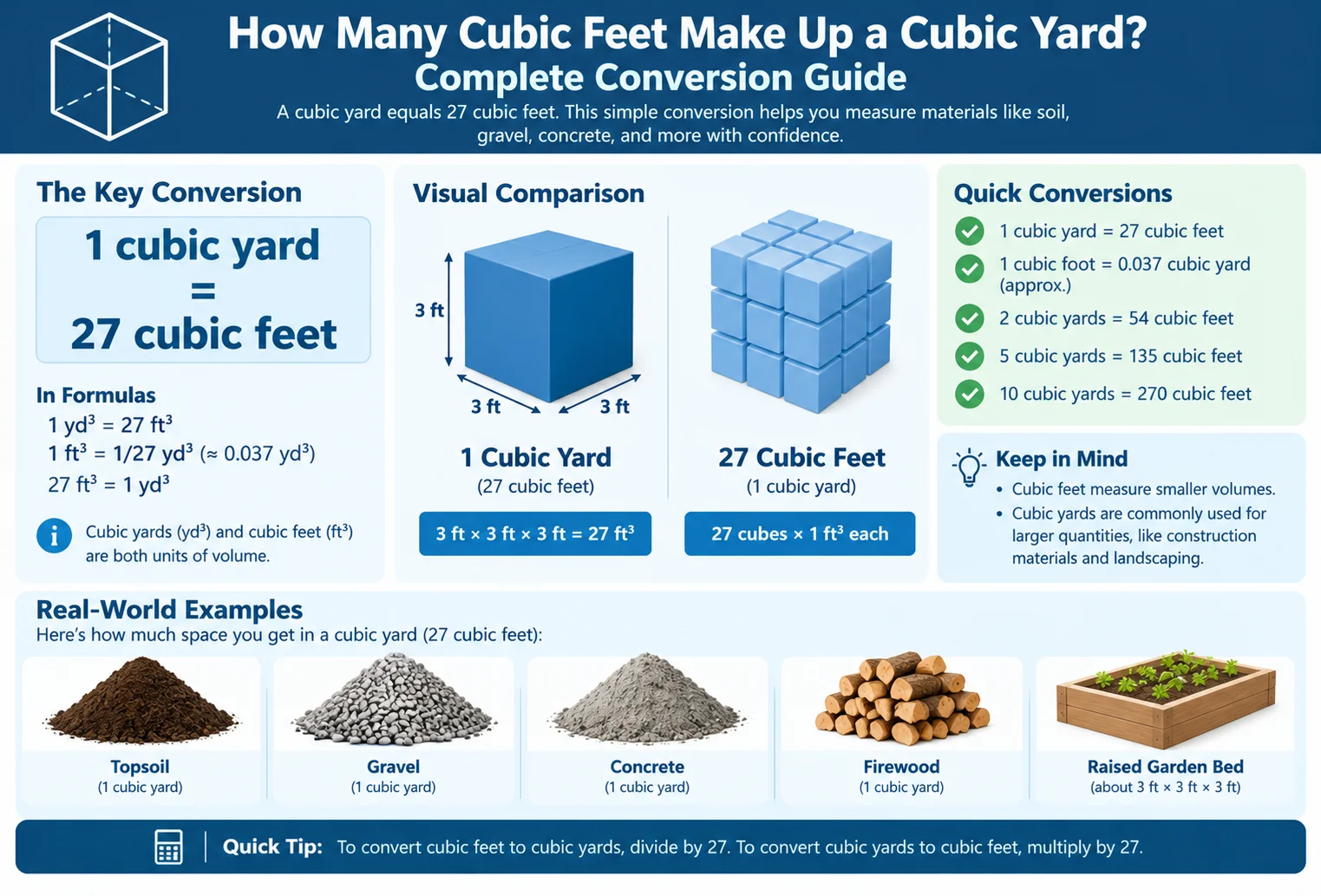
One cubic yard equals 27 cubic feet.
A cubic yard is a unit of volume commonly used for landscaping materials, soil, mulch, gravel, sand, and concrete. A cubic foot is a smaller unit of volume. To convert cubic yards to cubic feet, multiply the number of cubic yards by 27.
| Cubic Yards | Cubic Feet |
|---|---|
| 0.25 cubic yard | 6.75 cubic feet |
| 0.5 cubic yard | 13.5 cubic feet |
| 1 cubic yard | 27 cubic feet |
| 2 cubic yards | 54 cubic feet |
| 3 cubic yards | 81 cubic feet |
| 4 cubic yards | 108 cubic feet |
| 5 cubic yards | 135 cubic feet |
| 10 cubic yards | 270 cubic feet |
What Is a Cubic Foot?
A cubic foot is a unit of volume representing a cube that measures 1 foot long, 1 foot wide, and 1 foot high.
Its volume is:
1 ft × 1 ft × 1 ft = 1 cubic foot
Cubic feet are often used to measure smaller quantities of material, storage capacity, and the volume of boxes or containers.
Because a cubic yard contains 27 cubic feet, you can convert between the two units using a simple multiplication or division formula.
How to Convert Cubic Feet to Cubic Yards
If you know the volume in cubic feet and want to express it in cubic yards, divide the number of cubic feet by 27.
Formula:
Cubic yards = Cubic feet ÷ 27
For example, suppose you have 81 cubic feet of gravel:
81 ÷ 27 = 3 cubic yards
Therefore, 81 cubic feet equals 3 cubic yards.
Cubic feet to cubic yards conversion table
| Cubic Feet | Calculation | Cubic Yards |
|---|---|---|
| 6.75 | 6.75 ÷ 27 | 0.25 |
| 13.5 | 13.5 ÷ 27 | 0.5 |
| 20.25 | 20.25 ÷ 27 | 0.75 |
| 27 | 27 ÷ 27 | 1 |
| 40.5 | 40.5 ÷ 27 | 1.5 |
| 54 | 54 ÷ 27 | 2 |
| 81 | 81 ÷ 27 | 3 |
| 108 | 108 ÷ 27 | 4 |
| 135 | 135 ÷ 27 | 5 |
| 270 | 270 ÷ 27 | 10 |
Remember that converting volume does not change the amount of material. It only changes the unit used to describe that volume.
Why Does a Cubic Yard Equal 27 Cubic Feet?
The answer comes from the relationship between yards and feet.
One yard equals 3 feet. However, cubic measurements involve three dimensions: length, width, and height.
To find the volume of a cube measuring 1 cubic yard, convert each dimension into feet:
- Length: 1 yard = 3 feet
- Width: 1 yard = 3 feet
- Height: 1 yard = 3 feet
Multiply the three dimensions:
3 × 3 × 3 = 27 cubic feet
The conversion factor is therefore 27 because the linear conversion factor of 3 is applied in all three dimensions.
This distinction is important. One square yard equals 9 square feet because area has two dimensions, while one cubic yard equals 27 cubic feet because volume has three dimensions.
| Measurement Type | Dimensions | Conversion |
|---|---|---|
| Linear measurement | Length | 1 yard = 3 feet |
| Area measurement | Length × width | 1 square yard = 9 square feet |
| Volume measurement | Length × width × height | 1 cubic yard = 27 cubic feet |
How to Calculate Cubic Feet From Measurements
You can calculate the volume of a box, container, garden bed, or excavation using its length, width, and height or depth.
For rectangular spaces, use this formula:
Cubic feet = Length in feet × Width in feet × Height or depth in feet
For example, imagine a garden bed that is 6 feet long, 3 feet wide, and 1 foot deep.
6 × 3 × 1 = 18 cubic feet
To convert this volume into cubic yards:
18 ÷ 27 = 0.67 cubic yard, approximately.
You would need about 0.67 cubic yard of material to fill the measured space to the specified depth, before accounting for settling, compaction, or extra material needed.
What if the measurements are in inches?
Convert the measurements to feet first, or calculate the volume in cubic inches and divide by 1,728.
One cubic foot equals 1,728 cubic inches because:
12 × 12 × 12 = 1,728
For example, a box measuring 24 inches long, 18 inches wide, and 12 inches high has a volume of:
24 × 18 × 12 = 5,184 cubic inches
5,184 ÷ 1,728 = 3 cubic feet
This is a useful method when measuring small containers or spaces with a tape measure marked in inches.
How Many Cubic Feet Are in a Cubic Yard of Mulch?
One cubic yard of mulch equals 27 cubic feet, regardless of the mulch type. However, the area it covers depends on the depth at which you spread it.
For a rectangular area, divide the total volume by the depth in feet to determine the coverage area.
Coverage formula:
Square feet covered = Cubic feet ÷ Depth in feet
One cubic yard contains 27 cubic feet, so the approximate coverage is:
| Mulch Depth | Approximate Coverage From 1 Cubic Yard |
|---|---|
| 1 inch | 324 sq ft |
| 2 inches | 162 sq ft |
| 3 inches | 108 sq ft |
| 4 inches | 81 sq ft |
| 6 inches | 54 sq ft |
These figures assume an even layer and do not include extra material for settling, uneven ground, or waste. Follow the recommended depth for your particular landscaping application.
How Many Cubic Feet Are in a Cubic Yard of Soil?
A cubic yard of soil contains 27 cubic feet. If you are filling a garden bed, lawn area, planter, or raised bed, this conversion helps you estimate how much soil to order.
The required volume depends on the area’s length, width, and fill depth.
For example, a garden bed measuring 10 feet long and 3 feet wide, filled to a depth of 1 foot, requires:
10 × 3 × 1 = 30 cubic feet
Convert the result to cubic yards:
30 ÷ 27 = 1.11 cubic yards, approximately.
You would need a little more than 1 cubic yard of soil to fill that space to the measured depth. Actual ordering requirements can vary because loose soil may settle after delivery and watering.
How Many Cubic Feet Are in a Cubic Yard of Gravel?
One cubic yard of gravel also equals 27 cubic feet. The conversion is the same for all materials because cubic yards and cubic feet measure volume, not material type.
However, gravel’s weight depends on its composition, moisture, particle size, and density. A cubic yard of gravel can weigh substantially more than a cubic yard of mulch.
If you are planning a driveway or walkway, calculate the required volume using the area’s dimensions and the intended gravel depth. Check the supplier’s weight and delivery limits before ordering.
How Many Bags Make Up a Cubic Yard?
Bagged materials are often sold in cubic-foot quantities. To determine how many bags equal one cubic yard, divide 27 by the volume of each bag in cubic feet.
Formula:
Number of bags = 27 ÷ Cubic feet per bag
| Bag Size | Bags Needed for 1 Cubic Yard |
|---|---|
| 0.5 cubic foot | 54 bags |
| 0.75 cubic foot | 36 bags |
| 1 cubic foot | 27 bags |
| 1.5 cubic feet | 18 bags |
| 2 cubic feet | 13.5 bags, so 14 whole bags |
| 3 cubic feet | 9 bags |
The table compares volume only. Bagged material may settle during transportation, and the actual amount you need depends on the space being filled and the depth of the material.
Common Mistakes When Converting Cubic Yards to Cubic Feet
Using 3 instead of 27
One yard equals 3 feet, but one cubic yard equals 27 cubic feet. For volume, you must multiply all three dimensions.
Confusing square feet with cubic feet
Square feet measure area, while cubic feet measure volume. If you are calculating how much material fills a space, you need volume measurements.
Forgetting the depth
For landscaping and construction, length and width alone are not enough to calculate volume. You also need the depth or height.
Ignoring compaction and settling
Soil, mulch, and gravel may settle or compact after placement. Your mathematical volume is a starting estimate, and you may need extra material depending on the project.
Rounding too early
Keep your calculation as precise as practical, then round the final purchase quantity to a suitable amount. This helps reduce errors when converting several cubic yards or calculating bag quantities.
Frequently Asked Questions
How many cubic feet make up 1 cubic yard?
One cubic yard equals exactly 27 cubic feet. Multiply 3 feet by 3 feet by 3 feet to calculate the volume of a cubic yard.
How many cubic feet are in half a cubic yard?
Half a cubic yard equals 13.5 cubic feet. Calculate this by multiplying 0.5 by 27.
How many cubic feet are in 2 cubic yards?
Two cubic yards equal 54 cubic feet because 2 × 27 = 54.
How many cubic feet are in 3 cubic yards?
Three cubic yards equal 81 cubic feet. Multiply 3 by 27 to get the result.
Is a cubic yard bigger than a cubic foot?
Yes. A cubic yard is 27 times the volume of a cubic foot. A cubic yard contains 27 cubic feet.
Does the conversion change for soil, mulch, gravel, or concrete?
No. One cubic yard always equals 27 cubic feet, regardless of the material. What changes between materials is their weight, density, moisture content, and how they settle or compact.
How do I convert 100 cubic feet to cubic yards?
Divide 100 by 27:
100 ÷ 27 ≈ 3.70 cubic yards.
Therefore, 100 cubic feet is approximately 3.70 cubic yards.
How many cubic feet are in a cubic yard of concrete?
One cubic yard of concrete equals 27 cubic feet. Concrete suppliers commonly use cubic yards when estimating the quantity needed for slabs, footings, and other construction projects.
Conclusion
One cubic yard contains 27 cubic feet. To convert cubic yards to cubic feet, multiply by 27; to convert cubic feet to cubic yards, divide by 27.
This simple calculation is useful for estimating soil, mulch, gravel, concrete, and other bulk materials. Measure the length, width, and depth of your project, calculate the required volume, and allow for settling or compaction when necessary.
Discover More Articles
How Many Feet Is the Empire State Building?