

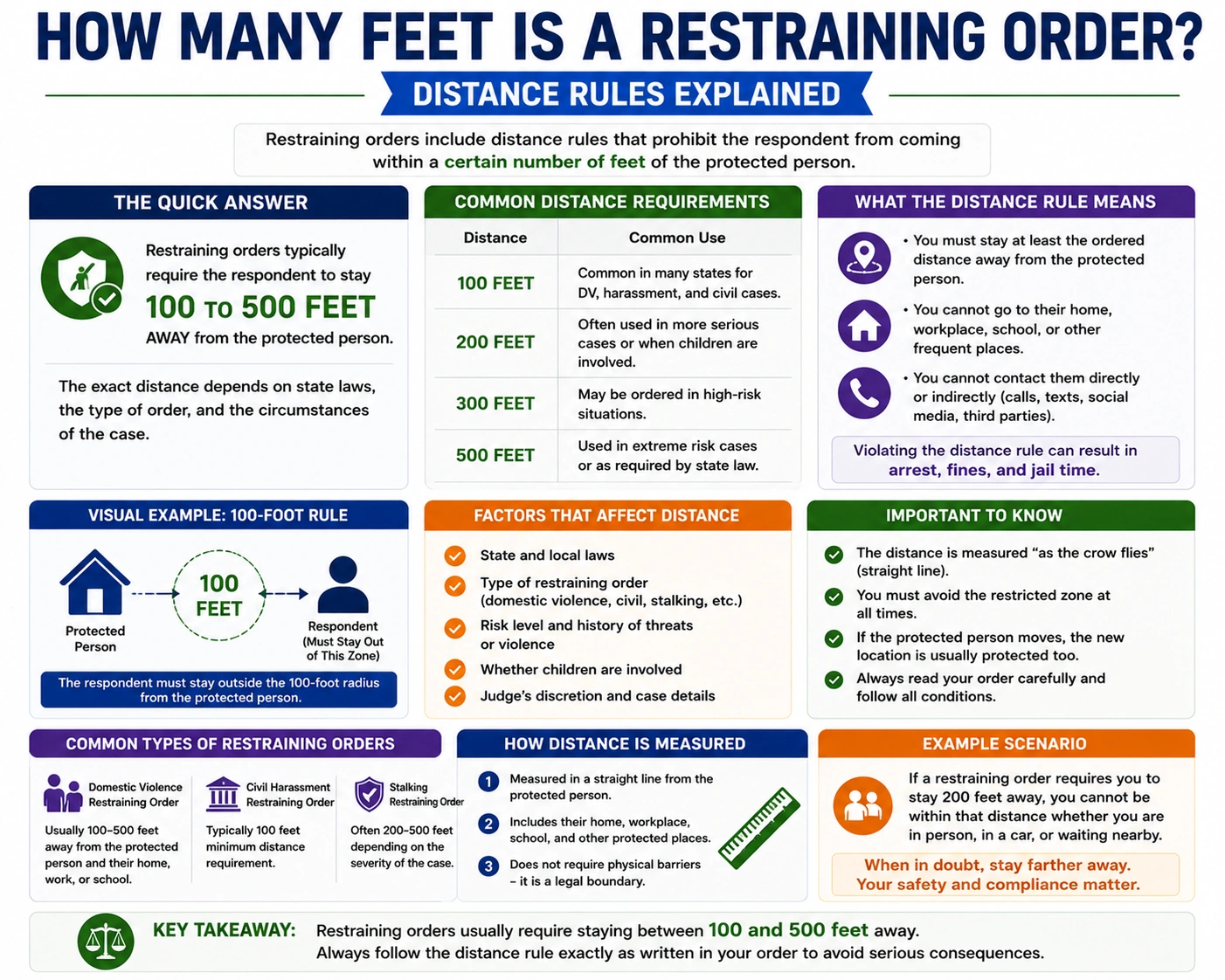
If you are wondering “how many feet is a restraining order,” the answer depends on the specific court order and local laws.
In many cases, restraining orders require a person to stay:
- 50 feet away
- 100 feet away
- 300 feet away
- Or even farther
A very common distance requirement is:
100 feet
However, there is no universal distance that applies to every restraining order. The exact number of feet depends on:
- State laws
- Court decisions
- Safety concerns
- The relationship between the people involved
- The severity of the situation
In this guide, you will learn:
- What a restraining order is
- Common distance requirements
- How courts determine restrictions
- What happens if an order is violated
- Common misconceptions
- Important legal considerations
This article is for general educational purposes and not legal advice.
Quick Answer About Restraining Order Distance
Most restraining orders include “stay-away” requirements.
Common distances include:
- 50 feet
- 100 feet
- 300 feet
- 500 feet
The most frequently used distance in many jurisdictions is around:
100 feet stay-away distance
But every court order is unique.
Some restraining orders may also require:
- No phone calls
- No texts
- No emails
- No social media contact
- No third-party communication
What Is a Restraining Order?
A restraining order is a legal court order that limits contact between individuals.
It is designed to protect someone from:
- Harassment
- Threats
- Abuse
- Stalking
- Violence
Courts issue restraining orders to help improve safety.
Purpose of Protective Orders
Restraining orders aim to:
- Prevent harmful contact
- Establish legal boundaries
- Protect victims
- Reduce conflict
Violating a restraining order can lead to criminal charges.
Types of Restraining Orders
Different courts use different names, including:
- Protective orders
- No-contact orders
- Stay-away orders
- Orders of protection
The exact rules vary by location.
How Many Feet Is a Typical Restraining Order?
There is no single standard distance.
However, courts commonly use certain ranges.
Common Distance Requirements
Typical restraining order distances include:
| Restriction Type | Common Distance |
|---|---|
| Minor stay-away order | 50 feet |
| Standard restraining order | 100 feet |
| School or workplace protection | 300 feet |
| High-risk situations | 500 feet or more |
Some orders may also prohibit entering:
- Neighborhoods
- Buildings
- Parking lots
- Shared public spaces
Examples by Situation
Different situations may result in different restrictions.
Domestic Violence Cases
Courts often require:
- No contact
- 100–300 feet of separation
Workplace Harassment Cases
Orders may prohibit approaching:
- Offices
- Parking areas
- Company property
School Protection Orders
Stay-away distances may extend around:
- Schools
- Bus stops
- Childcare centers
Why Distances Differ
Courts consider many factors when deciding restrictions.
These include:
- Safety risks
- Past incidents
- Threat severity
- Prior violations
- Shared children or housing
No two cases are exactly alike.
Common Types of Distance Restrictions
Restraining orders can apply to many locations.
Home Restrictions
A person may be prohibited from:
- Entering a residence
- Parking nearby
- Visiting neighboring property
Workplace Restrictions
Many orders prohibit contact near:
- Offices
- Job sites
- Parking garages
School Restrictions
Courts often include:
- Schools
- Universities
- Childcare facilities
Especially when children are involved.
Public Place Restrictions
Some orders apply in:
- Restaurants
- Gyms
- Stores
- Religious buildings
- Community centers
How Courts Decide Distance Requirements
Judges determine restraining order conditions based on safety concerns.
Safety Concerns
The primary goal is protection.
Courts evaluate:
- Risk level
- Fear of harm
- Threat history
Past Incidents
Repeated harassment or violence may lead to larger stay-away distances.
Local Laws
State and local laws influence:
- Minimum restrictions
- Enforcement rules
- Penalties
Children and Family Considerations
Cases involving children often require stricter boundaries.
Courts may also create:
- Custody exchange rules
- Supervised visitation plans
What Happens If Someone Violates a Restraining Order?
Violating a restraining order is serious.
Legal Consequences
A violation may result in:
- Arrest
- Fines
- Jail time
- Additional restrictions
Police Enforcement
Law enforcement officers can immediately respond to reported violations.
Criminal Penalties
In some areas, violations become:
- Misdemeanors
- Felonies
Especially for repeated offenses.
Common Misunderstandings About Restraining Orders
Many people misunderstand how restraining orders work.
Assuming Every Order Uses the Same Distance
Not all orders use:
- 100 feet
- 300 feet
- Any fixed number
Always read the exact court order carefully.
Believing Online Contact Is Allowed
Many orders prohibit:
- Social media messages
- Email communication
- Indirect contact
Thinking Accidental Contact Is Automatically Safe
Accidental encounters can still create legal problems.
It is often best to leave immediately and document the situation.
Ignoring Third-Party Contact Rules
Using friends or family members to communicate may violate the order.
Expert Tips for Following a Restraining Order
Understanding the order clearly is very important.
Read the Court Order Carefully
Every restraining order contains specific instructions.
Never assume the rules.
Avoid Indirect Communication
Even indirect contact can violate many orders.
Keep Documentation
Save:
- Court paperwork
- Communication records
- Incident reports
If questions arise later.
Ask an Attorney for Legal Advice
Laws differ by state and situation.
Professional legal guidance is often helpful.
Practical Situations Where Stay-Away Distances Matter
Distance restrictions commonly apply in:
Domestic Violence Cases
These are among the most common restraining order situations.
Stalking Cases
Courts may require large separation distances for safety.
Workplace Disputes
Harassment or threats at work can lead to stay-away orders.
School Safety Cases
Protective orders may apply near students or campuses.
FAQs
How many feet is a typical restraining order?
Many restraining orders require staying 100 feet away, but distances vary by case and court.
Is every restraining order the same distance?
No. Each restraining order may include different restrictions.
Can you go to jail for violating a restraining order?
Yes. Violating a restraining order can result in arrest, fines, or jail time.
Do restraining orders include online communication?
Often yes. Many orders prohibit texts, calls, emails, and social media contact.
What should you do if you accidentally encounter the protected person?
Leave immediately and avoid contact. Legal advice may also help depending on the situation.
Conclusion
So, how many feet is a restraining order?
The answer varies depending on the court order, but common distances include:
- 50 feet
- 100 feet
- 300 feet
- Or more
Typical stay-away distance=100 feet
Restraining orders are legal tools designed to improve safety and reduce harmful contact. Because every case is different, it is important to:
- Read the order carefully
- Follow all restrictions
- Avoid direct or indirect contact
- Seek legal advice when needed
Understanding how restraining orders work can help people better comply with court requirements and avoid serious legal consequences.
Discover More Articles
How Many Square Feet Does a Chicken Need?