

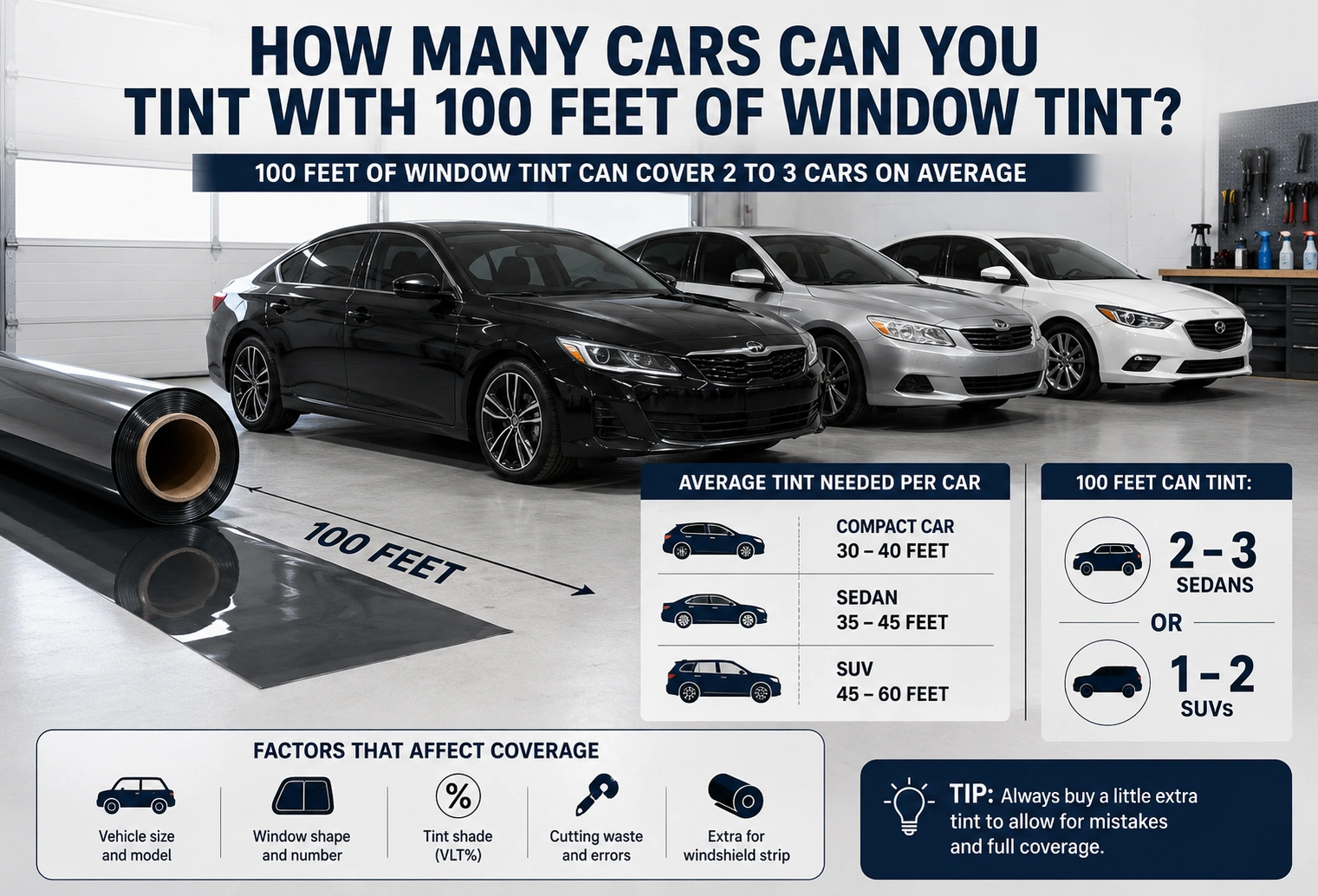
You can typically tint about 8 to 15 cars with 100 linear feet of automotive window tint, depending on the vehicle size, tint-roll width, windows being covered, and installation waste.
For a standard roll that is 60 inches wide, 100 linear feet provides:
100 × 5 = 500 square feet
because 60 inches equals 5 feet.
A typical sedan may require approximately 30–45 square feet of tint film, including cutting allowance. Based on that range, 100 feet of 60-inch-wide film could potentially cover around 11–16 sedans.
In real-world installation, however, waste from cutting, vehicle shape, mistakes, and layout means the practical number may be lower.
Quick Answer
| Vehicle Type | Approx. Tint Film Used per Vehicle* | Cars From 100 Linear Feet** |
|---|---|---|
| Small coupe | 25–35 sq ft | 14–20 |
| Sedan | 30–45 sq ft | 11–16 |
| Small SUV | 35–50 sq ft | 10–14 |
| Large SUV | 45–60 sq ft | 8–11 |
| Pickup truck | 35–55 sq ft | 9–14 |
| Full-size vehicle | 45–65 sq ft | 8–11 |
*Approximate planning figures including cutting allowance can vary substantially.
**Assumes a 60-inch-wide, 100-foot roll and does not represent guaranteed installation yield.
How Much Window Tint Does One Car Need?
The amount of tint needed depends on the vehicle and which windows are being tinted.
A basic automotive tint job may include:
- Front driver window
- Front passenger window
- Rear passenger windows
- Rear windshield
Some installations also include:
- Front windshield
- Small quarter windows
- Sunroof
- Additional glass panels
A small coupe may use considerably less film than a large SUV.
For planning purposes, a typical sedan might require around 30–45 square feet of usable film, while a larger SUV may require 45–60 square feet or more.
How Much Area Is in 100 Feet of Tint?
The phrase “100 feet of tint” usually means 100 linear feet, not 100 square feet.
The total area depends on the width of the tint roll.
For example, a 60-inch-wide roll is 5 feet wide.
Therefore:
100 feet × 5 feet = 500 square feet
So 100 linear feet of 60-inch-wide tint contains approximately 500 square feet of film.
100 Feet of Tint by Roll Width
| Roll Width | Width in Feet | Area in 100 Linear Feet |
| 36 in | 3 ft | 300 sq ft |
| 40 in | 3.33 ft | 333 sq ft |
| 48 in | 4 ft | 400 sq ft |
| 54 in | 4.5 ft | 450 sq ft |
| 60 in | 5 ft | 500 sq ft |
| 72 in | 6 ft | 600 sq ft |
This is why roll width is just as important as roll length when estimating how many vehicles can be tinted.
How Many Sedans Can You Tint With 100 Feet?
Assume the roll is 60 inches wide.
That gives:
100 × 5 = 500 square feet
If one sedan uses approximately 35 square feet:
500 ÷ 35 ≈ 14.3
The theoretical result is about 14 sedans.
If the installation requires 40 square feet per vehicle:
500 ÷ 40 = 12.5
That gives approximately 12 cars after allowing for whole vehicles.
Therefore, a practical estimate for a 100-foot roll of 60-inch-wide film is around 12–14 average sedans, depending on the vehicle and installation process.
How Many SUVs Can You Tint With 100 Feet?
SUVs generally have more glass than compact cars, so they can require more film.
If a typical SUV uses approximately 45 square feet:
500 ÷ 45 ≈ 11.1
That gives approximately 11 SUVs theoretically.
After accounting for waste and cutting patterns, the practical yield may be closer to 9–11 SUVs.
Large SUVs can require even more film.
How Many Pickup Trucks Can You Tint With 100 Feet?
Pickup trucks vary considerably.
A regular-cab truck has fewer side windows than a crew-cab truck, while larger crew-cab models have more glass.
If you estimate approximately 40–50 square feet per truck:
500 ÷ 40 = 12.5
to:
500 ÷ 50 = 10
This gives a rough theoretical range of 10–12 trucks from 500 square feet.
The actual number depends on the truck model and the windows included in the tint job.
Does Tint Roll Width Affect How Many Cars You Can Tint?
Yes.
Roll width has a major effect on total material.
For example, 100 linear feet of 60-inch-wide film provides 500 square feet.
But 100 linear feet of 40-inch-wide film provides only about 333 square feet.
That is a difference of:
500 − 333 = 167 square feet
So two 100-foot rolls can provide very different amounts of material if their widths differ.
How Much Tint Is Needed for Different Vehicle Types?
There is no single amount that applies to every vehicle.
| Vehicle Type | Typical Relative Film Requirement |
| Compact coupe | Lowest |
| Small sedan | Low |
| Midsize sedan | Moderate |
| Full-size sedan | Moderate-high |
| Small SUV | High |
| Crossover | High |
| Large SUV | Very high |
| Crew-cab pickup | High |
| Van | Very high |
The number of windows, window dimensions, glass shape, and whether the windshield is included all affect material use.
How Much Extra Tint Should You Allow for Waste?
You should not expect 100% of a roll to become usable installed film.
Waste can result from:
- Window shape
- Cutting patterns
- Curved glass
- Small unusable pieces
- Installation mistakes
- Damaged film
- Re-cuts
- Vehicle-specific window dimensions
A shop with efficient cutting techniques may achieve a better yield than someone installing tint for the first time.
For estimating inventory, allowing approximately 10–20% for waste can provide a more realistic planning figure, although actual waste varies by installer and vehicle.
Example: Calculating Cars From a 100-Foot Roll
Suppose you have:
- 100 linear feet of film
- 60-inch roll width
- 500 square feet of total film
- 40 square feet used per sedan
The theoretical number of cars is:
500 ÷ 40 = 12.5 cars
That means the roll provides enough material for approximately 12 complete cars, with some material remaining.
If you account for 15% material waste:
500 × 0.85 = 425 usable square feet
Then:
425 ÷ 40 = 10.625
Your practical yield could be around 10 cars.
This example demonstrates why the number of cars per roll can differ between theoretical coverage and actual shop production.
Can You Tint the Windshield With the Same Amount of Film?
Adding the windshield increases the amount of film required.
A full windshield is considerably larger than a typical side window.
If your calculation is based only on side and rear windows, adding the windshield can reduce the number of vehicles you can complete from the roll.
Windshield tinting also involves additional installation considerations and must comply with applicable laws.
Does Vehicle Size Matter?
Yes.
A compact coupe may have considerably less glass than a three-row SUV.
For example, if a compact car requires 30 square feet while a large SUV requires 55 square feet:
500 ÷ 30 ≈ 16.7
while:
500 ÷ 55 ≈ 9.1
The same 100-foot roll could therefore theoretically cover about 16 compact vehicles or 9 large SUVs.
Frequently Asked Questions
How many cars can you tint with 100 feet of tint?
A practical estimate is around 8–15 vehicles, depending on roll width, vehicle size, windows being tinted, and material waste. With a 60-inch-wide roll, an average sedan may yield roughly 10–14 vehicles.
How many square feet is 100 feet of tint?
It depends on the roll width. A 60-inch-wide roll contains approximately 500 square feet in 100 linear feet.
How many cars can a 100-foot roll of 60-inch tint cover?
A 100-foot, 60-inch-wide roll contains approximately 500 square feet. Depending on vehicle size and waste, it may cover roughly 8–15 cars.
How much tint does one sedan need?
A typical sedan may require approximately 30–45 square feet of film, depending on the windows being tinted and the cutting allowance.
How much tint does an SUV need?
A typical SUV may require approximately 35–60 square feet or more, depending on its size and number of windows.
Does tinting the windshield use more film?
Yes. Adding the windshield increases the total amount of film required per vehicle.
Does tint roll width matter?
Yes. A 100-foot roll that is 60 inches wide contains substantially more material than a 100-foot roll that is 36 or 40 inches wide.
How much tint should I buy for 10 cars?
For 10 average vehicles, the required amount depends on vehicle type and roll width. With a 60-inch-wide roll, approximately 400–500 square feet may be a reasonable starting point for planning, but installers should calculate based on the actual vehicles and expected waste.
Conclusion
So, how many cars can you tint with 100 feet?
A reasonable practical estimate is about 8–15 cars, but the exact number depends on the roll width, vehicle size, windows being tinted, and cutting waste.
If the tint is 60 inches wide, 100 linear feet provides:
100 × 5 = 500 square feet
For an average sedan using around 35–45 square feet of film, the theoretical yield is approximately 11–14 vehicles. After accounting for cutting and installation waste, the actual number may be closer to 10–12 cars.
For accurate inventory planning, calculate the square footage of film needed for the specific vehicle models you tint and include an allowance for waste rather than relying on linear feet alone.
Discover More Articles
How Many Tons for 1,600 Square Feet? AC Size Guide