

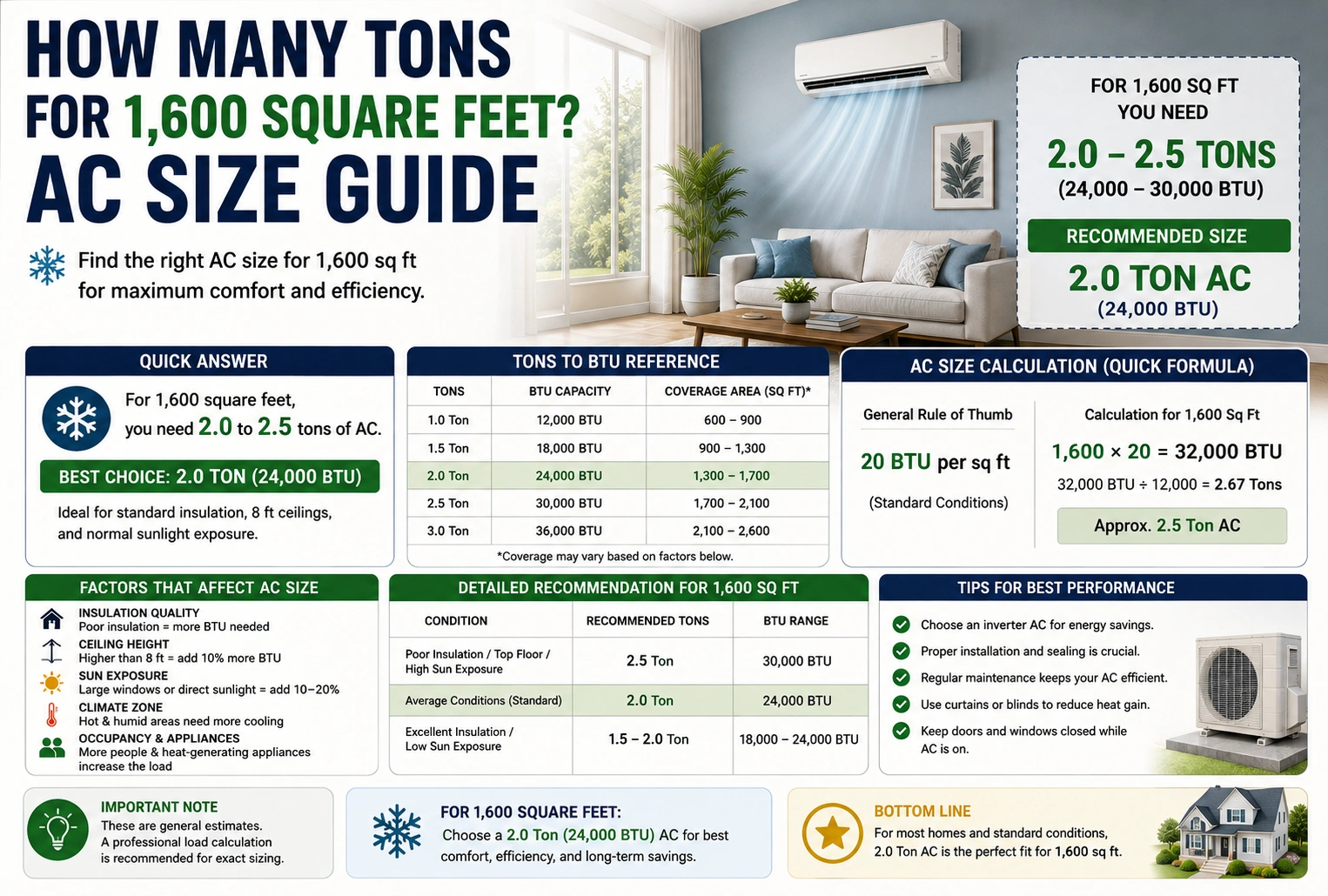
A 1,600-square-foot home will often need around 2.5 to 3 tons of air-conditioning capacity, but the correct size depends on climate, insulation, windows, ceiling height, sun exposure, and other factors.
A rough sizing estimate can put a 1,600-square-foot home in the range of approximately 30,000–36,000 BTU per hour, which equals 2.5–3 tons of cooling.
The exact requirement should be determined using a proper cooling-load calculation rather than square footage alone.
Quick Answer
| AC Size | BTU/hr | Approx. Square Footage Range* |
|---|---|---|
| 2 tons | 24,000 BTU | Up to about 1,200–1,400 sq ft |
| 2.5 tons | 30,000 BTU | About 1,400–1,700 sq ft |
| 3 tons | 36,000 BTU | About 1,600–2,000 sq ft |
| 3.5 tons | 42,000 BTU | About 1,900–2,300 sq ft |
| 4 tons | 48,000 BTU | About 2,200–2,600 sq ft |
*These are broad estimates, not universal sizing rules.
For many average 1,600-square-foot homes, 2.5 or 3 tons may be considered during preliminary planning.
How Many BTUs Does 1,600 Square Feet Need?
A common preliminary estimate for cooling is approximately 20–30 BTUs per square foot, although actual cooling loads can vary.
Using that range:
1,600 × 20 = 32,000 BTU
1,600 × 30 = 48,000 BTU
This produces a broad estimate of 32,000–48,000 BTU/hr.
Because one ton of cooling equals 12,000 BTU/hr:
32,000 ÷ 12,000 ≈ 2.67 tons
and:
48,000 ÷ 12,000 = 4 tons
This demonstrates why a simple BTU-per-square-foot calculation can produce a wide range. A proper load calculation is more reliable for selecting equipment.
How Many Tons Is 30,000 BTU?
One ton of cooling equals 12,000 BTU per hour.
Therefore:
30,000 ÷ 12,000 = 2.5 tons
So a 30,000-BTU air conditioner is a 2.5-ton unit.
For a 1,600-square-foot home, a 2.5-ton system may be appropriate in some situations, particularly when the home has favorable insulation and climate conditions.
How Many Tons Is 36,000 BTU?
A 36,000-BTU air conditioner equals:
36,000 ÷ 12,000 = 3 tons
Therefore, a 36,000-BTU system is a 3-ton AC unit.
A 3-ton system is a common size that may be considered for a 1,600-square-foot home, but whether it is actually appropriate depends on the home’s calculated cooling load.
Is 2.5 Tons Enough for 1,600 Square Feet?
It can be.
A 2.5-ton AC provides:
2.5 × 12,000 = 30,000 BTU/hr
For a 1,600-square-foot home, that equals:
30,000 ÷ 1,600 = 18.75 BTU per square foot
Whether this is enough depends on the building.
A well-insulated 1,600-square-foot home in a moderate climate may need less cooling than an older home with poor insulation and substantial solar exposure.
Is 3 Tons Enough for 1,600 Square Feet?
A 3-ton system provides:
3 × 12,000 = 36,000 BTU/hr
For 1,600 square feet:
36,000 ÷ 1,600 = 22.5 BTU per square foot
A 3-ton system may be suitable for many 1,600-square-foot homes, but it should not be selected solely because of the square footage.
A professional load calculation considers the home’s actual heat gain before recommending equipment.
2.5-Ton vs. 3-Ton AC for 1,600 Square Feet
| Feature | 2.5-Ton AC | 3-Ton AC |
| Cooling capacity | 30,000 BTU/hr | 36,000 BTU/hr |
| BTU per sq ft for 1,600 sq ft | 18.75 | 22.5 |
| Capacity difference | — | 6,000 BTU more |
| Potential use | Efficient/moderate-load homes | Higher cooling-load homes |
| Best choice | Depends on load calculation | Depends on load calculation |
Neither size is automatically correct for every 1,600-square-foot house.
What Size AC for 1,600 Square Feet in a Hot Climate?
A hot climate can increase the cooling load.
A home in a very hot region may require more cooling capacity than an identical home in a mild climate.
However, climate alone does not determine the AC size.
Factors such as insulation, roof construction, window area, window orientation, air leakage, and ceiling height also influence cooling demand.
For that reason, a 3-ton unit may be appropriate for one 1,600-square-foot house but oversized or undersized for another.
What Size AC for 1,600 Square Feet in a Mild Climate?
A well-insulated home in a mild climate may require less cooling capacity.
In some cases, a 2.5-ton unit could provide sufficient capacity.
If the house has excellent insulation, energy-efficient windows, limited sun exposure, and good air sealing, its actual cooling load may be lower than a basic square-footage estimate suggests.
Why Square Footage Is Not Enough to Choose AC Tonnage
Square footage tells you how large the floor area is, but it does not tell you how quickly the home gains heat.
Two homes with exactly 1,600 square feet can have very different cooling loads.
| Factor | Effect on Cooling Need |
| Hot climate | Increases cooling demand |
| Poor insulation | Increases cooling demand |
| Large sunny windows | Increases cooling demand |
| High ceilings | Can increase cooling demand |
| Good insulation | Reduces cooling demand |
| Energy-efficient windows | Can reduce cooling demand |
| Shade from trees/buildings | Can reduce cooling demand |
| Good air sealing | Reduces unwanted heat gain |
This is why professional HVAC sizing uses a detailed load calculation.
What Is a Ton of AC?
In air conditioning, a ton is a measurement of cooling capacity.
One ton equals:
12,000 BTU per hour
The term does not refer to the physical weight of the air conditioner.
| AC Tonnage | Cooling Capacity |
| 1 ton | 12,000 BTU/hr |
| 1.5 tons | 18,000 BTU/hr |
| 2 tons | 24,000 BTU/hr |
| 2.5 tons | 30,000 BTU/hr |
| 3 tons | 36,000 BTU/hr |
| 3.5 tons | 42,000 BTU/hr |
| 4 tons | 48,000 BTU/hr |
Can an AC Be Too Large for 1,600 Square Feet?
Yes.
Installing an AC that is substantially larger than the home’s actual cooling load can cause problems.
An oversized unit may cool the house very quickly and shut off before running long enough to properly remove humidity.
This can lead to:
- Short cycling
- Uneven temperatures
- Higher humidity
- Reduced comfort
- More frequent starts and stops
The goal is not simply to install the largest available system. The goal is to match the system’s capacity to the home’s actual cooling load.
Can an AC Be Too Small for 1,600 Square Feet?
Yes.
An undersized AC may run continuously during hot weather without maintaining the desired indoor temperature.
Potential problems include:
- Poor cooling
- Long operating cycles
- Excessive wear
- Higher electricity use
- Difficulty maintaining temperature
Proper sizing helps avoid both excessive and insufficient capacity.
Does Insulation Affect AC Size?
Yes.
Insulation slows heat transfer between the conditioned interior and the outdoor environment.
A well-insulated 1,600-square-foot house generally requires less cooling capacity than a poorly insulated house of the same size.
Roof insulation is especially important because roofs can receive substantial solar heat during hot weather.
Do Windows Affect AC Tonnage?
Yes.
Windows can have a significant effect on cooling load.
Large windows, especially those exposed to strong direct sunlight, can increase the amount of heat entering the home.
Energy-efficient windows, window treatments, exterior shading, and appropriate orientation can reduce solar heat gain.
Does Ceiling Height Affect AC Sizing?
Yes.
Square footage measures floor area, while ceiling height affects the volume of conditioned air.
For example, a 1,600-square-foot house with 8-foot ceilings has:
1,600 × 8 = 12,800 cubic feet
A 1,600-square-foot house with 10-foot ceilings has:
1,600 × 10 = 16,000 cubic feet
The second home has significantly more conditioned volume.
Ceiling height is therefore one of the factors that can influence HVAC sizing.
Frequently Asked Questions
How many tons of AC do I need for 1,600 square feet?
A 1,600-square-foot home will often be considered in the 2.5- to 3-ton range for preliminary planning, but the correct size depends on the home’s actual cooling load.
Is 2.5 tons enough for 1,600 square feet?
It can be, especially in a well-insulated home with a moderate cooling load. A 2.5-ton system provides 30,000 BTU/hr.
Is 3 tons too much for 1,600 square feet?
Not necessarily. A 3-ton system provides 36,000 BTU/hr and may be appropriate depending on climate, insulation, windows, and other factors.
How many BTUs is a 3-ton AC?
A 3-ton AC provides 36,000 BTU/hr of nominal cooling capacity.
How many BTUs is a 2.5-ton AC?
A 2.5-ton AC provides 30,000 BTU/hr.
What size AC do I need for a 1,600-square-foot house?
A rough preliminary estimate is 2.5–3 tons, but an HVAC professional should determine the final size using a cooling-load calculation.
Does climate affect how many tons I need?
Yes. Hotter climates generally create higher cooling loads, while milder climates can require less cooling capacity.
Can a 4-ton AC cool 1,600 square feet?
It may physically cool the space, but it could be oversized depending on the home’s actual cooling load. Oversizing can cause short cycling and humidity-control problems.
Conclusion
So, how many tons for 1,600 square feet?
A reasonable preliminary estimate is about 2.5 to 3 tons of AC, equivalent to approximately 30,000–36,000 BTU/hr.
A 2.5-ton unit provides:
2.5 × 12,000 = 30,000 BTU/hr
A 3-ton unit provides:
3 × 12,000 = 36,000 BTU/hr
The correct choice depends on climate, insulation, windows, ceiling height, air leakage, sun exposure, occupancy, and other characteristics of the home.
For the most accurate result, use a professional Manual J cooling-load calculation rather than choosing an AC solely from the home’s square footage.
Discover More Articles
How Many Square Feet Will 80,000 BTU Heat?