

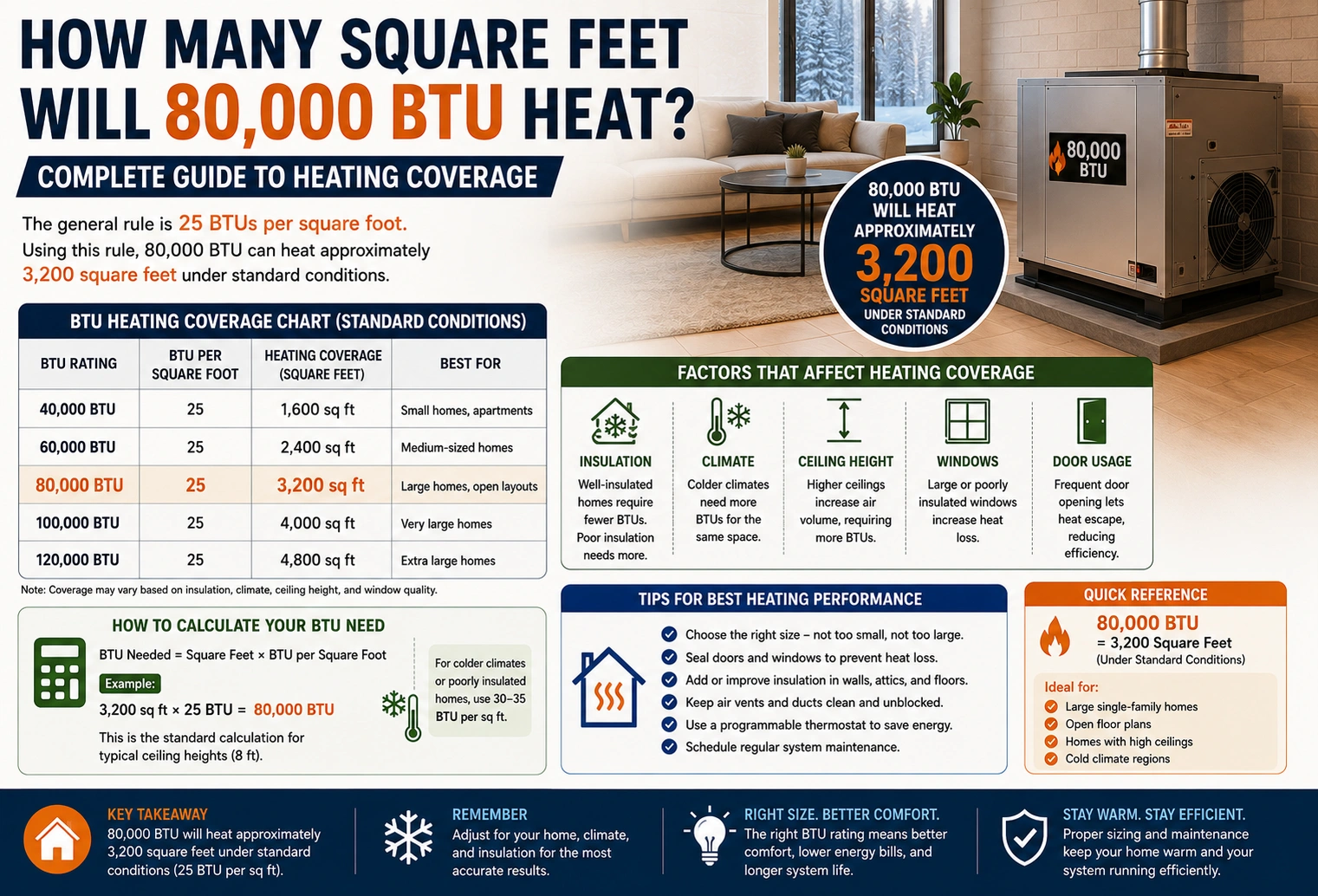
An 80,000 BTU furnace or heating system may heat approximately 1,600–4,000 square feet, depending on climate, insulation, home construction, ceiling height, windows, and heat loss.
For a simple estimate, you can divide the furnace’s BTU capacity by the estimated BTUs required per square foot.
For example, at 40 BTUs per square foot:
80,000 ÷ 40 = 2,000 square feet
At 30 BTUs per square foot:
80,000 ÷ 30 ≈ 2,667 square feet
At 50 BTUs per square foot:
80,000 ÷ 50 = 1,600 square feet
So, an 80,000 BTU heating system could cover around 1,600–2,700 square feet under many common assumptions, while highly efficient homes in milder climates may potentially require less capacity per square foot.
Quick Answer
An 80,000 BTU heater can roughly heat 1,600–4,000 square feet, but a more practical preliminary range for many homes is approximately 2,000–2,700 square feet.
| Heating Requirement | Approx. Area Heated by 80,000 BTU |
|---|---|
| 20 BTU/sq ft | 4,000 sq ft |
| 25 BTU/sq ft | 3,200 sq ft |
| 30 BTU/sq ft | 2,667 sq ft |
| 35 BTU/sq ft | 2,286 sq ft |
| 40 BTU/sq ft | 2,000 sq ft |
| 50 BTU/sq ft | 1,600 sq ft |
| 60 BTU/sq ft | 1,333 sq ft |
These are mathematical estimates. Actual furnace sizing should be based on the home’s calculated heat loss.
How Do You Calculate 80,000 BTU Heating Coverage?
The basic formula is:
Square Feet = BTUs ÷ BTUs Required per Square Foot
For example, if a house requires 40 BTUs per square foot:
80,000 ÷ 40 = 2,000 square feet
So an 80,000 BTU system would provide approximately 40 BTUs per square foot for a 2,000-square-foot home.
If the home requires only 30 BTUs per square foot:
80,000 ÷ 30 ≈ 2,667 square feet
This illustrates why the same 80,000 BTU furnace can serve different home sizes.
Is 80,000 BTU Enough for 2,000 Square Feet?
An 80,000 BTU furnace can be enough for a 2,000-square-foot home under many conditions.
The calculation is:
80,000 ÷ 2,000 = 40 BTUs per square foot
A requirement of 40 BTUs per square foot can be reasonable for some homes, depending on climate and construction.
However, an 80,000 BTU furnace could be too large for a highly efficient home in a mild climate or too small for a poorly insulated home in an extremely cold climate.
Is 80,000 BTU Enough for 2,500 Square Feet?
It can be.
For a 2,500-square-foot home:
80,000 ÷ 2,500 = 32 BTUs per square foot
If the home’s heat loss is around 32 BTUs per square foot, an 80,000 BTU system could provide the required capacity.
This may be possible in a reasonably insulated home, but the exact requirement depends on local weather conditions and the building envelope.
Is 80,000 BTU Enough for 3,000 Square Feet?
An 80,000 BTU system can potentially heat 3,000 square feet if the home has a relatively low heating load.
The calculation is:
80,000 ÷ 3,000 ≈ 26.7 BTUs per square foot
That is a relatively low heating requirement compared with homes in colder climates.
A highly efficient, well-insulated house may be able to use an 80,000 BTU furnace for this size, while an older or poorly insulated house may require more capacity.
Is 80,000 BTU Enough for 1,500 Square Feet?
For 1,500 square feet:
80,000 ÷ 1,500 ≈ 53.3 BTUs per square foot
An 80,000 BTU furnace can certainly provide substantial heating capacity for a 1,500-square-foot home.
However, depending on the home’s heat loss, it could be significantly oversized.
An oversized furnace may cycle on and off more frequently than necessary, which can affect comfort, efficiency, and equipment operation.
80,000 BTU Coverage by Home Size
| Home Size | BTUs Available per Sq Ft |
| 1,500 sq ft | 53.3 BTU/sq ft |
| 1,750 sq ft | 45.7 BTU/sq ft |
| 2,000 sq ft | 40 BTU/sq ft |
| 2,250 sq ft | 35.6 BTU/sq ft |
| 2,500 sq ft | 32 BTU/sq ft |
| 2,750 sq ft | 29.1 BTU/sq ft |
| 3,000 sq ft | 26.7 BTU/sq ft |
| 3,500 sq ft | 22.9 BTU/sq ft |
| 4,000 sq ft | 20 BTU/sq ft |
This table shows the theoretical BTU capacity per square foot. It does not determine whether a particular house actually needs that amount.
What Factors Affect How Much 80,000 BTU Can Heat?
Square footage is only one factor in furnace sizing.
Climate
The colder the climate, the more heating capacity a building generally needs.
An 80,000 BTU furnace may heat a larger home in a mild climate than it would in an area with severe winter temperatures.
Insulation
Insulation reduces heat transfer through walls, ceilings, floors, and attics.
A well-insulated home loses heat more slowly and may require less furnace capacity.
Windows
Windows can be a major source of heat loss.
Older single-pane windows generally lose more heat than modern, energy-efficient windows.
Ceiling Height
A house with 8-foot ceilings has less conditioned volume than a house with 10- or 12-foot ceilings.
Higher ceilings can increase heating requirements.
Air Leakage
Drafts around doors, windows, vents, and other openings can significantly increase heat loss.
A well-sealed home can retain heat more effectively.
Home Layout
An open floor plan can distribute heat differently from a home with many enclosed rooms.
The location and number of heating registers or indoor units also affect comfort.
80,000 BTU Furnace Size Comparison
| Furnace Capacity | Approx. Coverage at 40 BTU/Sq Ft |
| 40,000 BTU | 1,000 sq ft |
| 50,000 BTU | 1,250 sq ft |
| 60,000 BTU | 1,500 sq ft |
| 70,000 BTU | 1,750 sq ft |
| 80,000 BTU | 2,000 sq ft |
| 90,000 BTU | 2,250 sq ft |
| 100,000 BTU | 2,500 sq ft |
| 120,000 BTU | 3,000 sq ft |
This comparison assumes a constant 40 BTUs per square foot and is intended only for illustrating the calculation.
Is an 80,000 BTU Furnace the Same as 80,000 BTU Output?
Not always.
A furnace’s listed BTU rating may refer to its input capacity, while its actual heating output can be lower because of efficiency losses.
For example, a furnace with an 80,000 BTU input rating and 80% annual fuel utilization efficiency would have a nominal output around:
80,000 × 0.80 = 64,000 BTU
A higher-efficiency furnace with the same input rating can produce more usable heat.
Therefore, when comparing furnaces, check both input BTU and output BTU.
What Is the Difference Between Furnace Input and Output?
Input BTU refers to the amount of fuel energy entering the furnace.
Output BTU refers to the amount of heat delivered to the home.
For example:
| Furnace Input | Efficiency | Approx. Output |
| 80,000 BTU | 80% | 64,000 BTU |
| 80,000 BTU | 90% | 72,000 BTU |
| 80,000 BTU | 95% | 76,000 BTU |
| 80,000 BTU | 98% | 78,400 BTU |
Actual performance can vary by equipment and operating conditions.
This distinction is important when determining whether an 80,000 BTU furnace is large enough for a home.
Can an 80,000 BTU Furnace Be Too Large?
Yes.
A furnace can be oversized even if it heats the home quickly.
An oversized furnace may:
- Cycle on and off frequently
- Provide less consistent temperatures
- Increase mechanical wear
- Reduce comfort
- Operate less efficiently in some situations
Modern variable-speed and modulating systems can behave differently, but correct sizing is still important.
Can an 80,000 BTU Furnace Be Too Small?
Yes.
If the heating capacity is lower than the home’s heat loss during cold weather, the furnace may run for long periods without maintaining the desired temperature.
Potential signs include:
- Furnace runs continuously
- Indoor temperature falls during very cold weather
- Rooms remain cold
- System struggles to reach the thermostat setting
A professional heat-loss calculation can help determine whether the furnace has sufficient capacity.
How Many BTUs Do You Need for 2,000 Square Feet?
A rough estimate depends on the BTU-per-square-foot requirement.
| BTU/Sq Ft | BTUs Needed for 2,000 Sq Ft |
| 20 | 40,000 BTU |
| 25 | 50,000 BTU |
| 30 | 60,000 BTU |
| 35 | 70,000 BTU |
| 40 | 80,000 BTU |
| 50 | 100,000 BTU |
| 60 | 120,000 BTU |
At 40 BTUs per square foot, an 80,000 BTU system corresponds to 2,000 square feet.
How Many BTUs Do You Need for 2,500 Square Feet?
For a 2,500-square-foot home:
| BTU/Sq Ft | Required Capacity |
| 20 | 50,000 BTU |
| 25 | 62,500 BTU |
| 30 | 75,000 BTU |
| 32 | 80,000 BTU |
| 35 | 87,500 BTU |
| 40 | 100,000 BTU |
| 50 | 125,000 BTU |
At approximately 32 BTUs per square foot, an 80,000 BTU system would match a 2,500-square-foot home.
How Many BTUs Do You Need for 3,000 Square Feet?
For 3,000 square feet:
| BTU/Sq Ft | Required Capacity |
| 20 | 60,000 BTU |
| 25 | 75,000 BTU |
| 26.7 | 80,000 BTU |
| 30 | 90,000 BTU |
| 35 | 105,000 BTU |
| 40 | 120,000 BTU |
| 50 | 150,000 BTU |
An 80,000 BTU system corresponds to approximately 26.7 BTUs per square foot for a 3,000-square-foot home.
Frequently Asked Questions
How many square feet will 80,000 BTU heat?
An 80,000 BTU heating system may heat approximately 1,600–4,000 square feet, depending on the required BTUs per square foot. For many homes, 2,000–2,700 square feet is a useful preliminary range.
Is 80,000 BTU enough for 2,000 square feet?
It can be. At 2,000 square feet, an 80,000 BTU system provides 40 BTUs per square foot.
Is 80,000 BTU enough for 2,500 square feet?
It can be in a reasonably efficient home. An 80,000 BTU system provides 32 BTUs per square foot for 2,500 square feet.
Is 80,000 BTU enough for 3,000 square feet?
It may be enough for a highly efficient home or a mild climate, but it may be undersized for a poorly insulated home or colder climate.
Is 80,000 BTU too much for 1,500 square feet?
It could be. At 1,500 square feet, an 80,000 BTU system provides approximately 53.3 BTUs per square foot, which may exceed the actual heat loss of an efficient home.
Does an 80,000 BTU furnace always produce 80,000 BTUs of heat?
No. If 80,000 BTUs refers to furnace input, the actual heat output will be lower depending on the furnace’s efficiency.
Does insulation affect how much area an 80,000 BTU furnace can heat?
Yes. Better insulation generally reduces heat loss, allowing a given heating capacity to serve a larger area.
Does climate affect 80,000 BTU furnace coverage?
Yes. Homes in colder climates generally require more BTUs per square foot than homes in mild climates.
Should I choose a furnace based only on square footage?
No. Square footage is useful for a preliminary estimate, but proper furnace sizing should be based on a heat-loss calculation.
Conclusion
So, how many square feet will 80,000 BTU heat? A reasonable preliminary estimate is approximately 2,000–2,700 square feet for many residential applications, although the possible range can extend from roughly 1,600 to 4,000 square feet depending on the building and climate.
The basic calculation is:
Square Feet = 80,000 ÷ Required BTUs per Square Foot
For example:
80,000 ÷ 40 = 2,000 square feet
and:
80,000 ÷ 30 ≈ 2,667 square feet
The actual answer depends on climate, insulation, windows, ceiling height, air leakage, home layout, and the furnace’s actual output capacity.
For a permanent heating installation, do not size the furnace from square footage alone. A professional heat-loss calculation provides a much more reliable way to determine the appropriate heating capacity.
Discover More Articles
How Many Square Feet Does a Mini Split Cool? Sizing Guide