

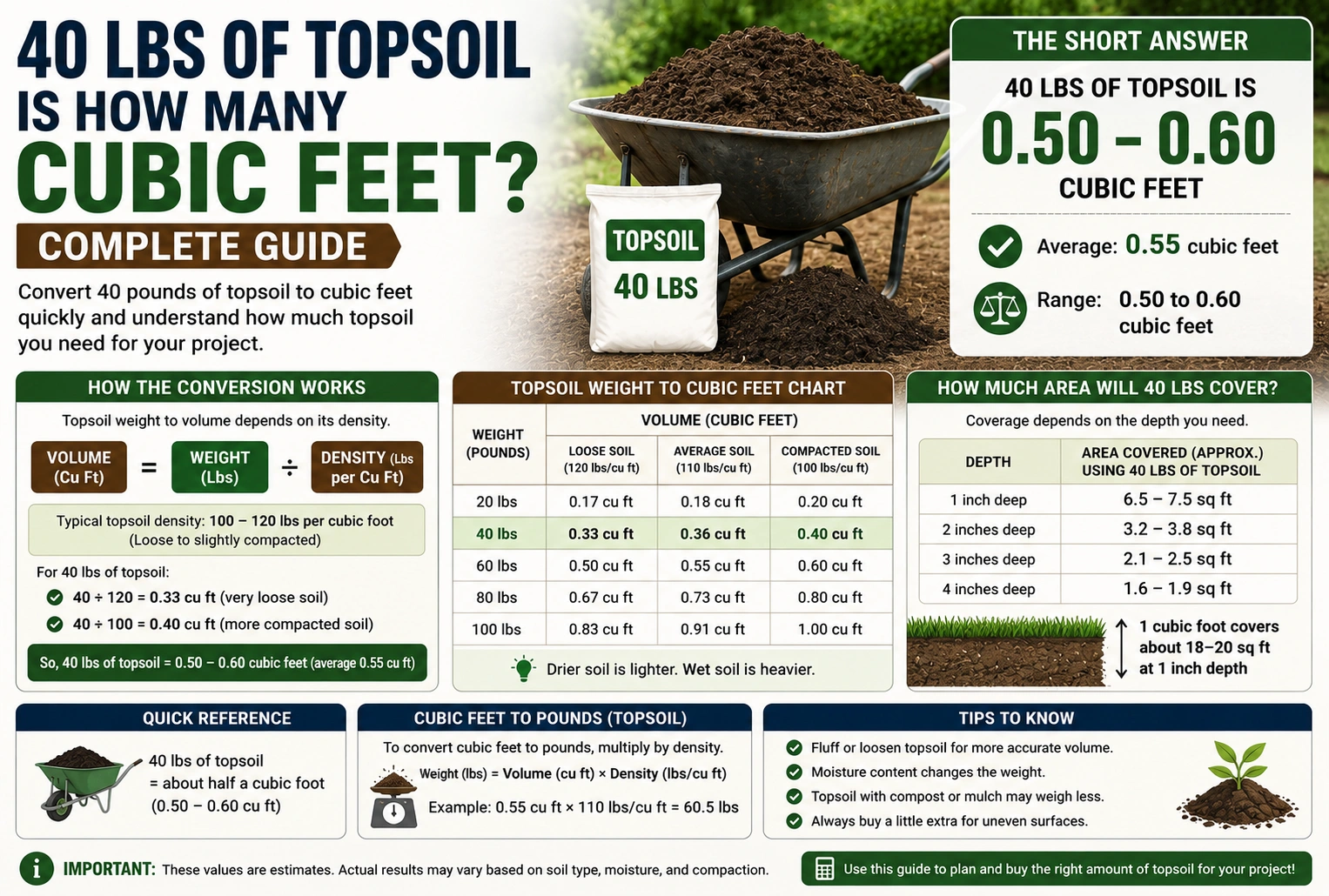
If you’re asking 40 lbs of topsoil is how many cubic feet, there is no single exact answer based on weight alone because topsoil density varies.
As a practical estimate, a 40-pound bag of topsoil may contain roughly 0.5 cubic feet of material, although the actual volume depends on the product’s moisture content, composition, and density.
Always check the bag label for the manufacturer’s stated volume when available.
| Topsoil Amount | Approximate Volume |
|---|---|
| 40 lb bag | ~0.5 cubic ft |
| 2 × 40 lb bags | ~1 cubic ft |
| 27 × 40 lb bags* | ~13.5 cubic ft |
| 54 × 40 lb bags* | ~27 cubic ft |
| 1 cubic yard | 27 cubic ft |
*These are mathematical estimates based on 0.5 cubic foot per bag, not universal product specifications.
Why 40 Pounds of Topsoil Does Not Equal One Fixed Volume
Weight and volume measure different things.
Pounds measure weight.
Cubic feet measure volume.
A 40-pound bag of dry, dense soil can occupy a different amount of space from a 40-pound bag of lighter, more organic soil.
Moisture also matters.
Wet soil generally weighs more for the same volume than dry soil. This means two bags that each weigh 40 pounds can potentially have different volumes depending on their composition and moisture level.
That is why the most reliable answer comes from the volume printed on the specific product bag.
Estimated Cubic Feet in a 40-Lb Bag
For a general planning estimate, you can use approximately:
40 lb of topsoil ≈ 0.5 cubic feet
This is a useful estimate when you’re trying to plan a small gardening or landscaping project.
However, don’t treat 0.5 cubic feet as a universal specification for every 40-pound bag.
For example, if a manufacturer states that its 40-pound bag contains 0.75 cubic feet, use 0.75 cubic feet instead of the general estimate.
The product label always takes priority.
How to Convert Topsoil Weight to Volume
If you know the soil’s density, you can calculate volume from weight.
The basic relationship is:
Volume = Weight ÷ Density
However, density must be expressed in compatible units, such as pounds per cubic foot.
For example, if a particular soil has a density of 80 pounds per cubic foot:
40 ÷ 80 = 0.5 cubic feet
So 40 pounds would occupy approximately 0.5 cubic feet at that assumed density.
But soil density is not constant.
It can change because of:
- Moisture
- Organic matter
- Sand content
- Clay content
- Compaction
- Product formulation
For this reason, a simple weight-to-volume estimate should be used for planning rather than as an exact product measurement.
40-Lb Topsoil Coverage by Depth
Once you know the approximate volume, you can estimate how much area the soil can cover.
If a 40-pound bag contains approximately 0.5 cubic feet, its coverage would be:
| Soil Depth | Approximate Coverage |
|---|---|
| 1 inch | 6 sq ft |
| 2 inches | 3 sq ft |
| 3 inches | 2 sq ft |
| 4 inches | 1.5 sq ft |
| 6 inches | 1 sq ft |
These figures assume a volume of exactly 0.5 cubic feet.
The calculation is based on:
Square feet = Cubic feet × 12 ÷ Depth in inches
For example, at 2 inches:
0.5 × 12 ÷ 2 = 3 square feet
So approximately half a cubic foot of topsoil can cover 3 square feet at 2 inches deep.
How Many 40-Lb Bags Make a Cubic Foot?
Using the 0.5-cubic-foot estimate:
1 ÷ 0.5 = 2 bags
So approximately:
2 bags of 40-lb topsoil = 1 cubic foot
Again, this is only an estimate.
If the actual product contains 0.75 cubic feet per bag:
1 ÷ 0.75 = 1.33 bags
This demonstrates why checking the bag’s volume is important.
How Many 40-Lb Bags Make a Cubic Yard?
One cubic yard contains:
27 cubic feet
If one 40-pound bag contains approximately 0.5 cubic feet:
27 ÷ 0.5 = 54 bags
So you would need approximately:
54 bags of 40-pound topsoil
to equal one cubic yard based on the 0.5-cubic-foot estimate.
| Bag Volume | Bags per Cubic Yard |
|---|---|
| 0.25 cu ft | 108 bags |
| 0.40 cu ft | 67.5 bags |
| 0.50 cu ft | 54 bags |
| 0.60 cu ft | 45 bags |
| 0.75 cu ft | 36 bags |
| 1.00 cu ft | 27 bags |
This table shows why bag volume matters more than bag weight when comparing soil products.
How Much Area Does a 40-Lb Bag Cover?
If your 40-pound bag contains approximately 0.5 cubic feet, coverage depends on how deeply you spread it.
At 1 inch deep, it covers about:
6 square feet
At 2 inches deep:
3 square feet
At 3 inches deep:
2 square feet
At 4 inches deep:
1.5 square feet
So if you’re filling a garden bed with a 2-inch layer, one estimated 0.5-cubic-foot bag would cover about 3 square feet.
How Many Bags Do You Need for a Garden Bed?
Suppose you have a garden bed that measures:
10 feet × 6 feet
Its area is:
10 × 6 = 60 square feet
You want to add 2 inches of topsoil.
First calculate the required cubic feet:
60 × 2 ÷ 12 = 10 cubic feet
So you need approximately 10 cubic feet of topsoil.
If each 40-pound bag contains approximately 0.5 cubic feet:
10 ÷ 0.5 = 20 bags
You would need approximately 20 bags based on the 0.5-cubic-foot estimate.
Another Example
Suppose the garden bed is:
12 × 8 feet = 96 square feet
At 3 inches deep:
96 × 3 ÷ 12 = 24 cubic feet
At 0.5 cubic feet per bag:
24 ÷ 0.5 = 48 bags
So approximately 48 bags would be required.
Bagged Topsoil vs. Bulk Topsoil
For small projects, bags can be convenient.
For larger projects, buying topsoil by the cubic yard may be more practical.
| Option | Best For | Main Advantage |
|---|---|---|
| 40-lb bags | Small projects | Easy to handle |
| 1–2 cu ft bags | Small/medium beds | More volume per bag |
| Bulk cubic yard | Large projects | Efficient for large quantities |
| Bulk delivery | Large landscaping | Less individual handling |
If your project requires dozens of 40-pound bags, compare the total cost with bulk topsoil.
Price Comparison: Bags vs. Bulk
Prices vary significantly by location, soil type, brand, and delivery charges, so there is no universal price.
However, you can compare the cost per cubic foot.
For example, suppose:
- One 40-pound bag contains 0.5 cubic feet
- The bag costs $4
- Bulk topsoil costs $40 per cubic yard
Bagged soil:
$4 ÷ 0.5 = $8 per cubic foot
Bulk soil:
$40 ÷ 27 ≈ $1.48 per cubic foot
In this example, bulk soil provides much more volume for the money.
| Purchase Method | Example Price | Volume | Example Cost per Cubic Foot |
|---|---|---|---|
| 40-lb bag | $4 | 0.5 cu ft | $8.00 |
| 40-lb bags | $20 | 2.5 cu ft | $8.00 |
| Bulk topsoil | $40 | 27 cu ft | ~$1.48 |
Important: These are example calculations, not current market prices. Actual retail and delivery costs can be very different.
Factors That Affect Topsoil Volume
1. Moisture
Wet soil weighs more than dry soil for the same volume.
2. Soil Composition
Topsoil can contain different proportions of sand, clay, organic material, and other components.
3. Compaction
Loose soil occupies more space than heavily compacted soil.
4. Organic Matter
Organic-rich soil may have a different density than dense mineral soil.
5. Product Formulation
Commercial topsoil products are not all made from the same materials.
Common Mistakes When Calculating Topsoil
Mistake 1: Assuming Every 40-Lb Bag Is 0.5 Cubic Feet
The 0.5-cubic-foot figure is an estimate.
Always check the actual package.
Mistake 2: Using Pounds to Calculate Area Directly
Weight alone doesn’t tell you coverage.
You need the volume and desired soil depth.
Mistake 3: Forgetting Soil Depth
A 40-pound bag spread 1 inch deep covers much more area than the same bag spread 4 inches deep.
Mistake 4: Confusing Cubic Feet With Square Feet
Cubic feet measure volume.
Square feet measure area.
You need depth to connect the two.
Mistake 5: Ignoring Settling
Freshly placed soil can settle over time. If you’re filling a bed, the final depth may be lower than the initial loose depth.
FAQs
1. How many cubic feet is 40 lbs of topsoil?
A 40-pound bag may contain roughly 0.5 cubic feet as a general estimate, but the exact volume depends on the soil product and its density. Check the package for the manufacturer’s volume.
2. How many 40-lb bags of topsoil are in a cubic yard?
If each bag contains approximately 0.5 cubic feet, it would take about 54 bags to equal one cubic yard, because a cubic yard contains 27 cubic feet.
3. How much area does a 40-lb bag of topsoil cover?
If the bag contains approximately 0.5 cubic feet, it covers about 6 square feet at 1 inch deep, 3 square feet at 2 inches, or 2 square feet at 3 inches.
4. Is a 40-lb bag of topsoil enough for a garden?
It depends on the garden’s size and how much soil you need to add. For a small area, one bag may be enough. Larger beds can require many bags or bulk delivery.
5. Is it better to buy topsoil by the bag or cubic yard?
For small projects, bags are convenient. For larger projects requiring many cubic feet, bulk topsoil by the cubic yard is often more practical. Compare the total cost per cubic foot before buying.
Conclusion
So, 40 lbs of topsoil is how many cubic feet? A useful general estimate is approximately 0.5 cubic feet, but the exact volume depends on the soil’s density, moisture, and composition.
The most important point is that 40 pounds does not represent a fixed volume.
For accurate calculations, check the bag for its stated cubic-foot volume. Then use:
Cubic Feet Needed = Square Feet × Depth in Inches ÷ 12
And remember:
1 cubic yard = 27 cubic feet
For small projects, a 40-pound bag can be convenient. For larger garden beds and landscaping projects, comparing bagged topsoil with bulk cubic-yard pricing can help you determine the most economical option.
Discover More Articles
How Many Square Feet Will 80,000 BTU Heat?