
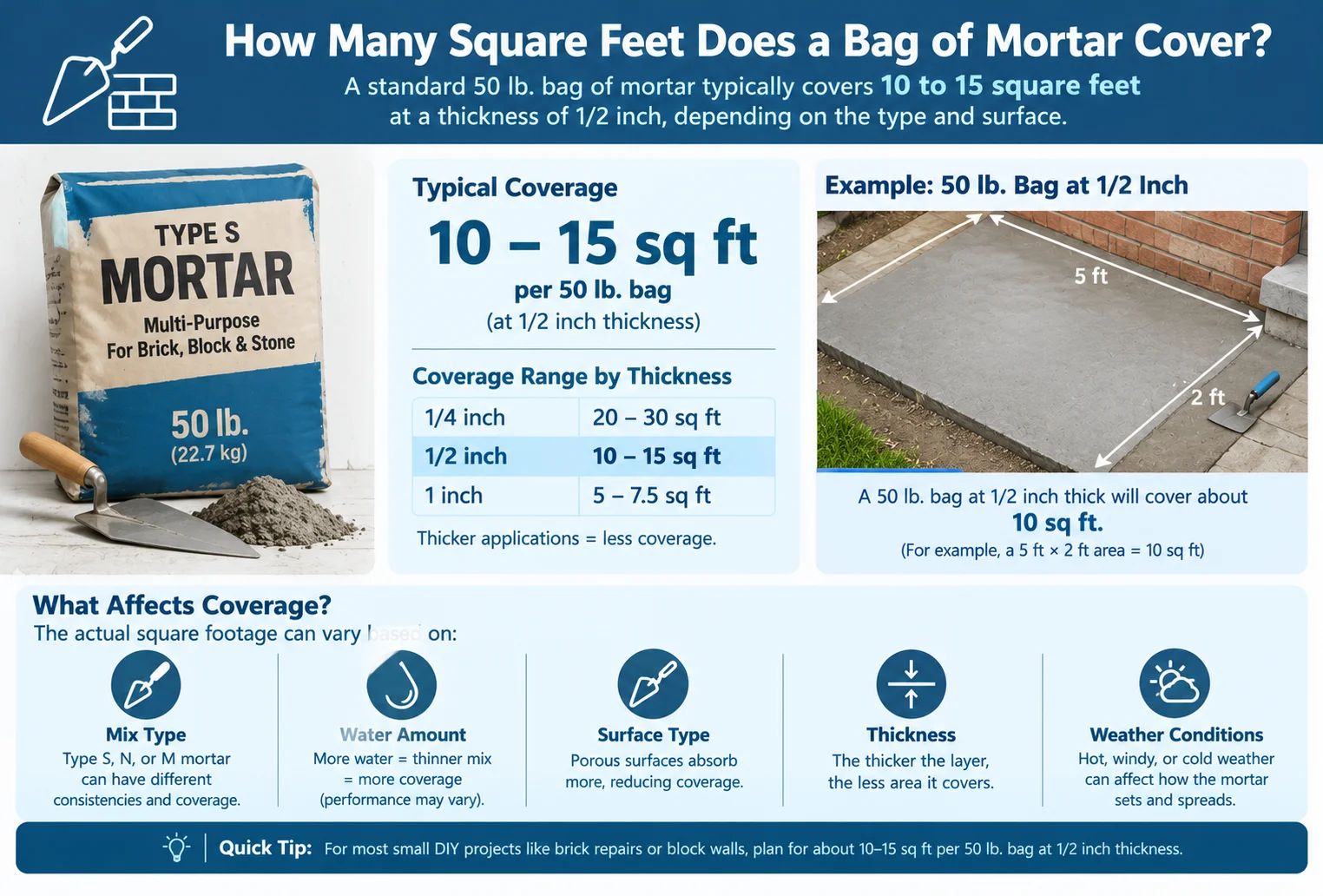
A bag of mortar typically covers approximately 10–35 square feet, depending on the bag size, mortar type, application, and thickness. A standard 80-pound bag of masonry mortar may cover around 12–20 square feet of brickwork, while a bag of thin-set mortar used for tile installation can cover considerably more or less depending on the trowel size and tile dimensions.
The most accurate estimate comes from the product’s coverage chart and the surface area you plan to cover.
A bag of mortar can cover different amounts of area depending on the product and how it is used. There is no single coverage figure that applies to every mortar mix.
| Mortar Bag or Application | Approximate Coverage |
|---|---|
| 40 lb bag of masonry mortar | About 6–10 sq ft of brickwork |
| 60 lb bag of masonry mortar | About 9–15 sq ft of brickwork |
| 80 lb bag of masonry mortar | About 12–20 sq ft of brickwork |
| 50 lb bag of thin-set mortar | Often about 40–100 sq ft of tile, depending on the trowel and tile |
| 50 lb bag of large-format tile mortar | Coverage varies substantially with tile size and trowel |
These figures are preliminary estimates, not universal manufacturer specifications. Thin-set mortar coverage can vary widely, and masonry mortar coverage depends on the brick or block dimensions, joint thickness, and workmanship.
What Determines Mortar Coverage?
Mortar coverage is affected by several factors, so two bags of the same weight may cover different areas in different applications.
Mortar Type
Masonry mortar is used to bond bricks, concrete blocks, and other masonry units. Thin-set mortar is commonly used to bond tile to an appropriate substrate.
These products have different formulations, yields, and application methods. A bag of masonry mortar should not be compared directly with a bag of thin-set mortar using only square footage.
Bag Weight and Product Yield
Larger bags generally contain more material, but bag weight alone does not establish the exact coverage. Check the package for the stated yield or coverage range.
For example, an 80-pound bag of masonry mortar generally provides more usable mortar than a 40-pound bag of the same product, assuming the same application and mixing method.
Mortar Joint Thickness
Thicker mortar joints require more material. In masonry work, joint dimensions and the size of the bricks or blocks influence how much mortar is needed.
For tile installation, the trowel notch, tile-back profile, and amount of mortar transferred to the tile affect consumption.
Surface and Installation Method
Uneven surfaces, irregular masonry units, large tiles, and waste during installation can increase material use.
Following the manufacturer’s instructions helps achieve the recommended mortar thickness and coverage.
How Many Square Feet Does an 80-Pound Bag of Mortar Cover?
An 80-pound bag of masonry mortar may cover approximately 12–20 square feet of brickwork under common planning assumptions. Actual coverage can fall outside this range depending on brick dimensions, joint thickness, and application.
For example, if a project requires 100 square feet of brickwork and you estimate 15 square feet per bag:
100 ÷ 15 = 6.67 bags
You would need to purchase at least 7 bags, before allowing for additional waste or unexpected conditions.
| Brickwork Area | At 12 sq ft per Bag | At 15 sq ft per Bag | At 20 sq ft per Bag |
|---|---|---|---|
| 50 sq ft | 5 bags | 4 bags | 3 bags |
| 100 sq ft | 9 bags | 7 bags | 5 bags |
| 150 sq ft | 13 bags | 10 bags | 8 bags |
| 200 sq ft | 17 bags | 14 bags | 10 bags |
| 300 sq ft | 25 bags | 20 bags | 15 bags |
The bag counts are rounded up to whole bags. Use the actual product coverage rate when available rather than relying solely on these estimates.
How Much Area Does a Bag of Thin-Set Mortar Cover?
Thin-set mortar used for tile installation can cover more surface area per bag than masonry mortar because it is applied differently and does not fill the same kind of brick joints.
A 50-pound bag of thin-set mortar may cover approximately 40–100 square feet, depending on the product, trowel notch, tile size, and installation technique.
| Trowel or Tile Situation | General Coverage Expectation |
|---|---|
| Small tiles with a smaller trowel | Often higher coverage per bag |
| Medium tiles with a moderate trowel notch | Moderate coverage |
| Large-format tiles with a larger trowel notch | Often lower coverage per bag |
| Uneven substrate or heavily textured tile backs | May require additional mortar |
This table describes general trends rather than guaranteed square-foot values. Follow the mortar manufacturer’s coverage chart for the exact product and recommended trowel.
How to Calculate How Many Bags of Mortar You Need
You can estimate the number of bags required by dividing the project area by the coverage per bag.
Formula:
Number of bags = Total project area ÷ Coverage per bag
Always round up to the next whole bag.
Example: A 120-Square-Foot Tile Project
Suppose the selected thin-set mortar covers 60 square feet per bag according to the product label.
120 ÷ 60 = 2 bags
You would need 2 bags before allowing for any additional material required because of waste or substrate conditions.
Example: A 200-Square-Foot Brick Wall
Suppose the selected masonry mortar covers 15 square feet per bag.
200 ÷ 15 = 13.33 bags
Rounding up, you would need 14 bags, before adding any extra allowance for waste or unexpected conditions.
The important step is to use the coverage rate for the specific mortar and application. Do not use a thin-set coverage rate to estimate brickwork or a masonry rate to estimate tile installation.
Should You Buy Extra Mortar?
It is sensible to account for some additional material when estimating a construction project. Mortar can be wasted during mixing and application, and actual coverage may differ from the estimate.
The amount of extra material depends on the project, the installer, the surface condition, and the manufacturer’s guidance. Rather than adding a fixed percentage automatically, compare the calculated requirement with the product’s coverage instructions and consider the likelihood of waste.
Keep unopened bags dry and follow the manufacturer’s storage instructions. Once mortar has been mixed, observe its stated working time and do not attempt to restore it by adding water beyond the product’s directions.
FAQs
How many square feet does a 50-pound bag of mortar cover?
Coverage depends on the mortar type. A 50-pound bag of thin-set mortar may cover approximately 40–100 square feet under different tile-installation conditions. Masonry mortar has a different coverage rate, so check its package.
How many square feet does an 80-pound bag of mortar cover?
An 80-pound bag of masonry mortar may cover around 12–20 square feet of brickwork, depending on the masonry units and joint thickness. The manufacturer’s yield information is the best guide.
How many bags of mortar do I need for 100 square feet?
If each bag covers 15 square feet, divide 100 by 15 and round up. You would need 7 bags before allowing for additional waste. The actual number depends on the mortar type and application.
Does mortar coverage depend on thickness?
Yes. Thicker joints or mortar layers generally require more material, reducing the area covered by each bag.
Is mortar the same as concrete?
No. Mortar is commonly used to bond masonry units or install tile, depending on the product. Concrete contains aggregates designed for applications such as slabs and foundations. They are not interchangeable in every situation.
Where can I find the exact coverage per bag?
Check the product label, technical data sheet, or manufacturer’s coverage calculator. Look for the intended application, recommended thickness or trowel, and stated yield.
Conclusion
A bag of mortar may cover approximately 10–35 square feet in some masonry applications, while thin-set mortar can cover a substantially different area depending on the product and installation method. An 80-pound bag of masonry mortar may cover around 12–20 square feet of brickwork, but actual results vary.
To estimate your material requirement accurately, identify the mortar type, measure the project area, and use the manufacturer’s coverage rate. Divide the total area by the coverage per bag and round up to determine how many bags to purchase.
Discover More Articles
How Many Feet Is the Empire State Building?
3 Ton AC: How Many Square Feet Can It Cool?
How Many Cubic Feet Make Up a Cubic Yard? Complete Conversion Guide